




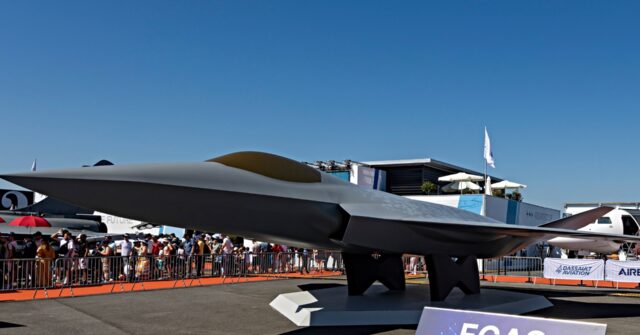
France and Germany agreed to scrap their joint-yet-troubled 100 billion euro project to build a next-generation European fighter jet after stakeholders failed to agree on just which country would be in overall charge.
The project, known as Future Combat Air System (FCAS), was launched in 2017 by French President Emmanuel Macron and then-German Chancellor Angela Merkel that sought to develop replacement fighter jets to France’s Rafale and the Eurofighter, used by Germany and Spain, which joined the program in 2019.
Rollout of the troubled, would-be replacements was set for 2040 – at the very earliest.
The ambitious project also called for the development of new combat drones and a futuristic “combat communications cloud” interlinking the drones and next generation jets through advanced sensors and communication systems. FCAS was described as an “emblematic” project amid Europe’s ongoing effort to overhaul its defense after decades of underinvestment.
The FCAS project, however, stalled over the past year, marred by disagreements between France’s Dassault Aviation and Airbus, which represented Germany and Spain in the project, over who should lead the project. Now, unnamed officials on Monday confirmed to international outlets on Monday that Paris and Berlin have pulled out of the troubled project after the companies failed to resolve their disagreements.
“President Macron and the Chancellor [Friedrich Merz] have come to the shared conclusion that the companies involved are unable to reach an agreement on the construction of a joint fighter aircraft,” an insider told Euractiv.
“Chancellor Merz has therefore advised President Macron not to pursue the construction of a joint fighter aircraft any further. The core of FCAS is to be continued as a European system of systems. This is, in a sense, the nervous system that links aircraft, drones and other components into an integrated whole,” the insider added.
The Élysée Palace reportedly confirmed that Macron and Merz held “lengthily and frequent discussions” on the troubled project, regretting that the companies involved could not reach a consensus. Per the sources, the German government concluded that it was not possible to exert further pressure towards resolving the disagreements.
Per The Guardian, Dassault Aviation insisted on being the project’s lead partner so as to protect its intellectual property. Airbus, on the other hand, opted for a more “equal partnership involving significant technology transfers.”
Despite the fighter jet program’s cancellation, unnamed sources told Euronews that the FCAS’ combat cloud development will proceed regardless. Dassault Aviation will reportedly continue developing a successor to the Rafale for France on its own, while Airbus is expected to search for new international partners.
Macron fiercely stood in defense of the then-faltering FCAS program in February, insisting that Europe should develop a common, carrier-capable, nuclear-armed aircraft. Chancellor Merz, however, suggested at the time that Berlin could drop from the project on grounds that what Germany needs from a next-gen fighter jet project is not what France does — adding more trouble to the already troubled project.
“The French need, in the next generation of fighter jets, an aircraft capable of carrying nuclear weapons and operating from an aircraft carrier. That’s not what we currently need in the German military,” Merz reportedly affirmed during a February podcast.
Read the full article here


