







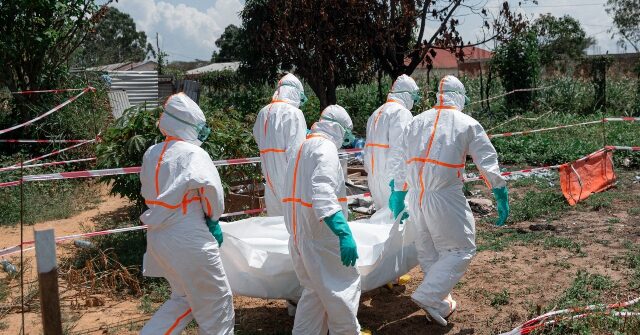
Sunday’s situation report from the Democratic Republic of the Congo (DRC) tallied a total of 101 fatalities, 19 recoveries, and 550 confirmed cases in the Ebola Bundibugyo outbreak.
The vast majority of the cases were detected in the eastern province of Ituri, where insurgent activity and public distrust of health officials has made detection and treatment extremely difficult.
The Associated Press (AP) noted on Tuesday that the true number of Ebola infections is probably much higher than 550, because the disease spread undetected for weeks before effective treatment and contact tracing began. Even now, after massive improvements in testing and tracking down people who have been exposed to Ebola, contract tracing is only about 64 percent effective.
“Attacks on health workers from angry residents, skepticism among some locals and armed conflict in hot spots continue to challenge efforts to stop the Ebola outbreak,” the AP observed.
The pace of collecting and analyzing samples from potential Ebola patients is still slow, with the World Health Organization (W.H.O.) reporting only 137 samples were tested on Tuesday. Thirty-five of them were positive results.
W.H.O.’s tally of Ebola cases was a bit lower than the DRC government’s, with 534 cases and 94 deaths counted as of Sunday, including a small number of cases from neighboring Uganda.
W.H.O. cautioned that the relatively low case fatality rate (CFR) in its report was likely due to many patients dying before the Ebola outbreak was officially declared. Ebola Bundibugyo has previously been seen to have a mortality rate of 25 percent to 50 percent, but the CFR from the current outbreak has been calculated at just 17.7 percent.
United Nations deputy spokesman Farhan Haq said on Monday that “response efforts continue to face significant challenges, including gaps in contact tracing, limited treatment capacity and shortages of essential medicines,” due in part to the instability of the eastern Congo.
The long-running insurgency has produced a large number of internally displaced persons (IDPs), and over half of them are living in the outbreak region in conditions that are conducive to disease transmission.
The center of the Ebola outbreak is a district of Ituri province known as Mongbwalu, which attracts a large number of laborers from other areas to work in its gold mines. Both the mines and the primitive housing occupied by the workers are crowded and unsanitary, which increases the risk of Ebola transmission through bodily fluids.
Doctors in Mongbwalu told the Associated Press that Mongbwalu’s itinerant workers are spreading Ebola infections to other areas, because it has been very difficult to get them to comply with health protocols. An unfortunate percentage of Mongbwalu residents do not believe Ebola is a real disease.
Doctors in the region are under-supplied, many of them have not been paid since the crisis began, and they stand a high risk of contracting Ebola while treating patients. Insurgent activity in the area makes it unsafe for medical staff to follow up on reported infections.
“During the first week, we did not even have time to go home and eat. The second week was the same. We only eat once a day, what amounts to breakfast in the evening,” a nurse told the AP.
“Despite the alerts we receive and the teams we have on site, we lack the means to travel into the field. As a result, there are alerts we are unable to investigate,” lamented Dr. Richard Lokudu, medical director of Mongbwalu General Referral Hospital.
On Wednesday, W.H.O. Director-General Tedros Adhanom Ghebreyesus celebrated “a moment of hope in the Ebola response,” as the first recovered Ebola patient in Mongbwalu was discharged from medical care.
“Their recovery is a testament to their strength and the dedication of health workers providing lifesaving care under challenging conditions,” Tedros said.
“It is also a reminder that many people can survive Ebola when they receive care early and safely,” he added.
Read the full article here


