




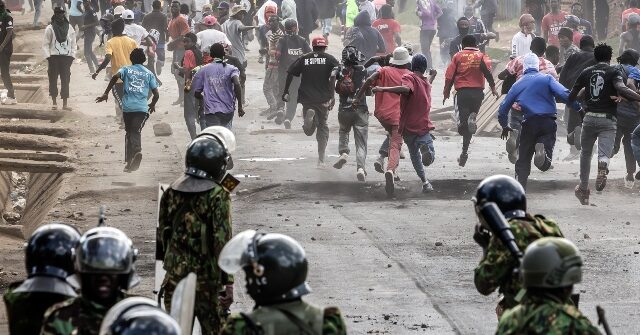
Leaders of the protests against construction of an American-built treatment center for Ebola in Kenya claim police shot one of the demonstrators in the head on Tuesday, fired live rounds at other demonstrators, and “arbitrarily arrested” 19 people.
Protest leader Patrick Wahome and several eyewitnesses told Reuters about the killing of the demonstrator on Tuesday, and two Reuters reporters “saw the body lying motionless with a large wound to the head in the back of a police van,” although they did not witness the shooting.
Kenya Human Rights Commission (KHRC), a non-profit group, claimed “hooded police officers” attacked demonstrators and journalists at Tuesday’s protest. KHRC also claimed one protester was killed, which “brings the death toll linked to this facility and due to police fire to three.”
“Today, police shot the third victim in the head. No accident there. Police act with open impunity, following orders from their command and the regime that has made it clear that our lives mean nothing to them,” KHRC said.
“IPOA must move fast. The officers responsible must be held criminally liable for these killings. So should their command. No cover-ups,” the group demanded.
IPOA is the Independent Policing Oversight Authority, a law-enforcement watchdog agency which accuses Kenyan police of using excessive force with distressing frequency.
“More disturbing evidence is surfacing. Police are unleashing deadly force on unarmed Nanyuki residents who pose zero threat and have already surrendered. KHRC is documenting this brutality for legal action,” KHRC said in another statement on Tuesday.
The facility inspiring so much anger among Kenyan protesters is located at the Laikipia Air Base, located near the town of Nanyuki. The United States is building a 50-bed quarantine facility to treat possible infections from the Ebola outbreak in the Democratic Republic of the Congo (DRC).
According to U.S. officials, the location was chosen because it is close to the Ebola outbreak and has enough capacity to handle incoming medical flights. The project was approved by Kenyan President William Ruto and the U.S. has sweetened the deal with $13.5 million in Ebola preparedness funding.
The protesters are angry that Kenya could be used as a “geopolitical isolation ward” or “dumping ground” for Ebola patients, as the plaintiffs in a lawsuit to halt construction put it. Some say they are afraid Ebola could escape containment at the facility and begin infecting Kenyans.
Residents of Nanyuki are worried that having an Ebola treatment facility at the airbase could depress their tourism industry. Critics of the quarantine facility say it was not planned in a fair and open manner and have sued for the government to release documents pertinent to the project. Ruto has said the facility could also be used to treat Kenyans who contract Ebola, but U.S. officials have not confirmed this was part of the agreement.
“This has gone on for hours and all the demonstrators say that they don’t believe the government’s claim that this Ebola facility will bring them any benefit; they’re deeply skeptical. They say they don’t want this facility in their town,” Al Jazeera News correspondent Malcolm Webb said while reporting on Tuesday’s protest.
“People on the street in Kenya are angry because for many of them, this looks like colonial decision making all over again – that we can come into a country, decide what we want to bring in, do whatever the hell we want has led to an incredible amount of anti-American backlash,” Brown University professor of public health Dr. Craig Spencer explained to NPR on Tuesday.
Spencer, who survived an Ebola infection while treating patients in Guinea in 2014, suggested Kenyans are aware of comments by President Donald Trump and Secretary of State Marco Rubio that they will not allow Ebola into the United States and are offended that they would send Ebola patients to Kenya, instead.
Spencer also worried that the quality of care at the tent facility in Nanyuki could be inferior to what patients would receive at a properly equipped quarantine hospital in America.
Kenyan doctor Bill Muriuki echoed that concern, noting that Kenya’s health system did not perform well during the Wuhan coronavirus pandemic. He also said Ruto and his officials did themselves no favors by neglecting to announce the Ebola facility to the Kenyan public.
“Kenyans only became aware of it when the Secretary of State for the United States, Marco Rubio, announced it to citizens. That’s when Kenyans were made aware; it’s not from our own government. To date, the deal itself has not been made public, so we cannot even say what is in it for Kenyans,” Muriuki told Al Jazeera.
Although Kenya’s High Court has issued several injunctions against the quarantine facility, construction seems to have proceeded apace, with staff and equipment from the United States arriving as recently as this week.
Read the full article here


