






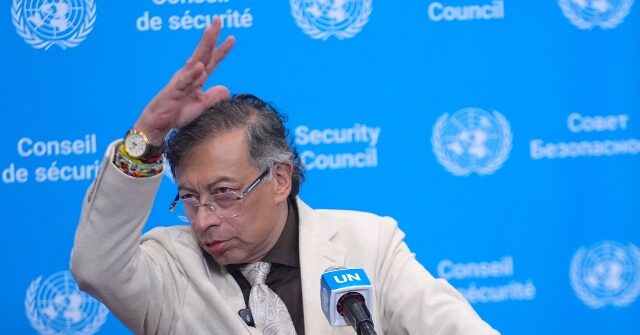
Outgoing Marxist President of Colombia Gustavo Petro while leading a U.N. Security Council debate on Wednesday claimed that the world is “returning to the Nazis” as a result of the alleged “20,000 deaths” in the war in Gaza.
Petro, who is in the last weeks of his four-year presidency, traveled to New York this week to participate in a series of U.N.-related events. Colombia holds the rotating presidency of the U.N. Security Council for the month of June 2026. As Colombia’s head of state, Petro presided over a Security Council debate titled, “Advancing political solutions in the Middle East: mediation and dialogue for a lasting peace.”
Petro prefaced his opening remarks by asserting that he will leave office once his term ends in August, noting, “This is, perhaps, my last participation in this scenario.” Petro warned of two things that he claimed could “end humanity,” demanding the Security Council act to contain them. The two elements, Petro told the Security Council, are the use of artificial intelligence (AI) in the hands of “private, few, economically powerful” interests and that the “widespread consumption of hydrocarbons driven by greed has led to the humanitarian crisis caused by the war.”
“It is the struggle over hydrocarbons that leads to missiles being fired on people, on babies. 20,000 people killed in Gaza, a fact that cannot be hidden by any economic or political interest — because, and this is the point of my writing, we are returning to the Nazis,” Petro said.
“And this is also what is happening today on a massive scale. It is no longer just Gaza, which is the cultural origin, so to speak, of the war in the Middle East, but it is compounded by the existence of oil and the existence of nuclear weapons,” he continued. “and it leads to the current situation in the Middle East, which people are trying to resolve with more missiles, with more war.”
The solution to the Middle Eastern conflicts, according to Petro, is to embrace the “rapid decarbonization of the world.”

Petro’s remarks drew the condemnation of the Israeli government. In a social media post, Foreign Minister Gideon Sa’ar described Petro as “the disgraced outgoing President of Colombia” who “is a stain on his great nation.”
“This antisemite is systematically trivializing the memory of the Holocaust,” Sa’ar wrote. “He is a communist that ruined his great country. Soon, he will be history.”
Similarly, Israeli ambassador to the U.N. Danny Danon described Petro through social media as a “delusional leader who spreads antisemitic statements.”
“It is not clear what he took before the discussion this morning, but nothing justifies the reprehensible words that came out of his mouth,” Ambassador Danon wrote, an apparent reference to accusations of drug and alcohol abuse Petro has fielded, including from former cabinet officials.

Petro’s “return to the Nazis” comment at the United Nations comes just days after the outgoing Colombian President wrote “heil Hitler” on a social media post, drawing a barrage of international condemnation — including from the Israeli Foreign Ministry, which described Petro’s actions as a “total loss of moral compass and an indelible stain on Colombia’s legacy.” Petro wrote the Nazi salute in response to a local opinion piece favorable to conservative outsider Abelardo de la Espriella, the frontrunner of Colombia’s upcoming June 21 presidential runoff election.
Petro addressed the controversy over the “heil Hitler” message in his U.N. Security Council address. He attributed his use of the Nazi salute to his “own stupidity, because of my lack of communication skills,” that led to him not properly contextualizing the use of the phrase.
“Because of my own stupidity, and a lack of communication skills, I failed to provide context for a statement I made in response to a Colombian journalist regarding an internal dispute, in which I claimed that he had shifted from liberal views to the fascist ideas he now defends,” Petro said.
“I won’t mention his name. What matters here is what happened: I posted the phrase ‘Heil Hitler’ in response, period, without any context,” he added, noting that the controversial post had “34 million views” and is now his most-viewed tweet since a post he once made in response to President Donald Trump.
The Argentine outlet Infobae reported that Petro requested the U.N. not take photos of him during his speech at the Security Council on the grounds that his gestures “could be taken out of context and used to associate him with Nazi symbolism.”
“When I do this, don’t take pictures of me, because these days they use everything I do, even my gestures, to try to make me look like a Nazi,” Petro reportedly said at the U.N.
Petro’s latest visit to the United Nations occurs roughly eight months after his September 2025 trip to New York during the 80th session of the U.N. General Assembly. At the time, Petro engaged in a series of hostile actions against President Donald Trump — including open calls for the U.S. military to disobey President Trump as commander-in-chief. The U.S. State Department revoked Petro’s U.S. visa in response to his actions. Months later, the State Department granted a provisional U.S. visa to Petro that allowed him to travel to Washington to meet with President Trump at the White House in February.
The Colombian public broadcaster RTVC reported in May that Petro was slated to avail himself of his U.N.-related trip to New York to meet with socialist New York Mayor Zohran Mamdani. Petro and Mamdani were also expected to participate in a leftist “Dignity in Democracy” summit on June 12 on the subject of “social inequality, democratic strengthening, and the concentration of economic power.” Petro’s U.N. agenda in New York is reportedly slated to conclude on Thursday, June 11.
The Washington Post reported that the State Department made it “very clear” to Colombian government officials that such engagement would constitute a violation of the terms of Petro’s U.S. visa restrictions following his calls in September for the United States military to disobey President Trump. Unnamed Colombian officials reportedly interpreted the State Department’s warning as a “threat to arrest Petro on site if he proceeded.”
“A visa is a privilege, not a right,” a State Department official reportedly told the Washington Post. “Any individual’s U.S. visa is at risk of revocation if they visit America and outrageously implore U.S. soldiers to disobey orders of the duly elected president of the United States.”
President Petro’s four-year term will end on August 7, 2026 — a day chosen by Colombia for its presidential inaugurations because it commemorates the 1819 Battle of Boyacá, an important conflict in the country’s war of independence from Spanish colonial rule. On that day, he will be succeeded by the winner of the June 21 presidential runoff between conservative Abelardo de la Espriella and Petro’s protegé, far-left Senator Iván Cepeda. Petro is barred from running for president again, as the Colombian constitution strictly states that no president may serve beyond a single four-year term.
Christian K. Caruzo is a Venezuelan writer and documents life under socialism. You can follow him on Twitter here.
Read the full article here


