






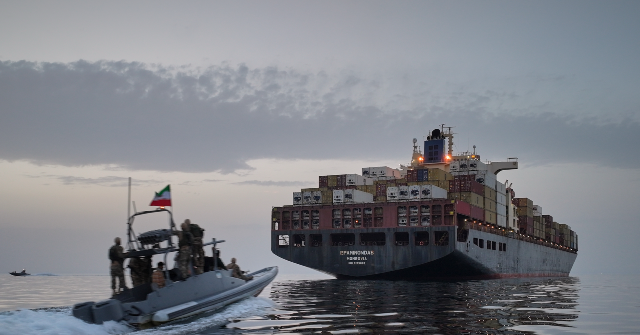
Iran’s terrorist Islamic Revolutionary Guard Corps (IRGC) declared on Wednesday that the Strait of Hormuz is “closed to the passage of all vessels” after the United States retaliated against Iranian attacks.
At least three liquid natural gas (LNG) tankers nevertheless managed to pass through the strait headed for Asian destinations, according to reports. U.S. Central Command declared the strait “open for transit” in a social media message on Thursday.

“From this moment, due to insecurity in the region, the Strait of Hormuz is declared closed to the passage of all vessels, including oil tankers and commercial ships, and any traffic will be targeted,” a statement from the Khatam al-Anbia Central Headquarters (KCHQ), nominally the supreme operational command for the Iranian military, said.
The KCHQ said its threat was issued in response to “continued acts of aggression by the criminal United States and in view of the start of attacks by that country’s aggressive military against several areas in the southern province of Hormozgan.”
“Claims by the United States that ships are transiting the aforementioned strait are rejected,” the statement added.
The IRGC issued a separate statement that warned “the Strait of Hormuz will be closed until further notice.”
The U.S. launched several waves of strikes in response to Iran shooting down a U.S. Army Apache helicopter on Monday. Some of those strikes hit targets in Iran’s southern Hormozgan province, whose coast includes the narrowest passage of the Strait of Hormuz. The provincial capital is Bandar Abbas, a port city that hosts the IRGC’s primary naval base.
On Wednesday, President Donald Trump said the United States has been able to slip numerous ships carrying “millions of barrels” of oil through the Strait of Hormuz, despite Iran’s efforts to shut down the strategic waterway. This is apparently the claim Iran “rejected” in its statement.
“Do you know we’ve been taking out millions of barrels of oil? Nobody knows it. You know who doesn’t know about it? Iran, until right now,” the president told reporters at the White House.
In a later post on his Truth Social platform, Trump said he directed the U.S. military to “execute a secret mission to support oil tankers and other commercial ships through the Strait of Hormuz” last month.
“Today, I am pleased to announce that this effort has resulted in more than 100 MILLION Barrels of Oil making its way through the Strait, and into the Open Market,” Trump wrote.
“More than 200 Commercial Ships have safely traveled through the Strait,” he said.
“This wildly successful effort is because the UNITED STATES of AMERICA CONTROLS the Strait of Hormuz — NOT Iran. Their military is defeated, and their economy is lost. It’s over for Iran!” he proclaimed.
U.S. Central Command (CENTCOM) on Wednesday briskly rejected Iran’s claim to have shut down the Strait of Hormuz.
“Commercial ships are continuing to transit in and out of the Strait of Hormuz tonight,” CENTCOM said.
Contrary to Iran’s denials, ship trackers have indisputably monitored a fair number of cargo ships and tankers passing through the Strait of Hormuz since Iran closed the passage and began attempting to extort “tolls” from international shipping in March.
The number of tracked vessels reported to the public is lower than the figure cited by President Trump, although since one of the primary methods of evading detection is to switch off a ship’s Automatic Identification System (AIS) or use it to broadcast false signals, it is possible that some ships have not been detected accurately by commercial services.
On Thursday, ship trackers LSEG and Kpler said three more tankers loaded with LNG passed through the Strait of Hormuz with their transponders turned off, reappearing on global monitoring systems after they were clear of possible Iranian attacks.
Two of the ships, Lebrethah and Rasheeda, were operated by QatarEnergy. The Rasheeda was last detected west of the Strait of Hormuz on April 30, while the Lebrethah was last seen in those waters on June 1.
Both ships were known to have taken on cargoes of LNG from Ras Laffan, Qatar’s primary shipping hub for energy products. The Rasheeda has been stranded in the Persian Gulf with its cargo since the beginning of Operation Epic Fury at the end of February.
When they reappeared east of the Strait of Hormuz, the Rasheeda was approaching Southeast Asia, while the Lebrethah was apparently bound for Pakistan. LSEG and Kpler could not say exactly when the ships passed through the Strait of Hormuz.
The third tanker, Marigold, is operated by the Abu Dhabi National Oil Company of the United Arab Emirates (UAE). It loaded a cargo from the UAE energy hub on Das Island on May 25, and reappeared east of the Strait of Hormuz on Wednesday.
The three ships brought the number of LNG tankers known to have passed through the Strait of Hormuz since Iran’s blockade to 12.
IRGC Aerospace Force commander Brig. Gen. Majid Mousavi threatened to unleash apocalyptic violence on Thursday if the U.S. continued to “destabilize” the Strait of Hormuz.
“Will you make the sacred Strait of Hormuz unsafe? We will turn the entire region into hell for you from across Iran,” he said.
President Trump said on Thursday that the U.S. military is prepared to take control of Iran’s entire energy infrastructure, including Kharg Island, Iran’s major seaport for oil exports located northwest of the Strait of Hormuz.
“At some point in the not too distant future, we will be taking Kharg Island, and other oil infrastructure points, and assume total control of their Oil and Gas Markets, much like we have with Venezuela, which is working out brilliantly for both Venezuela and the United States of America,” Trump wrote on Truth Social.
Read the full article here


