




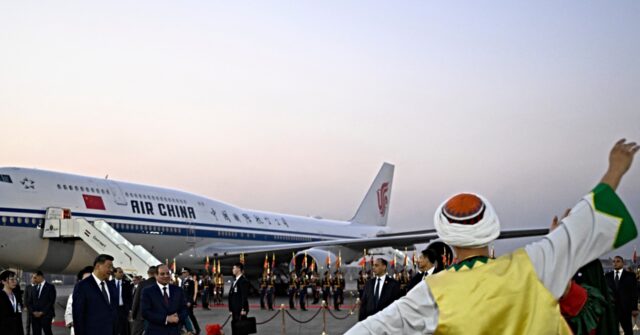
Chinese dictator Xi Jinping was greeted at the airport in Cairo by Egyptian President Abdel Fattah el Sisi and his wife Entisar Amer on Tuesday, as Xi flew from the Shanghai Cooperation Organization (SCO) meeting in Kazakhstan to make a state visit to Egypt.
Egypt rolled out a lavish welcome for Xi, who was visiting the country for the first time in a decade.

The National reported that roads in Cairo “have been lined with billboards showing the two leaders shaking hands since Sunday.”
Egyptian state media spent the past week posting glowing reports about the increasing economic and military partnership with China, including an op-ed penned by Sisi himself that praised the two countries as “partners contributing together to strengthening the role of the Global South in the international system.”
China’s state-run Xinhua news agency said China and Egypt would “set an example of friendship, solidarity, and coordination between developing countries, with strong political mutual trust, fruitful mutually beneficial cooperation, and close and effective coordination in multilateral affairs.”
Xinhua quoted Xi observing that “China and Egypt are both ancient civilizations, with a traditional friendship that has endured for thousands of years and stood the test of time.”
“Over the past 70 years since the establishment of diplomatic relations, the two countries have stood by each other and pursued win-win cooperation, regardless of changes in the international and regional situations,” Xi said.
Egypt’s President Abdel Fattah al-Sisi (R) and his wife Entissar Amer (C) walk next to China’s President Xi Jinping during his guard of honour at the Cairo International Airport on September 1, 2026. Xi Jinping is making a rare trip to the Middle East as both countries face the threat of U.S. sanctions over financial links to Iran. (Khaled DESOUKI / POOL / AFP via Getty )
Egypt was the first Arab country, and the first country in Africa, to formally recognize the People’s Republic of China in 1956 after the Communist takeover.
Sisi welcomed Xi as a “dear guest on the banks of the Nile and a friend of the Egyptian people,” and said Egyptians have “all love and affection” for China in return.
“Today, as we welcome President Xi Jinping to his second home, Egypt, we are embarking on a new phase of our increasingly developed relations,” he said.
China sent some of its most advanced J-16 Hidden Dragon jet fighters to Egypt in June to conduct a month-long joint military exercise called “Eagles of Civilization 2026” with the Egyptian air force.
The first Eagles of Civilization exercise was held the previous year, but did not include J-16 planes. The Egyptian Air Force sent French-made Dassault Rafale fighters to the exercise – an interesting choice given that Pakistan used Chinese-made surface-to-air missiles to shoot down Rafale jets piloted by India during their border skirmish in May 2025.
Egypt’s armed forces on Monday posted images of a Chinese People’s Liberation Army (PLA) YU-20 tanker aircraft refueling Egyptian Rafale jet fighters during the exercise, to demonstrate the interoperability of the equipment used by both sides.

Egypt also receives over a billion dollars a year in military funding from the United States, a level of support it has enjoyed – with a few pauses for political reasons – since 1987. Some U.S. lawmakers have been critical of continuing this support after Sisi took power in a 2013 coup, and they will not be mollified by the sight of Egyptian pilots flying high-end Western planes in wargame practice with China.
The South China Morning Post (SCMP) on Wednesday said Xi’s visit, timed to coincide with the 70th anniversary of Egypt recognizing Communist China, was meant to consolidate the political influence that flows from China’s huge investments in Egypt:
Chinese economic interests are deeply embedded around the Suez Canal. Chinese companies have established manufacturing and logistics operations, using Egypt as a production and distribution base linking their supply chains to European, African and Middle Eastern markets.
That footprint is still growing. Egyptian firms signed 17 export contracts worth US$168 million with Chinese buyers last month. Beijing’s investment in Egypt in the first half of 2026 is estimated at up to US$2 billion, with much of the funds going into the expansion of existing projects.
Beijing has also extended zero-tariff treatment to Egyptian goods, removing duties that had reached 30 per cent. Yet the commercial relationship remains asymmetric: Egypt’s trade deficit with China exceeded US$18 billion last year.
China is also hoping to sell A.I. data centers to Egypt using technology from telecom giant Huawei, while the U.S. is “trying to pull together a competing proposal involving Nvidia, Advanced Micro Devices and Microsoft.”
Egypt has always been adept at balancing competing great power interests, as demonstrated by its diverse inventory of American, Russian, and Chinese military equipment. The balance appears to have shifted toward China during the second Trump administration, as Sisi broke with the U.S. over the Gaza war, Houthi terrorism in the Red Sea, and the conflict with Iran.
“Washington and Beijing frame their rivalry around competing strategic camps. Cairo shows middle powers can keep both sides invested without giving either one exclusive influence, using the resulting competition to extract investment, technology, military capabilities and diplomatic leverage,” the SCMP observed.
Sisi’s rhetoric in the run-up to Xi’s arrival was fairly explicit in its complaints about the plight of the Palestinians, the instability caused by the U.S.-Iran conflict, and Egypt’s view of China as a potentially stabilizing force that aligns more closely with Cairo on those issues than America does, and has far more wealth and power to offer than Egypt’s fading friends in Russia.
“Xi’s visit to Cairo comes at a time when the US is embroiled in its Iran quagmire, and in which the US has in tandem slowly pulled out of the region in several ways, presenting China with a strategic space to fill,” Egyptian political analyst Abdall Nasef told The National.
“Egypt sees itself as moving toward greater strategic autonomy. It wants strong relations with Washington, but also Beijing, Moscow, and Europe,” H.A. Hellyer of the Royal United Services Institute told Reuters.
Read the full article here


