




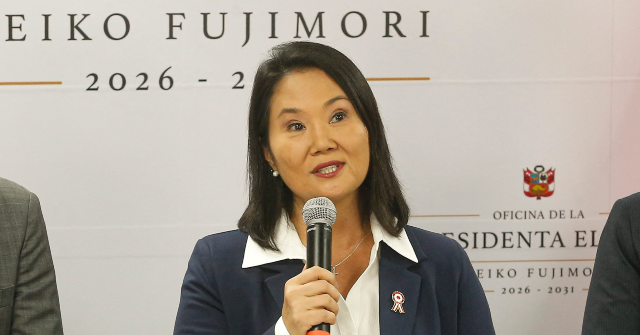
The government of Perú, under the recently inaugurated leadership of conservative President Keiko Fujimori, announced on Tuesday that it would sever diplomatic ties to the Islamic Republic of Iran, citing a variety of human rights and terrorism violations by the rogue regime.
Peru reportedly communicated the rupture in ties to the Iranian government through the latter’s embassy in Ecuador, as it does not have direct physical representation in Peru, representing the latest in a series of political losses in Latin America for the world’s premier state sponsor of terrorism. Once ascendant in the region through its relationship with late dictator Hugo Chávez in Venezuela, Iran, along with its allies such as China and Russia, has seen a steady erosion of regional influence; the successive election of conservative and libertarian governments in countries such as Argentina, Chile, Peru, Honduras, Colombia, Costa Rica, and the Dominican Republic have resulted in the installation of governments friendlier to the United States and its allies, prominently Israel. In Venezuela itself, the arrest of narcoterrorist dictator Nicolás Maduro paved the way for a nominally socialist government that restored diplomatic ties with Israel this year, a move seen as weakening Caracas’s bond with Tehran.
In an extensive missive published on Tuesday, the Peruvian government listed a variety of crimes and illicit behaviors by the Iranian government that made it unwilling to continue pursuing a diplomatic relationship.
“Given its firm commitment to the defense of democracy, a fundamental principle of its foreign policy, Peru has been observing with increasing consternation the deterioration of said value in Iran,” the statement noted, “particularly related to the repression of peaceful protests, the shutdown of freedom of the press, the discrimination against women and girls, and the persecution of political dissidents.”

The Peruvian government also named Iran’s disruptions of trade in the Strait of Hormuz as a factor in its decision. While maritime trade experts consider Peru to be almost entirely absent in trade through the Strait of Hormuz, Lima explained that Iran’s terrorist attacks against commercial ships “contravene principles such as the freedom of navigation and the right of passage through straits utilized for international maritime transit, which cannot be subject to unilateral conditions.”
“The government of Peru rejects in an equally energetic manner that Iran incites violence and escalates conflicts in the Middle East,” the statement continued, “as well as its obstruction of the world of the International Atomic Energy Agency (IAEA), whose inspectors it has denied on several occasions access to nuclear installations.”
The statement concluded listing the various international legal instruments that facilitate Peru’s ability to cut diplomatic relations but added that, to protect the rights of its citizens in Iran and for Iran to also have that right, Peru will continue to maintain consular services with the country.
The announcement represents one of President Fujimori’s first major diplomatic moves since being inaugurated as president in July, following her fifth and only successful bid to be president of the nation. Prior to being president, Fujimori served as a senator for the conservative Popular Force party. As a child, she served as the nation’s first lady during the tenure of her father Alberto Fujimori while he and wife (and presidential rival) Susana Higuchi divorced.
Fujimori campaigned on a strict law-and-order platform, promising to use the full force of the state to address rapidly growing criminal networks and violence. On foreign policy, Fujimori maintained a pro-American disposition and promised to bring Peru into President Donald Trump’s “Shield of the Americas” initiative, a regional plan to combat drug trafficking and narcoterrorism. Peru’s entry into the Shield of the Americas was among her first acts as president.
Fujimori is Peru’s tenth president in ten years, marking a period of extreme political turmoil in which rival parties used the nation’s loosely-written constitutional provisions on impeachment — requiring only a finding of “permanent moral incapacity” — to oust opposing presidents as rapidly as possible. This period of turmoil was exploited by a variety of malicious actors, including the governments of China and Iran, to increase their influence in the country.
In 2016, Iran’s proxy terrorist organization Hezbollah established itself as a political party in Abancay, Peru, home to the country’s largest Islamic population. The Iranian government had already reportedly seeded the region with “cultural centers” used to promote Shia Islam and support for Tehran, enhancing its influence in Latin America. Two years later, State Department counterterrorism official Nathan Sales told Congress the government had reason to believe that Iran had deployed terrorist operatives to Peru.
Iran made more diplomatic progress in countries with stable and overtly leftist governments, such as neighboring Bolivia, where it cemented a deal in 2023 to sell its Shahed model drones. In Venezuela, Iranian engineers were tasked with attempting to rehabilitate the country’s dilapidated oil refineries and petrochemical facilities, with limited success. The Iranian government also established close ties to the communist government of Cuba, which has regularly used its diplomatic status at the United Nations to defend Iranian interests.
Follow Frances Martel on Facebook and Twitter.
Read the full article here


