






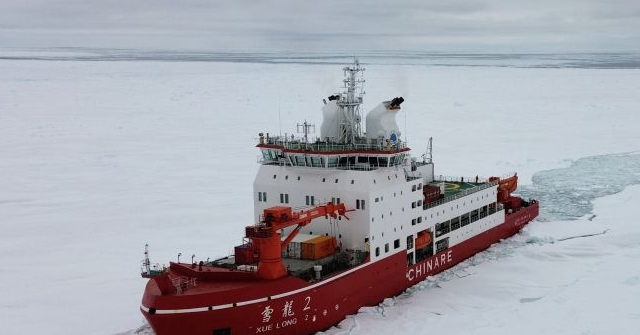
China’s state-run Global Times on Tuesday boasted of “soaring demand” for the “Ice Silk Road” trade route China has established through the Arctic — and castigated Western media for expressing “sour grapes” concerns about the environment, Chinese territorial aggression, and weaponized supply chains.
The Global Times was rather quick to declare the Ice Silk Road a roaring success, since it only just began regular service from China’s eastern city of Ningbo to ports in the U.K., Netherlands, Germany, and Poland, running by way of Russia’s Northern Sea Route through the Arctic.
Chinese shipping company Sea Legend only announced regular service through the Arctic route last week. The first container ship to use the express transit route departed from Ningbo on Saturday evening.
“According to media reports, demand for bookings this year has exceeded expectations: the first two voyages were fully loaded, while orders for subsequent sailings have continued to pour in,” the Global Times gushed.
The Chinese Communist paper sought to refute “sour grapes” complaints with a lengthy tirade about how China is merely exercising its “freedom of navigation” and Western companies are looking at Arctic shipping too, especially as “global logistics routes are becoming increasingly vulnerable.”
“Global maritime trade currently depends heavily on a small number of strategic chokepoints, including the Suez Canal and the Strait of Malacca,” the Global Times noted. “Any disruption to these routes could have a major impact on global trade. China’s Arctic shipping route provides a new option for Asia-Europe trade, helping diversify risks and improve efficiency.”
No one is particularly worried about the Suez Canal or the Strait of Malacca at the moment, but the Global Times clearly preferred not to dwell on the true menace to international shipping: Beijing’s friends in Tehran attacking commercial vessels in the Strait of Hormuz and Red Sea. China has been uniquely concerned for years that its shipping routes through the Strait of Malacca might be threatened and, a decade ago, that concern cropped up in early proposals for developing the “Polar Silk Road” or “Ice Silk Road.”
As for environmental concerns, the Global Times argued — as Chinese planners have done for years — that shipping through the Arctic during agreeable weather could cut transit times from China to Europe in half, with a commensurate reduction in carbon emissions.
For all the talk of “climate change,” Russia’s North Sea Route (NSR) is still only navigable during the summer months. The Ice Silk Road route is currently projecting operations between July and October each year.
Only 15 ships managed to make the transit in 2024, and 23 in 2025, a far cry from the traffic levels in the Strait of Hormuz and Bab el-Mandeb Strait when they were fully open. And for all of the Global Times’ boasting about China becoming a “reliable partner” in Arctic shipping, Europeans remain concerned about relying on a shipping lane controlled by Vladimir Putin’s Russia.
The UK Guardian reported on Sunday that the Ice Silk Road has potential, and other countries including Japan, Korea, and India appear to be interested in exploring it, but their environmental and security concerns are not as easily dismissed as the Global Times imagined.
Shipping and insurance companies are worried about ships suffering mechanical breakdowns or getting stuck in the ice along the lonely polar route, with such calamities increasing the danger of spilling the heavy fuel oil needed by massive cargo ships.
Most other trading nations are much more reluctant than China to invest heavily in a trade route controlled by hostile Russia, and which can only be navigated with the assistance of nuclear-powered Russian icebreakers. Furthermore, a great deal of the limited capacity in the Arctic route is already taken up by Russia’s “shadow fleet” — the aged, poorly-maintained cargo ships and tankers that use dodgy paperwork and stealth tactics to evade Western sanctions against Russia’s invasion of Ukraine.
The Bellona Environmental Foundation published a report last year that found up to a third of the traffic along Russia’s Northern Sea Route consists of ships under international sanctions, and there is reason to believe the percentage is even higher this year. Environmentalists hate the shadow fleet because its creaky ships pose higher risks of oil spills, while the captains of legitimate ships are not eager to share congested waterways with them.
“So can the northern sea route be used as a substitute for the Strait of Hormuz and the Suez Canal? The short answer is no, not for the moment,” concluded RMIT University professor of logistics and management Vinh Thai.
Read the full article here


