







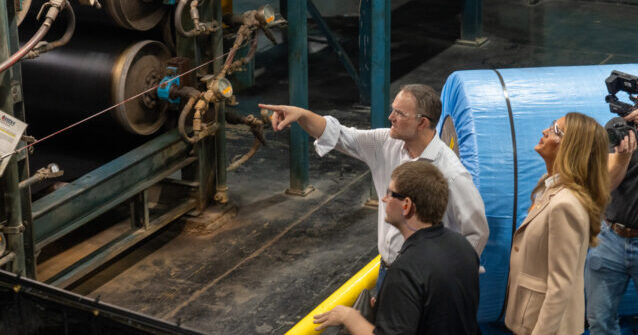
A capital-spending boom is boosting American manufacturing, with production of business equipment accelerating this year and strength spreading beyond computers into machinery, electrical equipment, fabricated metals and aerospace.
Output of business equipment rose 0.8 percent in July and was 6.6 percent higher than a year earlier, Federal Reserve data showed Tuesday. Production grew at a 12.7 percent annual rate in the second quarter after advancing at a 7.6 percent pace in the first three months of the year.
The gains helped manufacturing output rise 0.2 percent in July despite a decline in motor vehicle production. Factory output excluding vehicles and parts increased 0.4 percent.
Overall industrial production, which also includes mining and utilities, rose 0.2 percent following an upwardly revised 0.3 percent increase in June.
The figures point to an investment-led expansion within manufacturing that is considerably stronger than the headline increase in factory production. Durable-goods output rose 0.7 percent in July and 3.9 percent from a year earlier, while nondurable manufacturing fell 0.4 percent during the month and was down 1.6 percent from July 2025.
Business-equipment production has risen 5.9 percent since December, equivalent to an annual rate of about 10 percent. That followed a 10.7 percent increase during 2025, measured from the fourth quarter of 2024 to the fourth quarter of last year.
Information-processing equipment, which includes many of the products associated with the artificial-intelligence buildout, rose 1.5 percent in July and 8.9 percent from a year earlier. But the increase extended well beyond technology equipment.
Production of industrial and other equipment, the largest component of the business-equipment index, climbed 1.4 percent last month. Business-equipment output excluding motor vehicles and parts increased 1.5 percent and was up 5.2 percent from a year earlier.
The supply chain for capital goods also strengthened. Production of equipment parts rose 1.3 percent in July and 6.1 percent from a year ago. Output of construction supplies advanced 0.8 percent, the largest increase since January.
By industry, computer and electronic-products output rose 1.9 percent in July and 9.9 percent from a year earlier. Aerospace and miscellaneous transportation equipment increased 1.4 percent, electrical equipment gained 1.3 percent, fabricated-metal products advanced 1.2 percent and machinery production rose 0.8 percent.
Primary-metals output increased 1.4 percent, reversing part of a decline in June.
Motor vehicles and parts were the principal drag on durable manufacturing, falling 2.1 percent in July after three consecutive monthly increases. Even with the decline, auto production remained 2.1 percent above its year-earlier level.
The breadth of the gains suggests that the factory expansion is not solely the result of AI-related production or a rebound in automobile manufacturing. Durable-goods output excluding both selected high-technology industries and motor vehicles still rose in July and expanded at a 3.7 percent annual rate in the second quarter.
Defense and space production, which the Fed classifies separately from business equipment, increased 1.8 percent in July and 6.8 percent from a year earlier. It grew at a 14.7 percent annual rate in the second quarter.
Capacity utilization also points to rising demand for capital goods. The utilization rate for machinery factories reached 82.9 percent in July, compared with a long-run average of 78.2 percent. Electrical-equipment utilization climbed to 86.8 percent, well above its historical average of 81.7 percent.
Utilization across durable manufacturing rose to 76.2 percent from 73.4 percent in the fourth quarter of last year. That brought the rate close to its long-run average of 76.7 percent.
The capital-goods strength contrasts with continued weakness in consumer-oriented manufacturing. Production of consumer goods fell 0.4 percent in July and 1.8 percent from a year earlier. Output declined during the month at food, chemical, paper, printing, and apparel factories.
Manufacturing production as a whole grew at a 5.2 percent annual rate in the second quarter, the fastest pace since 2021. June’s increase was revised up to 0.3 percent from the previously reported unchanged reading, indicating the sector entered the third quarter with more momentum than earlier data had suggested.
Read the full article here


