




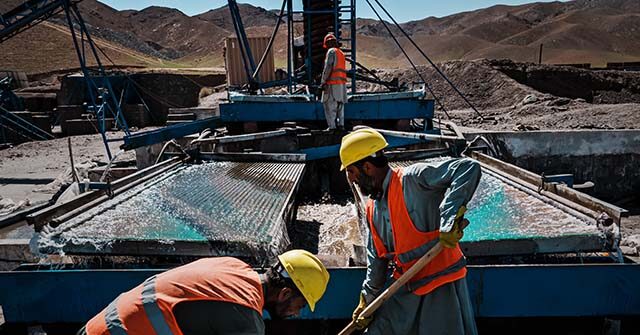
The National Natural Science Foundation of China (NSFC) on Monday announced a collaboration with Iran on the “exploration and processing of rare earth elements,” presented as a series of workshops that will be mostly funded by China.
The NSFC said that it will provide about $4,200 in funding for each workshop, while Iran’s National Science Foundation will help with travel arrangements and accommodations for Chinese researchers visiting Iran, and vice versa.
The South China Morning Post (SCMP) noted that Beijing chose a “particularly sensitive time” to announce a new collaboration with Iran, given ongoing hostilities between the United States and Iran.
Chinese dictator Xi Jinping is scheduled to visit the United States in September to discuss trade issues with President Donald Trump, although the meeting could already be imperiled by volleys of “tit-for-tat” sanctions between the U.S. and China. Trump is unlikely to be pleased by the announcement of a new Chinese collaboration with Iran at this uneasy juncture.
The SCMP pointed out that China seems to be taking a significant diplomatic risk for a very modest collaboration in an industry that China already dominates. China has the world’s largest known rare earth reserves and is the leading producer and refiner of the metals.
Iran might have significant rare earth deposits in its central region, but it has not developed the technology to confirm those deposits exist, or exploit them. All that is certain for now is that central Iran boasts the sort of iron and phosphate formations that could harbor rare earth deposits.
The Trump administration is determined to loosen China’s grip on the rare earth market, so Beijing might be hoping to get lucky in Iran and boost its mineral production enough to remain the world’s top supplier.
Conversely, the American Enterprise Institute (AEI) suggested in March that Iran might have invited China to help develop its rare earth industry, because Iran current spends millions per year importing the minerals for its electronics and weapons.
“As the United States and international community tighten sanctions on Tehran, Iranian authorities might fear that future sanctions could hamper their ability to import rare earth elements, an event that could adversely impact Iran’s refining and domestic electronics production,” AEI noted.
The Center for Strategic and International Studies (CSIS) speculated in June that Iran might want to develop its untapped mineral resources to pave the way for reintegrating with the global economy after hostilities have ended. In addition to rare earths, Iran has a good deal of copper to offer foreign buyers, assuming sanctions are lifted to make exports possible.
The modest scope of the China-Iran workshop program suggests China is essentially prospecting — getting a feel for the true size of Iran’s rare earth deposits and the costs of exploiting them, before making any major commitments. China may well conclude that Iran does not have enough of the rare “heavy” elements to make investments profitable.
Read the full article here


