







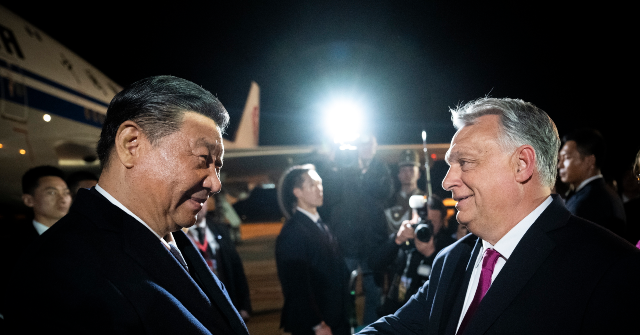
The Chinese Communist Party offered hearty congratulations to Hungary’s expected next prime minister, Péter Magyar, on Monday following his party’s sound defeat of current Prime Minister Viktor Orbán, signaling interest in maintaining the outsized influence Beijing developed during Orbán’s 16 years in power.
Orbán lost to Magyar, a former member of Orbán’s party, and his Tisza Party on Sunday in a landslide, relegating his political party, Fidesz, to the opposition. Orbán last spent eight years in leadership of the opposition after losing the 2002 election and, barring some proposed term limits, under current law can have the opportunity to run again for the prime ministership in the future.
Orbán and Fidesz have consistently been among China’s most reliable partners in Europe, enthusiastically buying into Beijing’s Belt and Road Initiative (BRI) and welcoming Chinese regime-linked corporations to establish footholds in the country and compete with local commerce. The BRI is a global debt trap scheme in which China offers predatory loans to poor countries meant to be used to invest in infrastructure projects. Much of the money is invested in imported Chinese labor managed by Chinese companies who profit from domestic government contracts at the expense of the country’s workers. As the projects are often prohibitively expensive and the loans taken on unfavorable terms, many BRI countries find themselves unable to pay them back and forced to accept Chinese government territorial control and political dominance.
Despite years of American officials warning other leaders around the globe of the risks of BRI projects — and countries such as Sri Lanka and Kenya suffering the consequences — Orbán enthusiastically embraced cooperation with China. As the Diplomat, an Asia affairs magazine, explained this week, “It is important to recognize that Hungary’s friendly positions toward China have not been the result of Beijing’s pressure.”
“It was Orbán who decided to send friendly signals to China as part of his political program, which has increasingly focused on criticism of liberal democracy, the EU, and the West,” it continued. “By engaging China, Orbán signaled to Brussels, and also domestically, that he had important connections.”
In addition to Hungary’s embrace of the BRI, Orbán’s government took out a billion-dollar Chinese loan in 2024 after Orbán visited Beijing, attempting to bring an extended campus of China’s Fudan University to Budapest — a plan that was quietly tabled following massive protests.
The Chinese Foreign Ministry signaled on Monday that it is not treating Magyar and his Tisza party as an obstacle to its ambitions in Hungary.
“China congratulates the Tisza party led by Mr. Peter Magyar on the parliamentary election victory in Hungary,” spokesman Guo Jiakun told reporters during his ministry briefing on Monday. “China deeply values its ties with Hungary and stands ready to work with the new Hungarian government on the basis of mutual respect, equality, and mutual benefit.”
Guo suggested that China expects to “enhance high-level exchanges, deepen political mutual trust, expand practical cooperation and people-to-people exchanges, and deliver more benefits to both peoples” through its relationship with Magyar.
Prior to his electoral victory, Magyar had suggested that his government, should it take over, would review contracts with China and potentially scrap any that were unfavorable to the Hungarian people. He softened his tone significantly after winning, declaring on Monday that China “is one of the world’s most important, largest, and most powerful countries,” and he was happy to maintain the close relationship that Orbán had built during his tenure.
“I believe it is in China’s interest as well as ours to cooperate very well so that both countries and both countries’ companies benefit mutually. That is what we will work towards,” Magyar told reporters.
He said that his party would indeed review Chinese investment deals, but added, “Not with the aim of blocking them or preventing them from happening.”
China’s state-run Xinhua News Agency highlighted that Magyar said he “would be very happy to visit Beijing and… to welcome Chinese leaders here in Hungary.”
Prior to his defeat, the Chinese government published years of favorable coverage of Orbán. As recently as late March, the state-run Global Times propaganda newspaper highlighted an interview in which Orbán declared that China was “simply unbeatable” and that Hungary would effectively treat the Communist Party’s genocidal regime as an equal to the United States.
“If you are thinking in the frame that there could be only one sun in the sky, we misunderstand the situation. China will be as one of the two main parties of world politics,” Orbán declared.
The Global Times noted that Chinese regime-controlled social media outlets were flooded with celebrations of Orbán: “a rare clear-headed politician in Europe, with some commenting that Orban’s long tenure demonstrates his exceptional ability and vision.”
In practice, the Orbán government went further than prioritizing Chinese and American relations equally, refusing to acknowledge America’s concerns about Chinese influence in the country. Hungarian Deputy Minister for Foreign Affairs and Trade Levente Magyar described cutting ties to China as a “red line” for his government in an interview in May 2025, urging President Donald Trump not to encourage decoupling from the nefarious influence of the Chinese communist economy.
“Hungary is benefiting from these very intensive Chinese economic and trade relations. We’re not willing to give those up,” he affirmed.
Follow Frances Martel on Facebook and Twitter.
Read the full article here


