




American multinational energy corporation Chevron on Monday signed asset swap agreements with Venezuela’s state-owned oil company PDVSA to expand oil production in the country’s Orinoco Belt, where the world’s largest accumulation of heavy and extra-heavy crude oil is located.
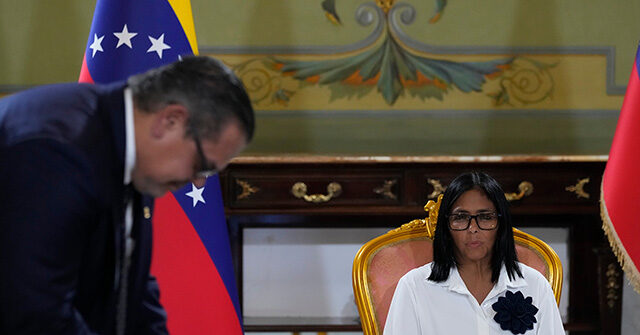
The agreements were signed on Monday evening during a ceremony hosted by “acting President” Delcy Rodríguez at the Miraflores presidential palace in Caracas. U.S. Ambassador Laura Dogu, who was present at the event, detailed on social media that Kyle Haustveit, Assistant Secretary for the U.S. Department of Energy’s Hydrocarbons and Geothermal Energy Office (HGEO), was also present at the signing ceremony. Haustveit traveled to Caracas to meet with Rodríguez.
“We continue to move forward with President Donald Trump’s three-phase plan and working toward Venezuela’s economic transformation,” Ambassador Dogu wrote.

Chevron detailed in an official press statement that per the terms of the new agreement, the company will receive an additional 13.21 percent working interest of the Petroindependencia, S.A. joint venture, which brings Chevron’s total stake to 49 percent.
Additionally, Petropiar, S.A., a joint venture that Chevron holds a 30 percent interest in, was assigned rights to develop a new “Ayacucho 8” oil area in the Orinoco Belt of Venezuela. In return, Venezuela will receive from Chevron’s subsidiaries its 60 and 100 percent operated interests in the Deltana Block 21 offshore platform and Block 32 gas licenses, as well as its 25.2 percent non-operated interest in the Petroindependencia, S.A. joint venture located in western Venezuela.
Chevron detailed that it has maintained a presence in Venezuela that dates back to 1923 and noted that the Petroindependencia and Petropiar joint ventures operate extra-heavy oil from projects in the Orinoco Oil Belt.
According to the left-wing propaganda network Telesur, “acting President” Rodríguez described Chevron as a “model of perseverance after more than a century of operations in the country.” Rodríguez also called on the White House to “move forward towards a Venezuela without sanctions” and argued that rescinding existing U.S. sanctions on the Venezuelan socialist regime is “essential for providing full legal and institutional certainty to those who are committed to the country’s economic future.”
Chevron’s Javier La Rosa reportedly thanked Rodríguez for the signing of the agreements and emphasized that the asset swap represents “the first step in a new phase aimed at strengthening energy cooperation between the two nations.” The U.S. Embassy in Caracas pointed out on Instagram that, every agreement signed, such as the one between Chevron and PDVSA, “supports Venezuela’s economic recovery.”
A report published by the BBC last week indicated that Chevron is now importing an average of 250,000 barrels of Venezuelan crude oil per day into the United States following the January 3 U.S. law enforcement operation in Caracas authorized by President Donald Trump that resulted in the successful arrest of socialist dictator Nicolás Maduro and his wife, Cilia Flores, both of whom are presently undergoing trial proceedings on multiple drug trafficking charges in New York.
Following Maduro’s arrest, Delcy Rodríguez, who was concurrently serving as both Maduro’s vice president and oil minister, began collaborating with the United States, seeking American investment and expertise to help restore the nation’s lost oil output after decades of disastrous socialist mismanagement policies greatly diminished the country’s oil production capabilities.
Venezuela is home to the largest proven oil reserves in the world, but its extra-heavy crude oil is notorious for being thick, dense, and high in sulphur, which requires extra processing and refinement to yield fuel and other oil products. Such extra-heavy crude oil is reportedly what some U.S. refineries were “precisely” built to process.
“It’s a big deal not only for Chevron but the entire Gulf region,” Tim Potter, director of Chevron’s refinery in Pascagoula, Mississippi, told the BBC last week. “It’s a pretty big incentive for us to run it. The refinery was really designed, and we invested in the refinery, to run heavy oils like from Venezuela.”
Reuters reported on Monday that Chevron’s joint ventures with PDVSA are producing 260,000 barrels per day of crude oil, which amounts to roughly a quarter of Venezuela’s entire current total output. Chevron executives reportedly said in January that the company could increase output in Venezuela by about 50 percent in the next two years within its existing footprint.
Christian K. Caruzo is a Venezuelan writer and documents life under socialism. You can follow him on Twitter here.
Read the full article here


