







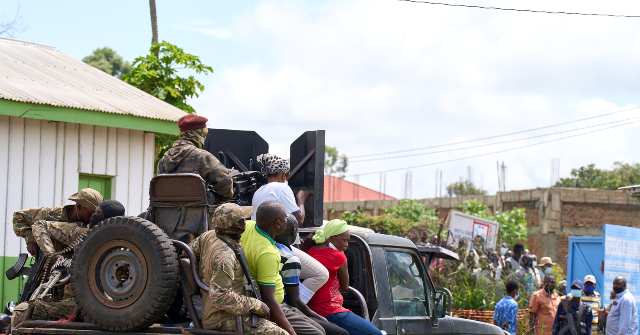
A second incident of Congolese youths storming an Ebola clinic to demand the return of infected bodies for funerals took place on Sunday evening, as the World Health Organization (W.H.O.) announced the number of suspected infections in the Democratic Republic of the Congo (DRC) and Uganda has surpassed 900.
Eyewitnesses reported gunfire at the Mongbwalu General Hospital in the eastern DRC province of Ituri, the epicenter of the Ebola Bundibugyo outbreak, as a mob of angry youths stormed the treatment center to demand the return of two bodies of Ebola victims. Some reports said members of the mob were armed, while others said police fired the shots in an attempt to disperse the crowd.
“There was gunfire and the medics were trying to evacuate the patients and the staff,” said Dr. Richard Lokudu, medical director of Mongbwalu General Hospital.
Lokudu said the hospital remained “on general alert” as of Monday morning. It was not clear from official reports if anyone was injured during the altercation.
A similar incident occurred on Thursday at Rwampara Hospital near Bunia, the capital of Ituri province. In that case, a mob of angry youths set fire to the Ebola treatment center when the hospital refused to hand over the body of a popular local soccer player who was believed to have died from Ebola.
On Saturday, another mob attacked an Ebola treatment clinic in Mongbwalu operated by Doctors Without Borders (MSF) and set fire to one of its tents. No injuries were reported, but 18 people who were undergoing Ebola testing fled from the facility and could not immediately be located to resume treatment.
“We strongly condemn this act, as it caused panic among the staff and also resulted in the escape of 18 suspected cases into the community,” Dr. Lokudu said after the Saturday arson attack.
Officials in the northeastern DRC banned funerals and gatherings of over 50 people on Friday, in an effort to slow the spread of the deadly disease. Funerals in the outbreak region are seen as super-spreader events because the bodies of dead Ebola victims can be highly contagious and people tend to come into physical contact with them during funeral ceremonies.
Many residents of the eastern DRC, especially younger people, reject the funeral restrictions — or do not believe Ebola exists at all. Some attribute Ebola infections to witchcraft and believe only supernatural and herbal remedies are effective. Others believe Ebola is a hoax invented by foreigners to oppress them, or even a biological weapon spread by injections at the clinics established to diagnose and treat the disease.
The strain currently spreading in the DRC and Uganda is called Ebola Bundibugyo, named after the small mountainous region of Uganda where it was first detected in 2007. Bundibugyo is a rare strain, involved in only one other known Ebola outbreak in the northeastern DRC in 2012.
One reason the current outbreak was able to spread so widely across the DRC before a public health emergency was declared is that most clinics in the region were only equipped to test for the more common Zaire and Sudan variants of Ebola. The Bundibugyo strain has no vaccine at present and it can evade detection by tests designed for the Zaire or Sudan strains.
The residents of Bundibugyo are lobbying W.H.O. to change the name of the Ebola strain on the grounds that it unfairly stigmatizes their community, which has not experienced any further Ebola outbreaks over the past two decades. W.H.O. has renamed diseases and strains for such reasons in the past, notably including monkeypox which was officially renamed “mpox” in 2022.
“Bundibugyo is too beautiful to be the name of a disease. We need to take back its name from this madness. Who do we need to sue? W.H.O.?” Ugandan government spokesman Alan Kasujja said last week on social media platform X.
The vast majority of the cases in the current outbreak have been found in the DRC. On Monday, Ugandan health officials reported two new cases, bringing the total number of confirmed infections in Uganda to seven.
The first five cases were all Congolese who brought their infections across the border into Uganda, but the two reported on Monday were local infections, a driver and a health care worker who were exposed to a Congolese patient who died in a Ugandan hospital on May 14.
“Both patients have been admitted to the designated treatment unit and are now receiving care,” Ugandan national director of health services Dr. Charles Olaro said.
Uganda has taken several steps to prevent the further spread of Ebola, including the suspension of public transit and air travel with the DRC as well as the cancellation of a major Catholic religious festival previously scheduled to be held on June 3 near the Ugandan capital of Kampala. Ugandan President Yoweri Museveni has also urged his citizens to “stop shaking hands” for the duration of the emergency.
Kasujja and other Ugandan government officials have been very insistent that the Ebola outbreak is spreading primarily in the DRC with zero local transmission in Uganda until the two cases that were announced on Monday.
W.H.O. Director-General Tedros Adhanom Ghebreyesus said on Sunday that the outbreak now includes over 900 suspected cases, including 101 confirmed infections.
Congolese officials said there are over 900 suspected infections in Ituri province and the surrounding area, with a smattering of additional cases reported in other parts of the country. Various DRC agencies have reported between 119 and 220 fatalities from the outbreak.
Parts of the eastern Congo are controlled by violent insurgent and jihadi groups with links to the Islamic State and al-Qaeda, and over a million people have been displaced from their homes, making treatment and contact tracing for Ebola exceptionally difficult.
Red Cross regional coordinator Gabriele Arenas warned on Monday that the outbreak is “unfolding in communities already facing insecurity, displacement, and fragile health systems.”
Read the full article here


