








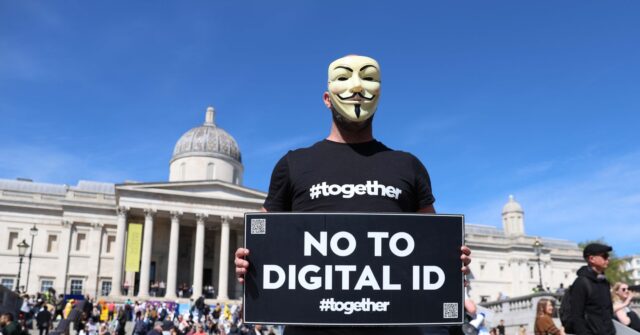
The floundering left-wing Labour Party government in Britain appears intent on imposing as much authoritarianism as possible on the public while it still remains in power, with Prime Minister Sir Keir Starmer using the King’s Speech on Wednesday to confirm plans to introduce a Digital ID system while plans for deep surveillance of private digital devices are revealed.
When in doubt, break glass for more Blairism appears to be the order of the day. Fighting for his political life following a disastrous performance in last week’s local elections, Prime Minister Starmer has not only turned to major figures from the previous Labour government, tapping Blairite veterans former PM Gordon Brown and Deputy leader Harriet Harman to come on board as advisors, he now seems intent on fulfilling his predecessor’s unfulfilled aims, introducing a Digital ID.
Although the Brown government began to introduce such a system, it was eventually scrapped following the 2010 general election, which the Conservative Party made a referendum on the idea. While long classified as fundamentally un-British — with the UK abandoning national identity cards following the Second World War in contrast to many other European nations — the project of a Digital ID has remained a key goal of the scheme’s architect, Former PM Tony Blair, who remains a key power broker in the background of the Labour Party.
On Wednesday, amid ongoing rumours of potential leadership challenges, Starmer’s government outlined its plans for the upcoming parliament in the King’s Speech, in which the Monarch reads a list of priorities written for him by Downing Street.
“My Ministers will also proceed with the introduction of Digital ID that will modernise how citizens interact with public services [Digital Access to Services Bill],” King Charles III told the State Opening of Parliament.
The government has previously pitched the concept as a cure-all for illegal immigration, saying it could be used to ensure that anyone seeking a job or renting a flat has their citizenship or immigration status instantly verified. Other potential uses put forward include accessing government services and collecting health records.
However, opponents have long raised concerns about Digital IDs, particularly regarding privacy and creeping state intervention. The British government has not showered itself in glory in recent years in terms of keeping digital secrets safe, with it recently accidentally leaking a list of thousands of spies, soldiers, and allies on the ground in Afghanistan to the Taliban, undercutting the notion that it would protect the much less sensitive data of average Britons.

Brexit boss Nigel Farage has also warned that a Digital ID system would likely be tied to other leftist government initiatives such as long-mooted plans for carbon credit scores or Central Bank Digital Currencies (CBDC), which the Bank of England is currently developing. In contrast, Mr Farage has long expressed doubt that the system would be effectively used to stem illegal immigration, noting that installing surveillance cameras across the country has done little to prevent crime and would therefore likely be used to monitor law-abiding citizens.
Following the King’s Speech on Wednesday, the Reform UK leader — whose party’s historic election victory last week sparked the latest crisis for the government — said that if given power, he would eliminate any Digital ID system imposed by the Labour government.
“All that Digital ID will be is a means of controlling the population, of telling us what we can and can’t do, of fining the innocent. And didn’t we see it all when we had the pandemic? When you had to have vaccine ID to travel, to do various things, did that stop the covid pandemic spreading? Did it hell, all that it did was put cost and inconvenience on everybody else,” he said.
Demonstrating the potential room for mission creep and the willingness of senior members of the Labour Party to back increasingly authoritarian measures, former government minister for Safeguarding and Violence Against Women and Girls, Jess Phillips, who has so far been the highest profile government official to resign this week following Labour’s election drubbing, complained in her resignation letter that the government had failed to introduce her pet measure of installing software on all phones to scan encrypted messages. While the measure is supposedly intended to detect and prevent the distribution of child pornography, it would have effectively given a backdoor to the government into citizen’s private messages.
However, Phillips lamented in her resignation letter that she had “given up” on the belief that it would be passed by the government. Noting that Labour governments “come around rarely”, she said: “I’m not sure we are grasping this rare opportunity with the gusto that’s needed and cannot keep waiting around for a crisis to push for faster progress.”
Follow Kurt Zindulka on X: Follow @KurtZindulka or e-mail to: kzindulka@breitbart.com
Read the full article here


