
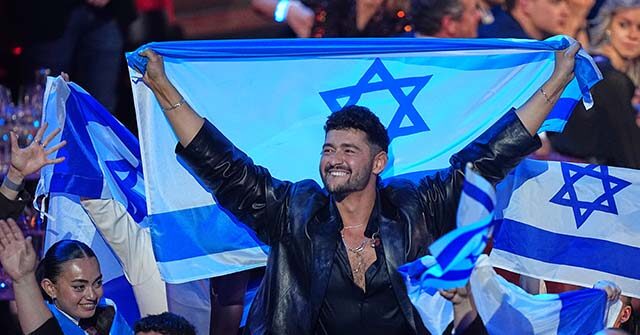
This weekend’s Eurovision Song Contest, the 70th edition of the spectacle, continued Israel’s streak of coming in second place, but represented a massive diplomatic and public relations win for a country leftist agitators have been trying to expel from the event for years.
Pro-Hamas and general leftist activists – including, prominently, Swedish environmental protester Greta Thunberg – have called for Israel to be expelled from the contest and threatened to boycott the event in the aftermath of the October 7, 2023, terrorist attacks on the country by Hamas, accusing Israel of “genocide” for actions to ensure that Hamas could not repeat its wanton rape, torture, and murder spree.
Rather than supporting the victims of jihadist terror, a host of celebrities, including Americans with no known ties to Eurovision, and radical leftist politicians demanded that the European Broadcast Union (EBU), which runs the contest, expel Israel on the grounds that Russia was expelled in 2022 for invading fellow competing country Ukraine. The EBU ultimately stood by Israel, noting the country’s presence in the contest since 1973 and its four wins, one of the longest legacies in Eurovision history. In response, five participating countries – Spain, the Netherlands, Slovenia, Ireland, and Iceland – boycotted the event this year, paving the way for the return of Eastern European competitors Moldova, Romania, and the ultimate winner on Saturday, Bulgaria.
Those boycotts appeared to have, rather than forced the EBU and participants into ostracizing Israel, made it palatable for others at the event to treat Israel like a normal, and welcomed, part of the affair. The 70th edition of Eurovision was the least controversial one since October 7, producing a landslide victory and a wave of dejection from anti-Israel activists.
Israeli singer Noam Bettan, representing the country with the song “Michelle,” came in second place to Bulgaria’s Dara and her song, “Bangaranga,” an especially meaningful placement given that he faced audible jeers during his semi-final performance and a heavily online boycott movement against Israel around the world.
Four people were reportedly expelled from the arena for their jeers. While some anti-Israel observers have interpreted their action, in a crowd of 10,500 people, as a sign of mainstream opposition to Israel’s presence, four disrupters is a significant shift from 2025, when host Switzerland chose to simply mute the audience during the television broadcast to allow for rampant anti-Israel booing rather than secure the venue to allow artists a fair shot at performing.
Independent of the crowd, Bettan was also a much more prominent presence leading up to the event and within the “bubble” where artists practice. Other competitors were filmed greeting, welcoming, and embracing Bettan – something considered unthinkable as recently as 2024. Among those including Bettan as a normal country representative were British pop icon Boy George, who was present representing the microstate of San Marino.
Moldovan performer Satoshi, who entered the contest with a celebratory patriotic song titled “Viva Moldova!”, also had a pleasant exchange with Bettan.
An unverified photo also circulated of Bettan alongside Albanian singer Alis and Danish singer Søren Torpegaard Lund. It is common practice at Eurovision for artists from competing countries to support each other by cheering each other on along the sidelines and making social media videos singing each other’s songs or performing each other’s dance moves. Israel has been the lone exception in the past two years, as other delegations have actively discriminated against the Israeli team.
Even if the photo of Bettan and his colleagues were not real, in 2025 and 2026, Albania and Denmark could have faced a coordinated hate campaign demanding they disavow it, as those caught breaking the unspoken rule to discriminate against Israel have faced a torrent of online hatred and previously cracked under pressure. In 2024, for example, singer Eden Golan managed to film a video with only one other artist in the arena – Käärija, a Finnish rapper who had won second place in the competition in 2023. After the video showing a friendly exchange surfaced online, Käärija publicly apologized for making it and demanded it be taken down.
In contrast, in addition to that unverified photo, leftists targeted Danish artist Torpegaard Lund this year after he uploaded a video to social media in which a laptop was visible bearing pro-Israel and anti-Hamas stockers. What would have been a massive scandal tanking Denmark’s chances just a year ago faded away when the artist explained in a brief note that the laptop was not his, but that he “works with many different people” and “fundamentally believe[s] in respect, love, and making space for one another.” No apology or deletion of the post. Denmark finished in seventh place, apparently unhurt by the incident – a significant achievement for the country opening the marathon-lengthened show.
Even the champion this year appeared to act warmly towards Israel. Dara, the Bulgarian singer, reportedly “liked” a video featuring a clip of Bettan’s performance, and one report claimed that Bulgarian officials reached out to the Israeli public broadcaster, KAN, and urged them to highlight Dara’s apparently support.
Neither the Bulgarian delegation nor the Israeli delegation have confirmed such a report. However, the report has also appeared to have no negative impact on the exuberant coverage of Bulgaria winning its first ever Eurovision trophy. Even boycotting activists on social media have not attempted to weaponize the reports against the artist. Last year, in contrast, Austrian singer JJ was forced almost immediately to disavow Israel following his victory. His predecessor Nemo, a Swiss “non-binary” rapper, was among those ostracizing Eden Golan in 2024 and, in a fit of outrage at Israel’s return this year, shipped his trophy back to the EBU in protest in December. Rumors claimed the trophy returned shattered in pieces and covered in toilet paper.
Noam Bettan’s treatment at Eurovision this year indicates that anti-Israel bullying is no longer en vogue in the halls of the prestigious, and often goofy, song contest. It is also evidence that virulent anti-Israel animosity is becoming increasingly unpopular in Europe, at least among fans of the competition, after years of growing rates of antisemitism throughout the continent.
Follow Frances Martel on Facebook and Twitter.
Read the full article here