
The Defense Ministry of the United Arab Emirates (UAE) confirmed a drone attack on the country’s Barakah Nuclear Power Plant on Sunday, causing a fire but otherwise not disrupting the plant’s generation.
UAE government statements were careful not to blame any party for the attack, emphasizing that investigations were ongoing, but described the strike as a “terrorist” attack and condemned the apparent targeting of the Arab world’s only functioning nuclear power plant.
The strike follows weeks of drone and missile attacks on the UAE by Iran, the world’s most formidable state sponsor of terrorism, in the context of its conflict with the United States and Israel. Iranian authorities initially responded to Operation Epic Fury, the American military campaign beginning in February, by launching bombing attacks on its neighbors, most prominently the UAE, Saudi Arabia, Qatar, and Bahrain. The Iranian regime has especially attempted to disrupt the UAE’s energy industry, bombing critical oil and natural gas facilities and blocking the free flow of commercial ship traffic in the Strait of Hormuz, where much of the UAE’s oil transits. The Iranian regime leaders who have so far survived Operation Epic Fury have demanded that the countries they bombed pay “compensation” for allegedly aiding the American military activity.
The government of Abu Dhabi confirmed on Sunday that a “fire incident… caused by a drone strike” had affected the power plant, stating that the damage was isolated to an electrical generator outside of the plant and that none of the heart of the nuclear facility suffered any damage.
“The Federal Authority for Nuclear Regulation (FANR) confirmed that the fire did not affect the safety of the power plant or the readiness of its essential systems, and that all units are operating as normal,” it said in a statement, discouraging “rumors or unverified information.”
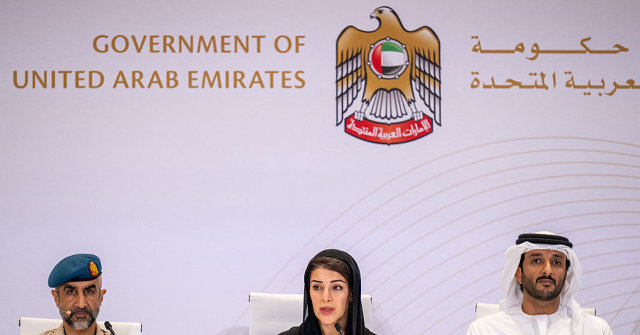
Without identifying the perpetrators of the drone attack, the UAE Defense Ministry confirmed that it had intercepted two drones “from the western border direction,” and a third had struck the generator outside the nuclear power plant.
“The ministry added that investigations are underway to determine the source of the attacks, noting that further details will be announced upon completion of the investigations,” a statement read. “The Ministry of Defence affirmed that it remains fully prepared and ready to address any threats and will firmly confront any attempts to undermine the country’s security in a manner that safeguards its sovereignty, security, and stability, and protects its national interests and gains.”
No group or individual has accepted responsibility for the drone attack though some reports have identified Iran as a top suspect given the ongoing missile and drone campaign against UAE energy facilities from the jihadist regime. The Jerusalem Post, citing unnamed “sources familiar,” claimed that the sources believed that Iran had “ordered” the attack and UAE authorities were now working on whether the Iranian military itself or one of its many proxy terrorist arms were responsible. The top suspect other than Iran’s terrorist Islamic Revolutionary Guard Corps (IRGC) is the Houthi terrorist gang in Yemen, known formally as “Ansar Allah.” A recent study published this month indicated that, after months of limiting its terrorist activity, the Houthi group has focused on rebuilding its missile and drone arsenal with Iranian help, apparently acquiring the ability to build the weapons from components shipped covertly.
The Jerusalem Post noted that, while the official channels of the UAE government had carefully avoided laying blame on any party, Anwar Gargash, a senior adviser to UAE President Mohammed bin Zayed Al Nahyan, hinted at suspicions towards Iran in a statement following the attack.
“This prohibited escalation once again highlights the nature of the challenges facing the region in confronting the forces of evil, chaos, and destruction. No one will bend the will of the United Arab Emirates,” he said in a statement on social media, vowing a response to the attack “whether carried out directly by those responsible or through one of their proxies.”
The UAE received rapid words of support, and condemnation for the attack, from both senior leaders in the United Nations and the International Atomic Energy Agency (IAEA), the U.N.’s official proxy.
“The IAEA is following the situation closely and is in constant contact with the UAE authorities, ready to provide assistance if needed,” the agency said in a statement, adding that Director-General Rafael Grossi, a candidate in the ongoing U.N. secretary-general race, “expresses grave concern about the incident and says military activity that threatens nuclear safety is unacceptable.”
Secretary-General Antonio Guterres also condemned the attack, describing himself as “deeply alarmed” by the incident.
“I have consistently warned against any further escalation of the conflict in the Middle East, and this incident provides yet another reason for all sides to halt the fighting completely,” he stated. “There must be no further attacks near civilian infrastructure, including nuclear power plants. Attacks to nuclear installations are totally unacceptable, a violation of international law, and must be condemned.”
Follow Frances Martel on Facebook and Twitter.
Read the full article here