


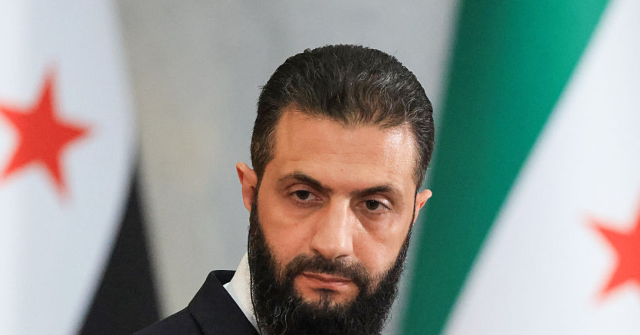
The government of Syria, under former wanted al-Qaeda jihadist Ahmed al-Sharaa, granted the head of the International Atomic Energy Agency (IAEA) access to a formerly secret nuclear site in the country on Tuesday, vowing to cooperate with the United Nations agency.
IAEA Director-General Rafael Grossi’s tour of a Deir ez-Zor facility believed to have been used by former dictator Bashar Assad for illicit nuclear development follows over a year of communication between Sharaa’s new regime and Grossi’s office in the aftermath of the fall of the Assad regime. Over half a century of Assad dynasty rule came to an end in December 2024 when Sharaa’s jihadist militia, Hayat Tahrir al-Sham (HTS), drove Assad and his family out of Damascus.
During his time in Syria this week, Grossi visited the previously undeclared Deir ez-Zor nuclear site and engaged in several meetings with Syrian Foreign Minister Asaad al-Shaibani, who emphasized in public statements that the Sharaa government initiated the invitation to the IAEA to inspect former Assad regime nuclear sites.
“The visit, which included the site at Deir ez-Zor and a second location related to the nuclear material identified by Syria recently, marks the most significant advance to date in the cooperation between Syria and the Agency,” the IAEA said in a statement on Tuesday, “towards resolving the outstanding safeguards issues arising from undeclared activities related to the former regime, under Syria’s Non-Proliferation Treaty (NPT) Safeguards Agreement.”
Syria is a signatory to the NPT, which creates specific obligations regarding limits to nuclear development for military purposes. While the Syrian government emphasized that it would abide by international obligations, officials insisted that Syria would defend its “right” to civilian nuclear development. The state-run Syrian Arab News Agency (SANA) paraphrased al-Shaibani as stating in a joint press conference with Grossi that Sharaa expects to pursue the development of nuclear technology alongside the IAEA.
“Al-Shaibani said Syria had granted access to the Deir ez-Zor site after more than 18 years on its own initiative and as a sovereign decision,” SANA reported. “He reaffirmed Syria’s sovereign and legal right to civilian and peaceful uses of atomic energy and to pursue a peaceful nuclear program and benefit from its applications.”
Grossi reportedly affirmed this plan, stating that “nuclear technology in Syria would focus on energy, health, and water management” and the IAEA intends to offer “cooperation and support” in this development. He told reporters that his office had been working with Sharaa’s government for 18 months on an agreement to allow the IAEA access to nuclear materials previously belonging to the Assad regime, particularly the Deir ez-Zor site, which was described as a “secret” nuclear site run illicitly by Assad. Grossi also reportedly floated the possibility that Syria would develop “international partnerships” in which other countries would help develop its nuclear technologies.
The press briefing followed a visit to the formerly secret site. The IAEA described Grossi as being “briefed on the excavation work being carried out by Syria and [having] observed features of the site relevant to the Agency’s assessment of the nuclear related activities formerly conducted there.”
The IAEA is reportedly allowing the HTS regime to maintain custody of the nuclear material “subject to IAEA guarantees” and regular inspections. Al-Shaibani described cooperation as being in “advanced stages” and assured the public that Syria would “provide the necessary conditions for handling nuclear materials and storing them safely.” Similarly, the IAEA stated that Syria “exercises sovereign responsibility over all nuclear material on its territory, that the material remains in Syrian national custody, and that Syria will continue to perform its responsibilities in accordance with its international obligations and its national interests.”
Prior to the Syrian Civil War, which began in 2011, dictator Assad entrenched his regime in a diplomatic network led by Syria’s allegiance to Iran first and foremost, which paved the way for alliances with other rogue states such as Russia and North Korea. Assad publicly stated that he was not interested in pursuing nuclear weapons, but evidence in the late 2000s indicated that the dictator was building illicit nuclear facilities, alarming neighboring Israel.
In 2007, the Israeli military launched an incursion into Syria to destroy what it believed to be a secret nuclear facility. Much later, in 2018, the Times of Israel reported that the secret site, believed to be in Deir ez-Zor, was a secret nuclear reactor believed to have been built by North Korean officials. While the Israeli government admitted to the mission about a decade later, in 2011, the IAEA also launched an investigation that resulted in a report concluding that the “destroyed building” in the Israeli operation “was very likely a nuclear reactor.”
Der Spiegel reported in 2015 that, while the war raged at the time, the IAEA had an opportunity to visit Deir ez-Zor after it was captured by the radical jihadist organization the Islamic State, which invited the United Nations agency to inspect it.
“The terror organization conquered the area around Deir ez-Zor several months ago and offered the IAEA the opportunity to have another look around the Kibar facility,” the German newspaper reported at the time. “But the Vienna-based organization declined, not wanting to provide Islamic State with any kind of legitimacy.”
Follow Frances Martel on Facebook and Twitter.
Read the full article here