
A mysterious low-budget animated film called Niu Lai, or “The Cow Arrives,” became an unexpected hit in Chinese theaters this past week, crossing $1 million in box office sales as word of mouth spread of how truly awful the film is.
The film has grossed about $2.5 million cumulatively in theaters as of Monday despite not being released with effectively no advertising and being marketed so poorly that theater workers and fans are drawing their own posters to indicate to viewers that their theater is playing the film. Discussion of the film has taken over China’s major, regime-controlled social media outlets such as Weibo and Douyin and, given the reportedly nonexistent political content in the film, the Chinese government has done nothing to censor the film.
This social media chatter has driven ticket sales, which floundered at just $995 in the first nine days after its release on August 5.
A staged shot of a phone screen displaying screenshots from the animated filmNiuLai, alongside a collection of fan remixes, Aug.16,2026. The lowbudget featurelength animation became a viral boxoffice phenomenon after its extremely low production quality drew attention from cinemagoers. (WANG GANG/ Feature China/Future Publishing via Getty Images)
The state-run Global Times newspaper, the country’s most prominent English-language state propaganda outlet, marveled at the success of the film domestically on Sunday, but belied some nervousness that word of the film spreading abroad could give international viewers an unfairly negative perception of the quality of Chinese film production. Damage to the reputation of China’s animated film industry in particular could be harmful to the regime a year after a homemade movie, Ne Zha 2, became the highest-grossing animated film of all time.
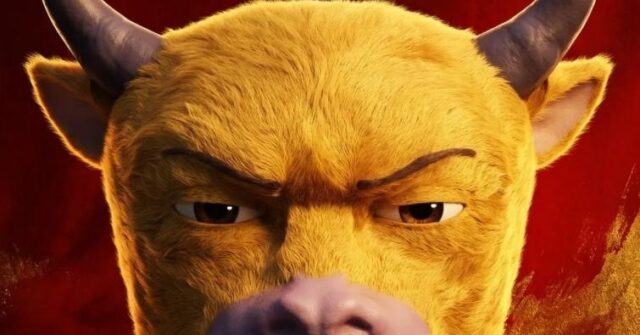
Niu Lai, according to the South China Morning Post, centers around “a dream sequence involving a calf and a skylark that helps teach him about love, courage, perseverance and sacrifice.” Commentary on the film from those who have seen it online suggests that the plot is presented in a convoluted manner that makes it difficult to follow, however, in addition to the aesthetic objections to the project.
Viewers have in particular panned the animation quality of the movie, which features square, pixelated characters boasting blank eyes and robotic movements. ABC News cited commentary online describing the movie as “unbelievably terrible;” the Global Times shared online users complaining it was “worse than AI-generated animation” and “disaster-level.”
The China Digital Times shared some other comments from survivors of the viewing experience, who shared on Chinese regime-controlled social media comments such as “I watched for an hour and laughed for an hour.” An online commentary defending the film, however, disparaged those who described it as a “urinal in the history of domestic films.”
“In today’s world where AI can generate 4K high-definition animation, and movies are rolling special effects down to the pore level, it’s not hard to find that Niu Lai can still maintain this style of art. You say it’s ‘rough’? That is resistance to the assembly line production of digital capitalism,” the defense, of an unclear satirical nature, proclaimed.
The defense was reportedly more spirited than that offered by the official Niu Lai page on Weibo. According to the Global Times, that page declared that the movie it was made to promote “falls short of established industry standards for theatrical animation in terms of visuals, storytelling and other aspects.”
Chinese movie theaters have been caught flat-footed when seeking to play the film in their locations, as the film does not appear to have an official movie poster. Fans and employees at theaters have thus begun doodling their own posters, which some users joked featured higher quality art than the movie itself.
The origin of the film remains largely a mystery. Multiple Chinese news outlets have identified the director as Xin Yumeng. The only other person credited with aiding in the film is Sun Lifan, Xin’s mother. The “production company” responsible for the movie, identified as Dalian Jingyuan Decoration Engineering Co., Ltd., was reportedly registered as an interior decorating business before 2021, when it rebranded as a film and television studio.
An alleged interview with Xin being circulated in Chinese media, allegedly to promote the film and taking place three days before its release, took place on a podcast called “Entrepreneurial Youth Speaks.” In it, Xin allegedly states that the film took him five years to make and that he personally paid for all equipment with help from his parents. The timeline would align with the year in which Dalian Jingyuan Decoration Engineering Co. shifted away from interior decorating.
Xin reportedly emphasized that he did not use AI to animate the film, noting that widespread access to AI models did not exist when he began making the movie. ABC News noted that the Associated Press attempted to reach Xin and was unable to make contact to confirm that he is, in fact, the director of Niu Lai.
The Global Times compared Niu Lai to its biggest competition in the Chinese box office: Christopher Nolan’s The Odyssey, nervously insisting that China’s viewers can engage both high-brow foreign content and low-budget domestic endeavors. Regime-approved industry expert Zhang Peng is quoted as telling the newspaper that actual quality films are still “at the heart of the cinema business” and that Niu Lai was the product of a “bubble built on traffic,” and should not be used as indicative of the true tastes of Chinese filmgoers.
“Niu Lai has been driven by curiosity and social currency, with audiences essentially paying a premium for the feeling of being part of a trending phenomenon,” Zhang said. “When cinemas add screenings for Niu Lai, they may appear to be responding quickly to market demand, but in reality, they are giving in to online buzz rather than making decisions based on the quality of the film itself.”
“Niu Lai, meanwhile, serves as a warning that speculative filmmaking and curiosity-driven marketing should not be mistaken for a replicable formula, as relying on such tactics offers little positive value for the long-term development of the film industry,” Zhang emphasized.
The state media fretting follows China obtaining the crown of the world’s highest-grossing animated film ever, Ne Zha 2, last year, which made nearly $2.3 billion at the box office. Contrary to Niu Lai, Ne Zha 2, the story of a magical boy, received global praise for its high animation quality and complex storytelling.
In response to its triumph last year, state media boasted that China was effectively ready to overtake Hollywood as the world’s premier film industry due to the alleged authenticity of the “local mythology and moral frameworks.”
Follow Frances Martel on Facebook and Twitter.
Read the full article here