


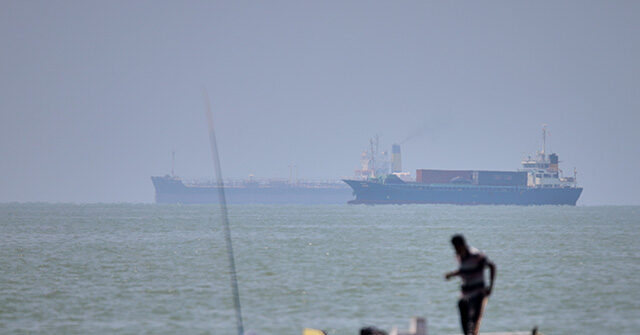
Although Iran proclaimed the Strait of Hormuz was once again closed on Saturday, tankers continued to move through the vital waterway, including Very Large Crude Carriers (VLCCs) and liquid natural gas (LNG) tankers.
The strait was ostensibly reopened on Thursday, after President Donald Trump and Iranian President Masoud Pezeshkian signed their Memorandum of Understanding (MOU) to establish the framework for a peace deal.
Just a few days later, on Saturday, Tehran announced the strait was closed again because Israel was still fighting Iran’s terrorist proxy Hezbollah in Lebanon.
U.S. Central Command (CENTCOM) responded by stating that Iran “does not control the Strait of Hormuz.”
“Traffic continues to flow, and U.S. forces are monitoring the situation to ensure this remains the case,” said CENTCOM spokesman Capt. Tim Hawkins.
President Donald J. Trump signs a Memorandum of Understanding between the Islamic Republic of Iran and the United States of America at the Palace of Versailles, France on Wednesday, June 17, 2026. French President Emmanuel Macron was also in attendance. (Official White House Photo by Daniel Torok via Flickr)
“Safe passage through the international waterway remained intact today as 55 merchant ships transited, moving large amounts of cargo and more than 17 million barrels of oil to global markets,” CENTCOM said on Saturday.
“U.S. forces remain present and vigilant to ensure all aspects of the agreement with Iran are adhered to, obeyed, and in full force and effect,” the statement added.
CENTCOM referred to the latest bulletin from the Joint Maritime Information Center (JMIC), which lowered its risk advisory level for the Strait of Hormuz to “moderate” and said the strait is “now open.”
JMIC posted an update on Sunday that said traffic flows are “increasing,” but “navigational system interference and wider regional military activity continued to warrant caution.” Navigational inference included “hailing and surveillance activity” by Iran’s Islamic Revolutionary Guard Corps (IRGC).
Reuters reported on Monday that oil and LNG tankers are indeed moving through the Strait of Hormuz, and traffic is “slowly picking up.”
“Four LNG tankers controlled by Qatar headed into the Gulf and through the strait on Monday, while two supertankers, which can carry up to 4 million barrels of crude oil, crossed into the Gulf with one signaling its destination as the Iraqi port of Basra,” the report said, citing data from ship tracker Kpler.
“Two smaller crude tankers, carrying just under 2 million barrels of oil in total, sailed out of the Strait of Hormuz into the Gulf of Oman on Monday,” the report added, citing a different set of ship tracking data.
WATCH — Vance: Trump Creating a “Classic Trump Deal” Scenario That’s a Win-Win for the U.S. and Iran:
Reuters also noted that more ships could be passing through the strait with their Automatic Information System (AIS) transponders turned off for safety. However, based on visual observation, traffic did seem to slow considerably after the IRGC said the strait was closed again, falling from 26 ships spotted on Saturday to only five on Sunday.
The South Korean Ministry of Oceans and Fisheries said on Monday that two ships operated by South Korea have been able to pass safely through the Strait since the MOU was signed.
The ministry provided few further details in the interests of safety, because the ships have “not yet fully exited a high-risk zone,” but mentioned that neither of them is crewed by South Koreans or currently headed for port in South Korea.
Lloyd’s List Intelligence said on Sunday that commercial traffic “continued to move through the Strait of Hormuz over the weekend despite repeated Iranian claims that it had closed the waterway in response to what it described as Israeli violations of a ceasefire.”
Another maritime intelligence company, Windward, concurred with its own analysis that “traffic through the southern corridor was not reflecting any closure,” although it noted the strait was nowhere near returning to its prewar traffic load.
Windward split the analytical difference by observing that high-visibility traffic, with transponders switched on, had “stalled” even before the IRGC declared the strait was closed on Saturday.
“12 transits today, down from 21+ on June 20. Neutral and European tonnage: absent. 5 of 8 inbound vessels: dark,” Windward said.
“The current traffic profile: dark, sanctioned, Iranian-linked, resembling the late-blockade baseline more than a functioning open strait,’ the analysis concluded.
Read the full article here