


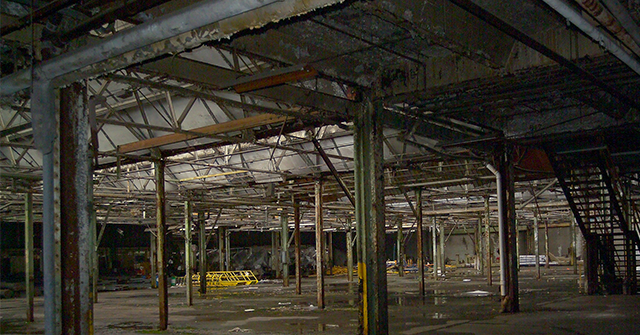
The Import Invasion Hollowed Out U.S. Factories
Why did America’s manufacturing productivity crash as we opened our markets to the world?
The trade-off with globalized trade was supposed to work something like this. Globalization would allow for additional specialization, improving productivity. We would concentrate on stuff we could produce most effectively, while importing stuff were comparatively less effective at making.
U.S. factories might employ fewer people, but the remaining workers would be producing more with better machines, better software, better supply chains, and better management. Productivity improvement was supposed to be the consolation prize for deindustrialization. We were losing jobs, the story went, but we were gaining efficiency.
But that’s not what happened at all. Manufacturing labor productivity grew at a 3.3 percent annual rate from 1987 to 2010. From 2010 to 2023, it shrank at a 0.3 percent annual rate.
(iStock/Getty Images)
A new NBER working paper by Robert Gordon and Kenneth Ryu, both at Northwestern University, investigates what went wrong. Why did the rise of imports degrade America’s manufacturing capacity and efficiency?
The clever move in the paper is to shift attention away from 2010, the post-financial crisis period that many see as the beginning of the breakdown in manufacturing. This is the so-called “secular stagnation” period. Gordon and Ryu argue that the real break came around 2000, when U.S. manufacturing output stopped growing. From 2000 to 2023, manufacturing output was essentially flat while real gross domestic product rose 57 percent.
Productivity is usually treated as a story about technology, management, or training. Sometimes we’re told it is just too tough to measure properly. Gordon and Ryu treat it as a story about industrial ecology. When output stagnates, plants close. When plants close, workers leave. When workers leave, supplier networks weaken. When suppliers move offshore, domestic firms lose access to parts, process knowledge, engineering feedback, and the accumulated know-how that comes from actually making things.
Losing the Industrial Ecosystem
What Gordon and Ryu call that “import invasion” did not just replace American goods with foreign goods. It hollowed out the system that produced American productivity. What we saw was surge in imports relative to what America still made at home. Imports as a share of domestic manufacturing output rose from 28 percent in 2000 to 45 percent in 2023. In other words, foreign production did not simply supplement American manufacturing. It increasingly substituted for it.
That matters because productivity gains are not primarily produced by Ivy League-educated consultants or white papers. They come from inside an industrial system. When import competition drives down domestic output, plants close, workers leave, suppliers disappear, and process knowledge migrates abroad. In other words, Gordon and Ryu argue that the factory floor is not just where goods are assembled. It is where engineers learn what works, where defects are discovered, where workers find better methods, and where suppliers and manufacturers solve problems together. Workers bring this kind of knowledge with them as they shift between firms when manufacturing employment is abundant. Hollow out production, and eventually you hollow out the capacity to improve production.
The most exposed industries were devastated. Apparel, textiles, furniture, and electrical equipment suffered enormous output losses after 2000. Across manufacturing industries, Gordon and Ryu find a strong relationship between rising import penetration and subsequent output stagnation.
Look at what happened to America’s computer industry. This was America’s great productivity machine. Yet by 2018, import penetration in computers and electronics had reached 84 percent—almost as high as the allegedly low-value textile production sector. The industry most associated with American technological supremacy had become deeply dependent on foreign production ecosystems.
The paper also has policy implications for today. A lot of the arguments against tariffs insist that reshoring production will mean a loss of productivity. The Gordon and Ryu paper suggests that this argument gets the problem backward. Productivity does not float above the real economy. It grows out of production itself. If bringing production home rebuilds the industrial ecosystem that globalization helped dismantle, reshoring should be seen as likely to improve productivity.
Read the full article here