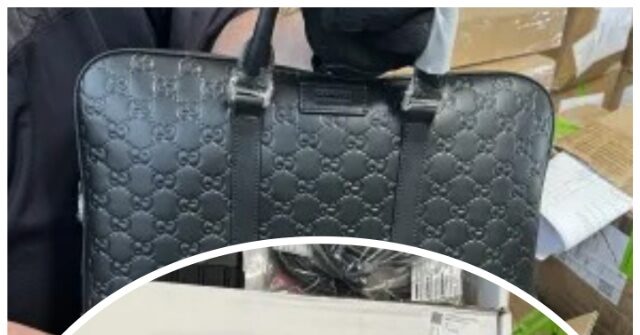
U.S. Customs and Border Protection (CBP) officers at the George Bush Intercontinental Airport port of entry seized nearly $4 million in counterfeit goods, including fake Louis Vuitton bags, Major League Baseball and Nike apparel, Cartier sunglasses, and Jaguar Land Rover computer systems.
CBP announced the seizures on Friday, all of which involved intellectual property rights violations and would have had a manufacturer’s suggested retail value of $3.7 million if the products were real. According to CBP, most of the shipments originated from China and were destined for locations within and outside the United States.
U.S. Customs and Border Protection
The products were deemed to be inauthentic by the agency’s Centers of Excellence and Expertise, CBP’s group of trade experts. The centers are CBP’s industry-focused operational organizations that, in addition to product authentication, serve to resolve trade compliance issues nationwide to protect the United States economy.
Historic seizure data collected by CBP show that high-value handbags, wallets, apparel, footwear, watches, jewelry, and consumer electronics are at higher risk of counterfeiting. Counterfeit versions of popular high-end brands are regularly sold by online retailers and at swap meets and flea markets.
According to authorities, the products are manufactured in unregulated and potentially exploitative environments abroad. Sales of these items in the United States are not an innocuous venture either, according to CBP. The revenue generated by the counterfeit merchandise scheme serves to launder money and mask profits, as if the revenue were from legitimate business activities.
Often, the proceeds serve as funding streams for organized crime. According to CBP, the counterfeit goods business is a multi-billion-dollar industry. Organized crime groups, which are often involved with Chinese money-laundering organizations known as “shadow bankers,” are frequently investigated by ICE Homeland Security Investigations (HSI) for using counterfeit goods to mask illicit funds.
The shadow bankers use the goods as part of a scheme known as trade-based money laundering, in which cash from crimes committed in the United States funds counterfeit products, most often imported from China. Once the products are sold through various retail channels, the ill-gotten cash begins to appear more like ordinary business income and less likely to attract the scrutiny of law enforcement authorities.

U.S. Customs and Border Protection
According to CBP, counterfeit goods are often spotted by their inferior quality. Peeling labels, misspellings or poorly printed labeling, and loosely packed items in the box can be signs that the product may not be legitimate. Counterfeit apparel and handbags may feature poor or uneven stitching and improperly sized or designed logos.
CBP Houston Area Port Director Roderick Hudson commented on the seizures, saying, “Counterfeit goods are poor quality products that cost U.S. businesses billions of dollars a year while robbing our country of jobs and tax revenues. CBP officers remain vigilant in protecting the American consumer, and we are committed to stopping counterfeit smuggling. These interceptions combat the illicit actors and organized crime, and enforcement actions help protect communities from potentially hazardous knockoffs.”
Randy Clark is a 32-year veteran of the United States Border Patrol. Before his retirement, he served as the Division Chief for Law Enforcement Operations, directing operations for nine Border Patrol Stations within the Del Rio, Texas, Sector. Follow him on X (formerly Twitter) @RandyClarkBBTX.
Read the full article here