







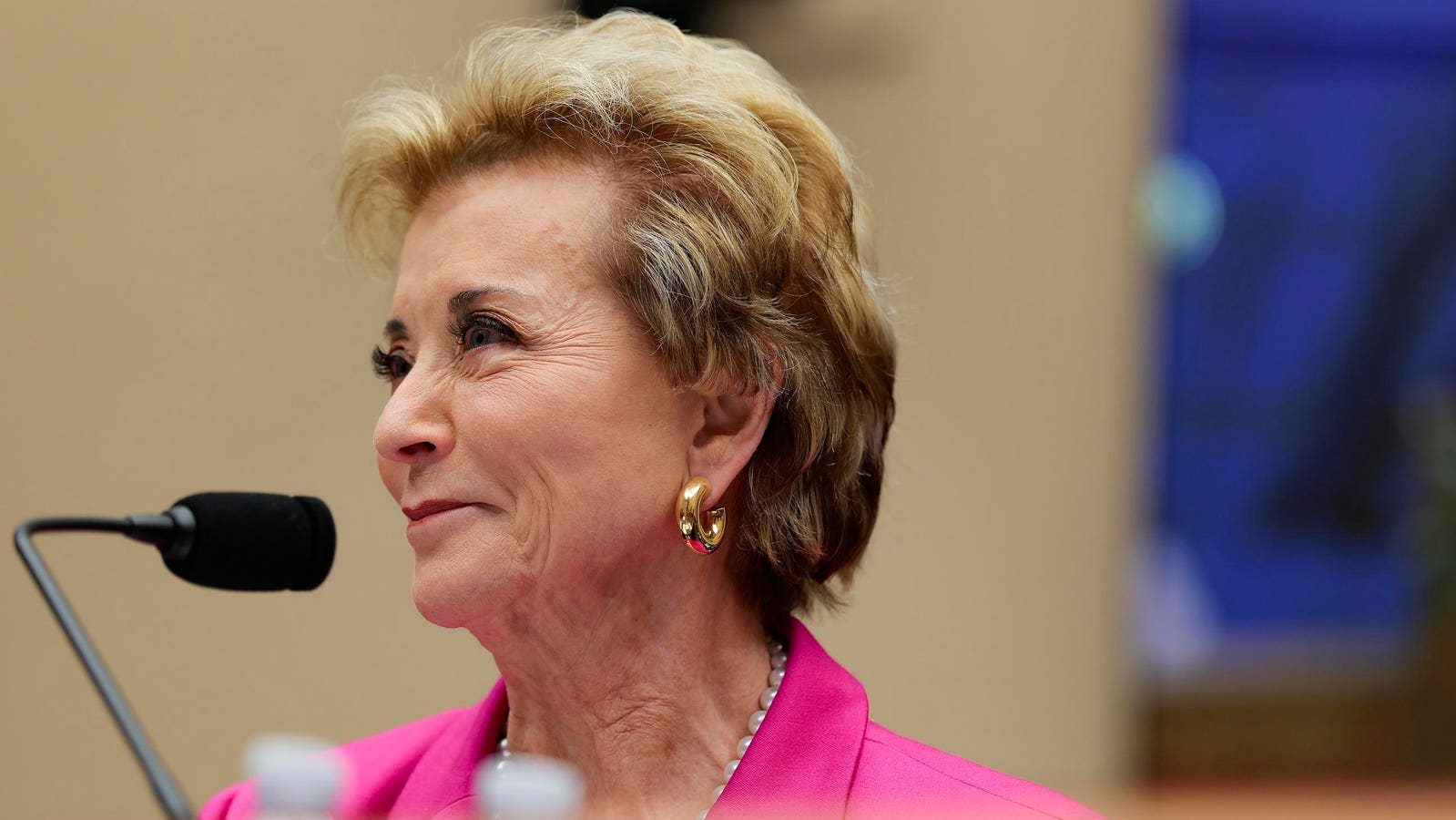
WASHINGTON, DC – MAY 14: U.S. Secretary of Education Linda McMahon testifies at the Rayburn House Office Building on May 14, 2026 in Washington, DC. The Education Department launched the Repayment Assistance Plan on Wednesday, with at least 46,000 borrowers applying to enroll their student loans in the new program within the first 24 hours. (Photo by Heather Diehl/Getty Images)
Getty Images
Thousands of borrowers have applied to enroll their student loans in the Repayment Assistance Plan, or RAP, a new income-driven repayment option that launched on Wednesday. Nearly 50,000 borrowers had applied to RAP within the first 24 hours of the program’s debut, said Education Department officials.
“@usedgov launched the new income-driven Repayment Assistance Plan today, and nearly 46,000 borrowers have already submitted an application to enroll!” said Under Secretary of Education Nicholas Kent in a statement on X on Wednesday. Kent encouraged borrowers with eligible federal student loans to “switch plans today!”
The launch of RAP is one of several major changes to federal student loan programs that the Trump administration began implementing on July 1. But while the Education Department continues to tout the benefits of RAP, advocacy groups are urging borrowers to carefully consider the potential benefits and drawbacks of the new repayment plan option before enrolling. Here’s what borrowers should know.
Repayment Assistance Plan For Federal Student Loans Launches This Week
RAP is an income-driven repayment plan available for federal Direct student loans. Like all prior IDR plans, monthly payments are based on the borrower’s income (usually their Adjusted Gross Income, or AGI, as reported on their federal tax return), with some adjustments made for family size. After many years in repayment, any remaining balance can become eligible for student loan forgiveness.
“Your required monthly payment amount under RAP is a percentage of your annual income, most commonly your adjusted gross income (AGI), divided by 12 to determine the monthly payment amount,” explained the Education Department in online guidance updated in advance of the launch of the new program. “Your monthly payment amount is then reduced by $50 for each dependent you claim on your federal tax return; however, your monthly payment may not be less than $10 a month.”
Republican lawmakers authorized the creation of RAP in the One Big, Beautiful Bill Act that Congress passed last summer. RAP is intended to be a replacement for several older income-driven repayment plans that will soon be phased out. The Education Department will start winding down the SAVE plan over the next several months, while the ICR and PAYE plans will be phased out by July 2028. IBR will remain available for borrowers currently in repayment, but anyone who takes out new federal student loans going forward (or consolidates their existing loans) will have RAP as their only income-driven repayment plan option.
Unlike prior IDR plans, RAP won’t use a fixed repayment formula at all income levels. Instead, the percentage of a borrower’s income that must be dedicated to their federal student loan payments will increase in steps as a borrower’s AGI increases. Spousal income will be factored into a married borrower’s monthly payment calculation if they file taxes as married-filing-jointly, but borrowers can exclude spousal income by filing taxes separately, similar to the other IDR options.
“The percentage of your annual income varies depending on your AGI,” explained the department in its online guidance. “If you’re married and file a joint federal income tax return, your monthly payment is generally based on the combined income of you and your spouse. However, your monthly payment will be reduced if your spouse also has federal student loans. If you’re married and file a separate tax return from your spouse, only your income and the dependents you claim on your tax return will be used to determine your monthly payment amount.”
RAP will have some unique benefits, including a waiver of excess interest accrual for borrowers if their required payments aren’t high enough to pay off the accruing interest on their student loans, preventing runaway balance growth. And the department can also dedicate up to $50 towards a borrower’s principal balance in this scenario, as well, allowing loan balances to decrease even if the payments are low. But borrowers won’t be able to get their student loans forgiven until they have been in repayment for at least 30 years, and payments made under RAP won’t count toward student loan forgiveness under other IDR plans.
Advocates Caution Borrowers Against Rushing To Enroll Their Student Loans To RAP
The Education Department has continued to push borrowers to enroll their federal student loans in RAP.
“The Repayment Assistance Plan (RAP) will be available to student loan borrowers starting July 1!” said the department’s Office of Federal Student Aid in a statement on X last week. “RAP, a new income-driven repayment plan, has an interest waiver and a matching principal payment benefit, ensuring your loan balance won’t grow as long as you make your full monthly payments on time.”
But some student loan borrower advocacy groups have warned that RAP is not as generous as the SAVE plan and could cause borrowers to have higher payments and pay much more in total over a longer repayment term, potentially increasing the risk of default.
“RAP departs radically from the core design tenets of all prior income-based repayment plans,” said The Institute of College Access and Success, or TICAS, in an analysis published last year after Congress passed legislation authorization the creation of the new repayment program. “RAP raises payments for most borrowers, hits the lowest-income borrowers the hardest, and extends the maximum repayment term from the current 10-25 years to 30 years, which will likely trap the lowest-income borrowers in debt for decades.”
TICAS also warned that borrowers could see their student loan payments “skyrocket by $400 per month” on average.
Other borrower advocacy organizations are urging SAVE plan borrowers to hold off on switching to RAP, particularly as a pending lawsuit is challenging the department’s plans for forcing student loans out of the more affordable repayment program.
“Switching off of SAVE to RAP is a bad idea for many student debtors,” said the Debt Collective, a national debtor’s union advocating for people with student loans, in a statement on X on Wednesday. “It’s telling that after sending 8M debtors half a dozen scary emails saying ‘switch now’ that less than 50k people have tried to switch to RAP.”
Borrowers Should Weigh Pros And Cons Before Switching Student Loans To RAP
But for many borrowers, the decision about whether to enroll their student loans in RAP will come down to weighing the potential benefits and drawbacks of the program. And given that Congress has now changed the rules for student loan repayment, at least some borrowers won’t have much of a choice but to eventually enroll in RAP if they want to maintain long-term access to payments tied to their income and a pathway to eventual student loan forgiveness.
“RAP has some important pros and cons that are different from the existing income-driven repayment plans,” explained the National Consumer Law Center in a new blog post published on Wednesday in conjunction with the launch of RAP.
“Your loan balance will always decrease while you’re in the RAP plan and making on-time payments because any interest that accrues during a month that is not paid off via your monthly payment will be waived (canceled),” said NCLC, outlining the potential benefits of the new student loan repayment plan. “In addition, if your monthly payment does not reduce your principal by at least $50 on its own, the government will reduce your principal by up to $50. Many borrowers will be able to pay off their loans sooner in RAP than in other IDR plans and will pay less in total over time.”
But NCLC also outlined some serious downsides including higher payments, a longer repayment term, and a limited ability to transfer student loan forgiveness credit earned under RAP to other income-driven plans.
“Your monthly bill may be more expensive than it would be in the other IDR plans, particularly if you took out your loans after 2014, are low income, high income, or have a spouse or children,” continued NCLC. “Time in RAP will not count towards forgiveness in the IBR plan. This means that if you eventually want to switch to IBR, you may have more years until you reach forgiveness.”
Borrowers evaluating whether to enroll their student loans in the Education Department’s newest repayment plan should take the time to carefully weigh their options before proceeding.
Read the full article here


