






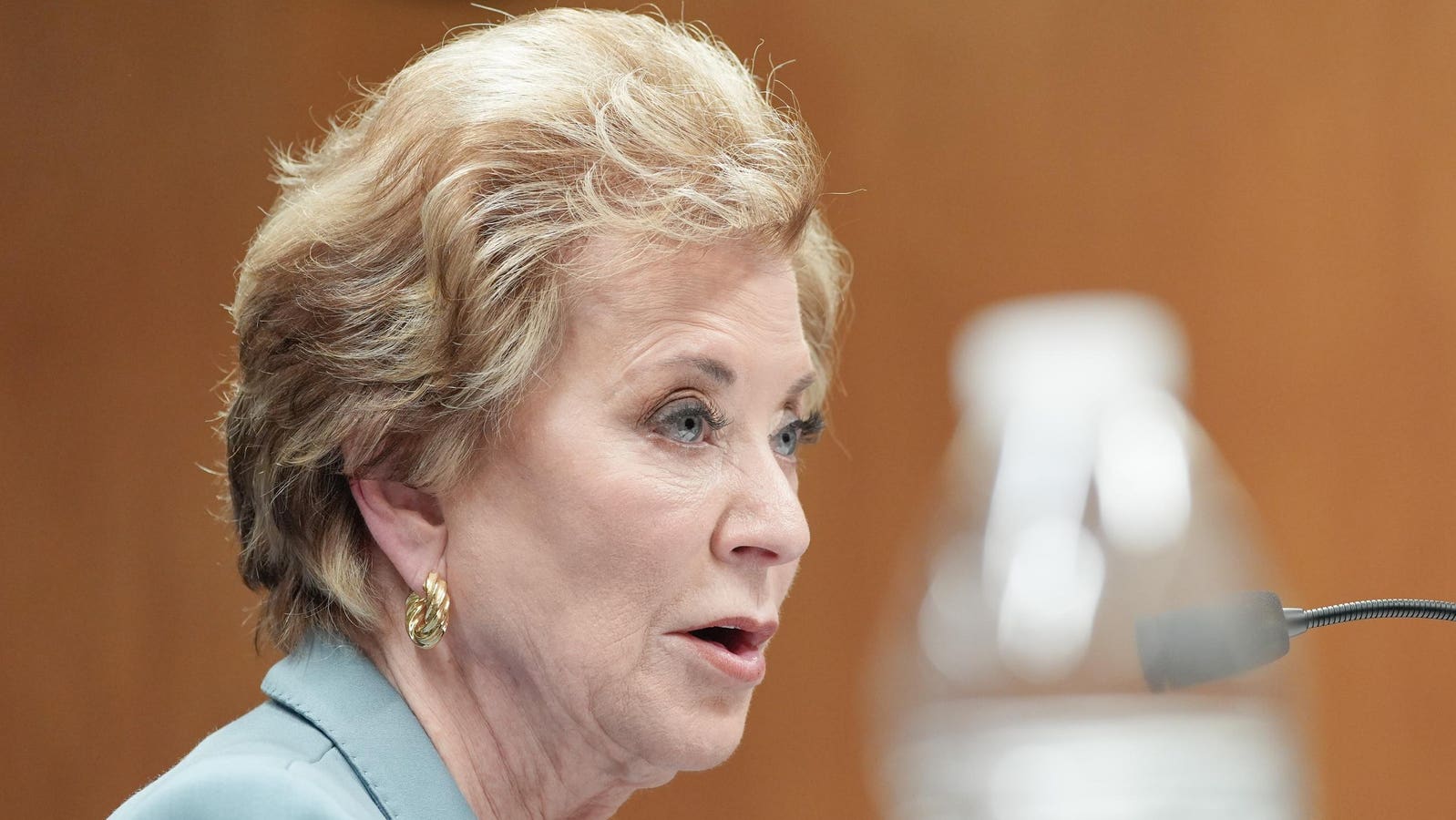
Education Secretary Linda McMahon testifies during a Senate Committee hearing on Capitol Hill, Tuesday, April 28, 2026, in Washington. McMahon and the Education Department are moving forward to transition student loans in SAVE to other repayment programs. (AP Photo/Mariam Zuhaib)
Copyright 2026 The Associated Press. All rights reserved.
The Education Department released new details last week on the timeframe for borrowers to move their student loans out of the SAVE plan and into other repayment programs. The information provides new insights for borrowers who are struggling to navigate a rapidly changing landscape for student loan repayment.
The updates, which the department included in a new court filing last Thursday as it faces a fresh legal challenge over the Trump administration’s efforts to kick student loan borrowers out of the SAVE plan, suggest that borrowers will have a bit more time than they may realize to transition their student loans to other payment plans. But many questions remain unanswered. Here’s the latest, and what borrowers should know.
Student Loans Expected To Be Transitioned Out Of SAVE Plan
The Education Department is preparing to initiate the process of moving borrowers with federal student loans enrolled in the SAVE plan, an income-driven plan created under the Biden administration, into other repayment programs starting in just a few days.
SAVE has been the subject of legal battles for more than two years, and millions of borrowers have been stuck in a forbearance since the summer of 2024 after a federal appeals court issued a nationwide injunction blocking the program. But the Trump administration and the GOP-led states that had challenged the SAVE plan reached a settlement agreement last December that ends the SAVE plan. That agreement was entered into court in March, paving the way for the department to terminate the program and start forcing borrowers to move their student loans to other repayment plans.
“On March 10, 2026, a federal court issued an order preventing the U.S. Department of Education (ED) from implementing the SAVE Plan,” said the department in online SAVE plan guidance updated shortly after the federal district court overseeing the SAVE plan litigation effectively endorsed the settlement agreement to end the plan. “With one exception, the most recent court action invalidated most of the July 2023 rule titled ‘Improving Income Driven Repayment for the William D. Ford Federal Direct Loan Program and the Federal Family Education Loan (FFEL) Program.’ This includes the following changes to the IDR plans: Calculating a monthly payment amount using the SAVE Plan or Revised Pay As You Earn (REPAYE) Plan formulas, applying discharges or interest subsidies under the SAVE Plan.”
“Importantly, the most recent court action requires that borrowers who have loans in forbearance because they enrolled in or applied for the SAVE Plan must select a new repayment plan and begin repaying their loans,” continued the department. “We strongly encourage you to act now so that you’re in the plan that best meets your repayment goals.”
Since then, the Education Department has indicated that starting on July 1, borrowers would receive notices from their student loan servicers giving them 90 days to select a different repayment plan. If they don’t do that, then the department has said it will force borrowers into a Standard repayment plan, which may result in much higher payments and lost progress toward eventual student loan forgiveness. The department has begun sending out mass emails to borrowers warning them of the upcoming 90-day notices that will go out in July and encouraging them to change plans as soon as possible.
Education Department Provides More Insight On Timeline For Moving Student Loans Out Of SAVE Plan
The Education Department is currently facing a lawsuit brought by student loan borrowers over its efforts to terminate the SAVE plan and force borrowers into other programs. The borrowers who brought the suit have argued that there was a window of time during the previous legal battle when SAVE was not blocked, and borrowers who were eligible should have received key benefits under the program at that time, including (if applicable) a discharge of their student loans. The lawsuit also argues that even if the phaseout of SAVE is ultimately proper, borrowers should instead be moved into the Revised Pay As You Earn (REPAYE) plan, which was SAVE’s predecessor plan. REPAYE is also supposed to be phased out (along with SAVE) under separate legislation passed by Congress last year, but the lawsuit argues that SAVE plan borrowers can and should be moved to REPAYE, at least for now.
The department disputes these arguments, and has maintained that both REPAYE and SAVE are essentially dead. In response to a motion for a preliminary injunction that seeks to prevent the department from moving student loans out of the SAVE plan while the current litigation continues, the department provided new information on the anticipated timeline for the transition.
According to the department, the 90-day notices will begin going out as soon as July 1, but these notices will be staggered, potentially over a prolonged period of time. That means that, depending on exactly when borrowers receive their 90-day notices, they may still have months before they need to move their student loans to other programs.
“No borrower will be required to move off the SAVE Plan until September 29, 2026 at the earliest,” said the department in its new filing last Thursday. September 29 is 90 days after July 1, which is the soonest that any SAVE plan notice will go out to borrowers. “And since Defendants are transitioning borrowers in tranches, most borrowers (potentially including one or even all four Plaintiffs) will get even more time than that.”
“We’ll say what they won’t: You have until September 29th at the earliest to choose a new repayment plan if you’re on SAVE,” said the Debt Collective, a debtor’s union advocating for student loan borrowers, in a statement on X on Friday. “And guess what — you’ll probably have more time than that. Don’t rush off of SAVE if you don’t have to. Keep the low payment as long as you can.”
Borrowers With Student Loans In SAVE Have Tough Choices Ahead
Student loan borrowers in the SAVE plan are in a tough spot. While no payments are due on their student loans, interest is accruing, which is increasing their loan balances. Furthermore, the time spent in the ongoing forbearance is not counting toward student loan forgiveness. Borrowers pursuing Public Service Loan Forgiveness, or PSLF, could eventually try to “buy back” the time, but the PSLF Buyback program is facing its own major problems, including significant backlogs. At the same time, payments under other income-driven plans may be much higher for some borrowers than they were under the SAVE plan, which was designed to be the most affordable option. That means borrowers who switch out of SAVE may have to budget for much higher monthly payments.
Student loan borrower advocacy groups are cautioning borrowers to think through what would be the best route for them, based on their individual circumstances.
“You do not have to wait to switch plans,” said the National Consumer Law Center in an article published in April. “It might make sense to switch plans now if you are able to afford payments in another plan, and you want to begin making progress toward paying off your loan or toward loan forgiveness through Public Service Loan Forgiveness (PSLF) or Income-Driven Repayment.” That could be the right move for some borrowers.
“On the other hand, it might make sense to wait until July 1 to switch plans if you want to enroll in RAP, which won’t be available until July 1, or you do not qualify for a $0 payment in another plan and cannot afford the payments you would owe in other plans,” continued NCLC. “Waiting until July 1 will give you more time before you need to make payments, but be aware that interest will continue to be charged while you wait.”
Ultimately, borrowers should understand that for now, SAVE is still very much on track to be completely phased out before the end of this year. And barring any new development in the latest legal battle over the Education Department’s actions, they should expect to have to transition their student loans to other repayment plans. Failure to act could be financially devastating for some borrowers. But the timing of the transition will ultimately come down to the borrower, their circumstances, their risk tolerance, and the specific timing of the department’s 90-day notices.
Read the full article here


