







China’s communist dictator Xi Jinping debuted yet another vague plan toward world peace on Wednesday during an official visit to Egypt, one that not-so-subtly suggested Middle Eastern states should consider limiting their ties to America.
Xi conducted a two-day visit to Cairo this week following a hectic diplomatic schedule that began by welcoming Jordanian King Abdullah II to Beijing in late August and also included at stop at the Shanghai Cooperation Organization (SCO) summit in Bishkek, Kyrgyzstan. There, Xi held meetings with some of his most important allies, such as Russian strongman Vladimir Putin and Iranian President Masoud Pezeshkian, though the optics of the latter meeting suggested that the Chinese government may rapidly be losing patience with Iran’s ongoing disruptions of global shipping in the Strait of Hormuz.
The visit to Egypt featured a lavish welcome from that nation’s government and a tour of the recently opened Grand Museum, home to some of the world’s oldest civilizational artifacts.
WATCH:


Xi’s extensive personal investment this month in Middle East diplomacy follows years of his regime attempting to elevate China’s political status in the region. Xi has repeatedly issued vague “peace proposals” and sought closer ties to Iran and its terrorist proxies, such as Hamas and Hezbollah. The Chinese government has also attempted to make inroads with leaders in countries such as Iraq and Syria. These efforts have yielded little success for Beijing, however, as its most prominent diplomatic achievement in the region, the 2023 normalization of ties between Iran and Saudi Arabia, has all but cratered following Iran’s repeated bombings of Saudi territory in response to American military action in Iran.
Losing influence with Iran and Saudi Arabia, Xi has turned to Egypt. There, the Chinese president emphasized the economic need for stability in the Middle East, suggesting that Egypt should assume a leadership role in diplomacy and resolving longstanding conflicts. He also introduced what Chinese state media called a “four-point proposal” to build a “new security architecture” in the Middle East.
Reports on Xi’s proposal did not mention the United States or American influence in the region but repeatedly emphasized the need for blocking “external interference.” The Chinese Communist Party has not publicly complained about, for example, Russia’s decades-long support for the defunct Assad dynasty in Syria, or Iran’s investments in the Houthi terrorist organization of Yemen. The Chinese government officially supports the establishment of a “Palestinian” state and opposes Israeli interests, leaving clear that the target of this opposition to outside influences is Israel’s top ally, America.
WATCH — Mike Waltz: We Have to Rely on Domestic Manufacturing for Our Defense:

“People in the Middle East should remain masters of their own affairs, and external interference should be rejected, Xi said,” according to the Chinese state-run Xinhua News Agency, “noting that China supports regional countries in strengthening dialogue on peace and security, exploring the building of a new security architecture for the Middle East, and taking their future into their own hands.”
“The international community, especially external powers, should abandon double standards in the Middle East, respect the sovereignty and territorial integrity of regional countries, and safeguard regional peace and stability,” he reportedly demanded.
Instead of receiving support from outside powers and relying on their national interests, Xi reportedly said that “the foundation for common security should be strengthened through development,” a thinly veiled proposal to welcome more Chinese investment in infrastructure. China has signed agreements with most Middle Eastern countries through its Belt and Road Initiative (BRI), a global infrastructure scam in which China offered predatory loans to poorer countries to be used to pay Chinese companies to build overpriced projects.
“China stands ready to work with Middle East countries to safeguard the security of international shipping lanes, advance development cooperation, promote the convergence of interests of regional countries, gradually enhance mutual trust, and eliminate the root causes of the conflict,” Xi claimed.
WATCH — Sen. Banks: Trump’s Donroe Doctrine Told China “You’re Not Welcome in Our Backyard”:
In reality, by claiming China would help “safeguard the security of international shipping lanes,” Beijing has neither successfully used its friendship with Iran to stop it from interrupting commercial shipping in the Strait of Hormuz nor offered People’s Liberation Army (PLA) assets to help protect civilian ships. While the Chinese government has repeatedly, and publicly, urged Iran to stop disrupting traffic, Iran’s relationship with China has suffered no known consequences for jeopardizing the country’s commerce in the region.
Egyptian strongman Abdel Fattah al-Sisi reportedly thanked Xi for his visit and signed a variety of trade agreements with China, including some associated with the BRI. Xinhua reported that Sisi hoped to “deepen cooperation in trade and investment, manufacturing, infrastructure development, finance, science and technology, and new energy.”
Sisi also suggested the countries should “strengthen military and security exchanges, and promote closer people-to-people exchanges.”
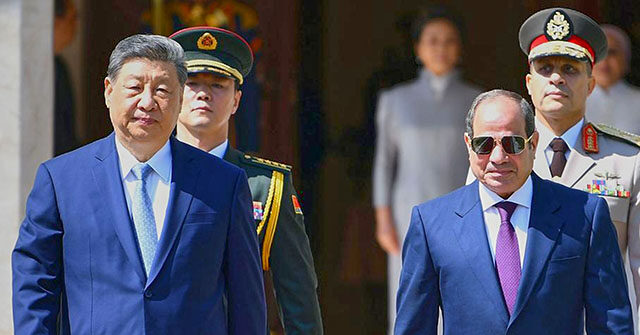
In this photo provided by Egypt’s presidency media office, Egyptian President Abdel-Fattah el-Sisi, right, walks with his Chinese counterpart Xi Jinping, at the Al-Ittihadiya Presidential palace in Cairo, Egypt, Wednesday, Sept. 2, 2026. (Egyptian Presidency Media Office via AP)
China’s state-run Global Times propaganda newspaper declared on Thursday that the objective of Xi’s vague “proposal” was to send “a clear message that Middle Eastern countries should pursue greater strategic autonomy in security affairs rather than rely excessively on external powers.” It, like Xinhua, omitted exactly which “external powers” were irritating Xi, citing a regime-approved “expert” who went slightly further, lamenting that Middle Eastern countries had “spent heavily on Western weapons.”
Hong Kong’s South China Morning Post, citing its own experts, described the Xi “proposal” as explicitly anti-American.
“Chinese President Xi Jinping has urged Middle Eastern nations to build a self-led security model, nudging them to cut reliance on Washington following further US-Iran military clashes,” it reported. The Morning Post also suggested that Xi did not explicitly advertise China as an alternative, only pressuring Middle Eastern states to distance themselves from America.
“This can be read as an implicit, if thinly veiled, reminder of the limits of the US role as the region’s security guarantor, an affirmation of emerging localised arrangements such as the Mecca Defence Pact, and an alignment with Iran’s long-standing call for external security powers to reduce their presence in the region,” John Calabrese, a non-resident senior fellow at the Washington-based Middle East Institute, told the Morning Post.
Xi reportedly returned to Beijing on Thursday following his stay in Egypt. His next international travel will reportedly take place in late September, when he is expected in the United States to meet President Donald Trump.
Follow Frances Martel on Facebook and Twitter.
Read the full article here


