








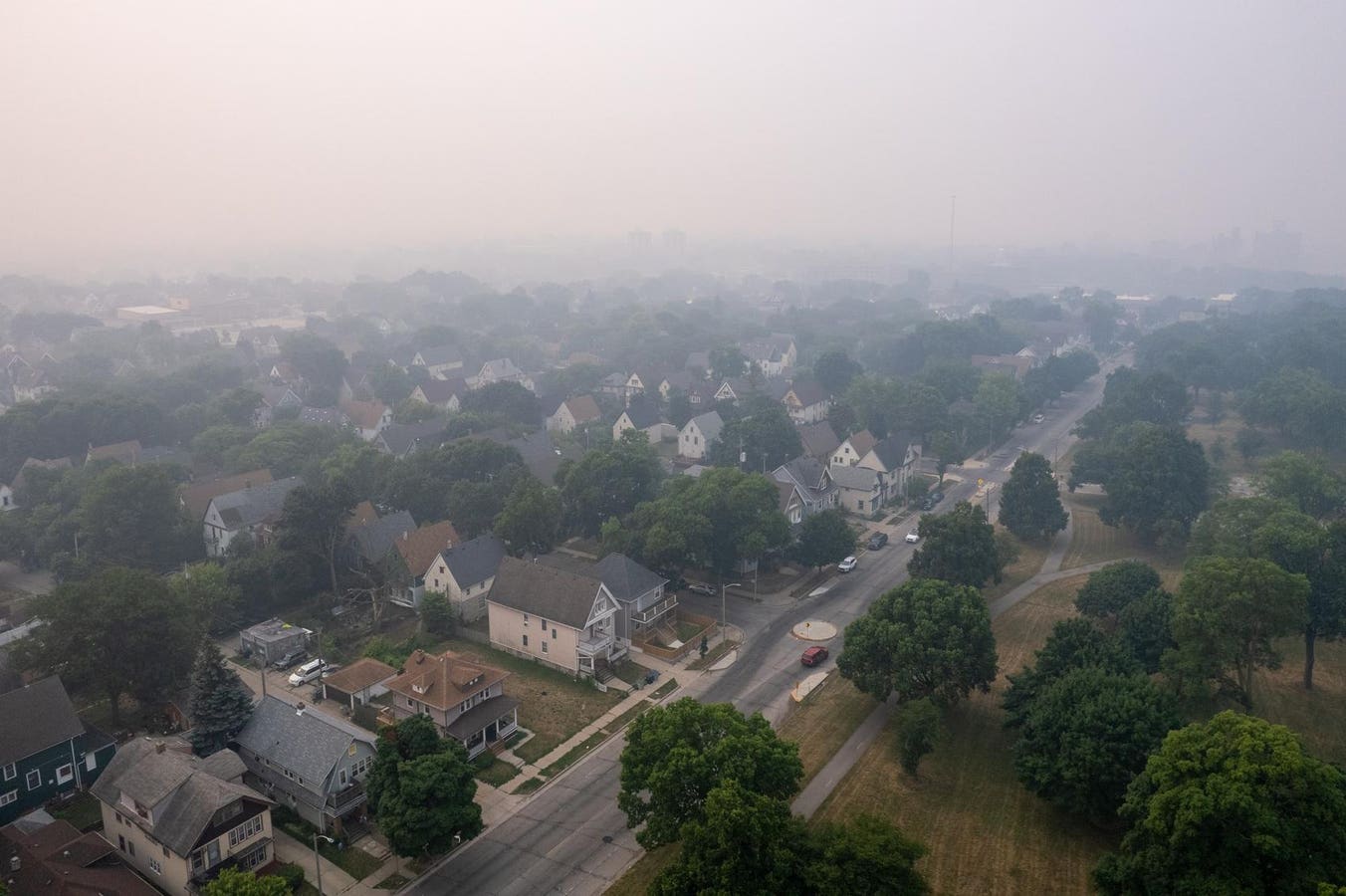
MILWAUKEE, WISCONSIN – JULY 16: Smoke from wildfires in Canada blanketed Milwaukee, Wisconsin, on July 16, 2026. (Photo by Jonathan Aguilar/Milwaukee Neighborhood News Service/CatchLight via Getty Images)
Jonathan Aguilar/Milwaukee Neighborhood News Service/CatchLight via Getty Images
Right now, fires burning in Ontario, Canada, are sending toxic wildfire smoke into the American Midwest and Northeast. Throughout the region, residents are being told to shelter in place, close their windows, turn on air-conditioning and stay inside to avoid breathing the dangerous air outside. This experience will change the way people think about their homes.
Here in Wisconsin, I am currently following the instructions to shelter in place, and it’s giving me flashbacks to the pandemic, when we were all told to stay home and wear masks. That confinement to our homes changed our preferences for housing. The same thing is likely happening right now, although on a much smaller scale.
Air Pollution Is Getting Worse Because of Wildfire Smoke
Air pollution is expected to worsen across the nation as climate change, combined with historically negligent forest management, increases the prevalence of fires and the frequency of smoke events. The current smoke event is concentrated in the Midwest and Northeast, but it is actually the American West that has the highest share of homes at high risk of poor air quality in the coming decades.
The United States is not unique in its problems with air pollution. Dangerous air quality has affected populations in China, India and all around the world for decades. I visited Beijing for a professional trip 10 years ago, when industrial smoke made the air dangerous to breathe. That was my first experience with truly hazardous air pollution. I adopted the practices of the locals: They wore masks outside and had air filtration systems in their offices, hotels and shopping complexes. It was a difficult way to live, but locals adapted because they had no choice.
Research Shows Bad Air Drives Down Home Prices
Air pollution in China from 2009 to 2018 had a downward impact on home prices, according to research published in the International Journal of Environmental Research and Public Health. For every 1% increase in PM 2.5, there was a 0.55% decrease in home prices. The researchers also found that the effects of air pollution on home prices were less acute in neighborhoods where residents were more highly educated and better able to adapt.
A recent survey from Rocket Mortgage found that 34% of prospective home buyers are prioritizing homes with high-end water and air filtration systems; that feature ranked second out of 22 priorities. These clean-home features outranked luxury amenities like pools and home theaters.
When air quality worsens, people can react in a few different ways to limit their exposure. They can invest in air filtration systems for the home they currently live in, or move to an area with less air pollution, or into homes in their area already equipped with air filtration systems. This shift in preferences can impact home prices, as evidenced by how home values changed in Beijing during its air pollution crisis.
You Can’t Outrun The Smoke
After visiting Beijing in the fall of 2016, I experienced a smoke event back home in Seattle. A heatwave in the Pacific Northwest sparked fires in British Columbia and Eastern Washington, sending a layer of smoke into Seattle, with ash falling from the sky. I thought it was a freak event: a weather anomaly. But it happened again in 2018. And in summer 2020, at the height of the pandemic, more fires sent smoke toward Seattle, and my family and I decided we had enough. We packed up the van and drove to Wisconsin, to my husband’s hometown in Williams Bay. We’ve been living here ever since. And although Seattle has had more severe smoke events than Williams Bay, the risk of wildfire smoke is increasing everywhere. So instead of running from this week’s smoke, we are staying in our home, equipped with air filters, trying to find ways to entertain ourselves while stuck inside.
Sheltering In Place Changes What People Want
Being stuck inside changes the way people value their homes. As we saw during the pandemic, sheltering in place changed the type of home people wanted. According to Redfin real estate agents, home buyers wanted more space for entertainment, more space for work and more space in general. Over the next decade, home buyers living in places with the highest risk of poor air quality will increasingly desire larger homes that make sheltering in place a bit easier for themselves and their families. But, unlike during the pandemic, home buyers will care less about outdoor space and focus more on indoor space where the air quality is controllable.
Climate change will reshape the housing market in ways we’re only beginning to understand. Air filtration systems may become a requirement instead of an added amenity in apartments. Larger homes with flexible indoor spaces will likely command premiums in regions prone to wildfire smoke. And the gap between those who can afford to adapt their homes or leave for cleaner air—and those who cannot—will widen. I moved from Seattle to Wisconsin, thinking I was outrunning the smoke. Now I’m sheltering in place here, too. The smoke will keep coming. We have to adapt. We have to make sure those who can’t afford to adapt on their own are given the resources, such as safety education and air filtration systems, to do so as well.
Read the full article here


