


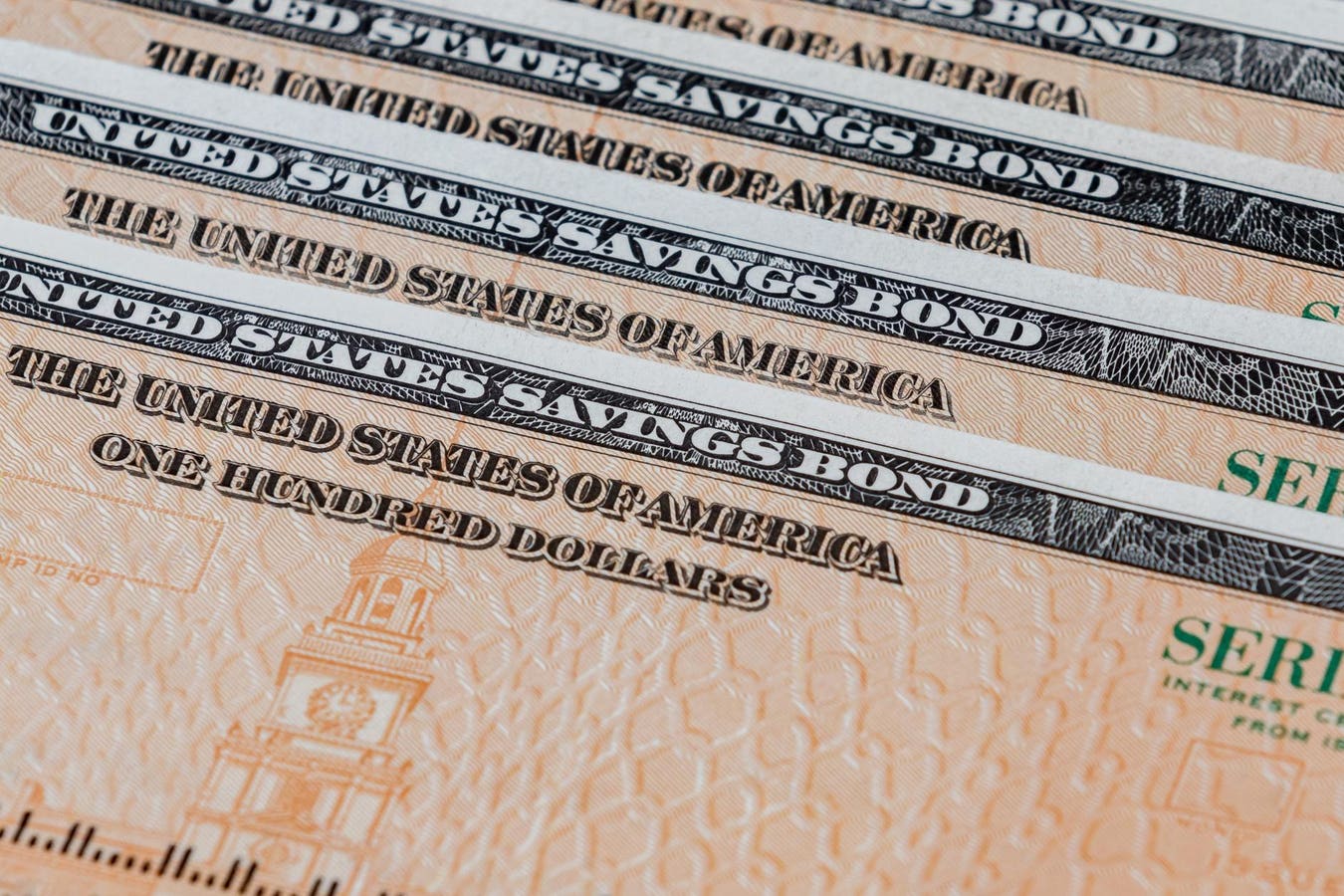
United States of America government savings bond series EE
getty
Treasury yields are climbing again, and this time the move is tied as much to geopolitics as economics. A new energy shock, rising inflation expectations and fading hopes for Middle East de‑escalation are pushing the bond market to reprice risk across the board — from mortgages to corporate borrowing to consumer credit.
If you don’t follow financial markets closely, it can be difficult to grasp how central Treasury securities — the mechanisms through which the federal government borrows money — are to the country and the world. And with yields rising for reasons that stretch far beyond routine economic data, understanding how these bonds work is the first step in making sense of what is happening now.
Setting The Context
On the foundational level, as the Federal Reserve Bank of St. Louis explains, there are three major types of bonds: bills, notes and bonds. Let’s call them all bonds.
Bonds have a price, an interest rate and a term. The government issues them, and investors buy the bonds for a set price. In return, investors receive set interest payments for the term of the bond.
Investors may not want to hold a bond for the entire term. They can sell them to other investors through secondary markets. Investors compare the bonds to newly issued ones by calculating the bond yield, while involves dividing the annual coupon (interest) payment by the original price.
As the St. Louis Fed explains, if the issuance of a $1,000 bond paid $50 annually, the yield was 5%. Later, the government issues another round of $1,000 bonds that offer 4.5% interest. The earlier bonds are now worth more because they pay higher interest.
Those holding the older bonds will want more money for them because of the higher interest and ultimate value. At the same time, buyers don’t want to pay too much for the older bonds because they could always buy the newest bonds. On secondary markets, prices and yields move inversely. When prices fall for any reason, yields go up. When prices rise, yields go down. The mechanism keeps markets working smoothly.
Why The 10‑Year Matters Right Now
Currently, yields on the 10-year Treasury have risen significantly.
The 10-year Treasury has particular importance. Lenders build interest rates for longer-term loans like consumer mortgages on two parts: a risk-free foundation — a safe place where investors could have put their money — and a risk premium a lender adds to justify lending money to a person or institution. For many forms of lending, the 10-year Treasury serves as the risk-free rate.
Treasury bonds more broadly also act as safe havens in times of uncertainty or trouble, a stability that is also the reason why the yields serve as the risk-free rate.
The 10-year yield has seen significant changes. The figures you see are calculated at constant maturity, a way of reconciling bonds across different maturities and rates. The following graphs from the St. Louis Fed differ only in the period they cover. Here’s a 60-year view:
10-year Treasury yield over 60 years
Federal Reserve Bank of St. Louis
And here is the 5-year view.
10-year Treasury yield over five years.
Federal Reserve Bank of St. Louis
Current 10-year yields have climbed but remain far from historical highs and closer to past norms.
Why These Moves Matter
Market conditions and implications are relative.
HSBC analysts called recent levels a “danger zone,” as CNBC reported, “the level of 10Y UST that tends to put pressure on virtually all asset classes.”
“It’s important to define ‘right now,’” says Andrew Clinton, chief executive officer and chief investment officer of Clinton Investment Management. “It seems to us the market has responded to a lack of any meaningful resolution in the Middle East coming out of the meetings in China. I think folks were hoping for some cooperation, and they didn’t get what they wanted to hear. I would argue that’s the reaction in risk [equity] markets today as well as the Treasury markets.”
The ongoing shuffle of administration promises of a deal with Iran and the latter dashing expectations hasn’t helped.
“If you go back and look at the [3.97%] low in yields in February, the reality was because the labor market was and is weak, and the trajectory of inflation to that point was considerably downward. We thought that was a reasonable reaction.” Now add the energy spikes from the Iran war. “The market is interpreting that in our view as an impulse that will cause inflation to rise into perpetuity. The immediate reaction in the bond market is moving from an easing environment to a 40% chance of tightening.”
“This is a geopolitical energy shock doing what monetary policy could not finish — forcing a reckoning with inflation that the Fed was already struggling to extinguish,” says Giacomo Santangelo, a senior lecturer in the Department of Economics at Fordham University. “The war’s closure of the Strait of Hormuz has transmitted directly into energy prices, headline CPI, and Treasury yields across the curve.”
“As for consumers’ financial well-being … consumption is compressed, and the aggregate data is not really showing it,” Santangelo adds. “Energy costs are consuming the discretionary margin that post-COVID went to experiences … and non-essential spending. Consumers are currently bridging the gap through debt accumulation rather than demand ‘destruction,’ certainly not the foundation of resilience. That bridge has a ceiling, and it is approaching faster than headline consumption figures are suggesting.”
Read the full article here