






The middle-aged Pennsylvania couple had lived together for more than a decade, buying a home together and sharing other assets. They never got married. It didn’t matter, they thought. But after he died of cancer recently, leaving her his entire estate, it did matter. A lot. Pennsylvania is one of a handful of states that still imposes an inheritance tax–a tax on transfers from a person who has died to the people who inherit, with rates based on the category of recipient. Transfers to spouses, but not to unmarried partners, are exempt. Pennsylvania subjected everything she was left to inheritance tax at the state’s top 15% rate. The woman, who asked not to be identified, was shocked.
Americans spend a lot of time thinking about where to live for tax purposes. States like Florida and Texas lure both billionaires and ordinary workers by touting their lack of a state income tax. Other states lure seniors with generous exemptions for retirement income. But another question gets less attention: Where is the most expensive place in the U.S. to die?
With the federal estate exemption for 2026 set at a generous $15 million per person ($30 million for a married couple), little more than one in a thousand estates is hit with the federal levy. In contrast, states’ estate and inheritance taxes, as well mandatory estate administration costs, can hit families with more modest wealth surprisingly hard. And since each state tax operates under its own often arcane rules, those costs can come as an unpleasant surprise. But with some advance knowledge and planning, they often can be minimized.
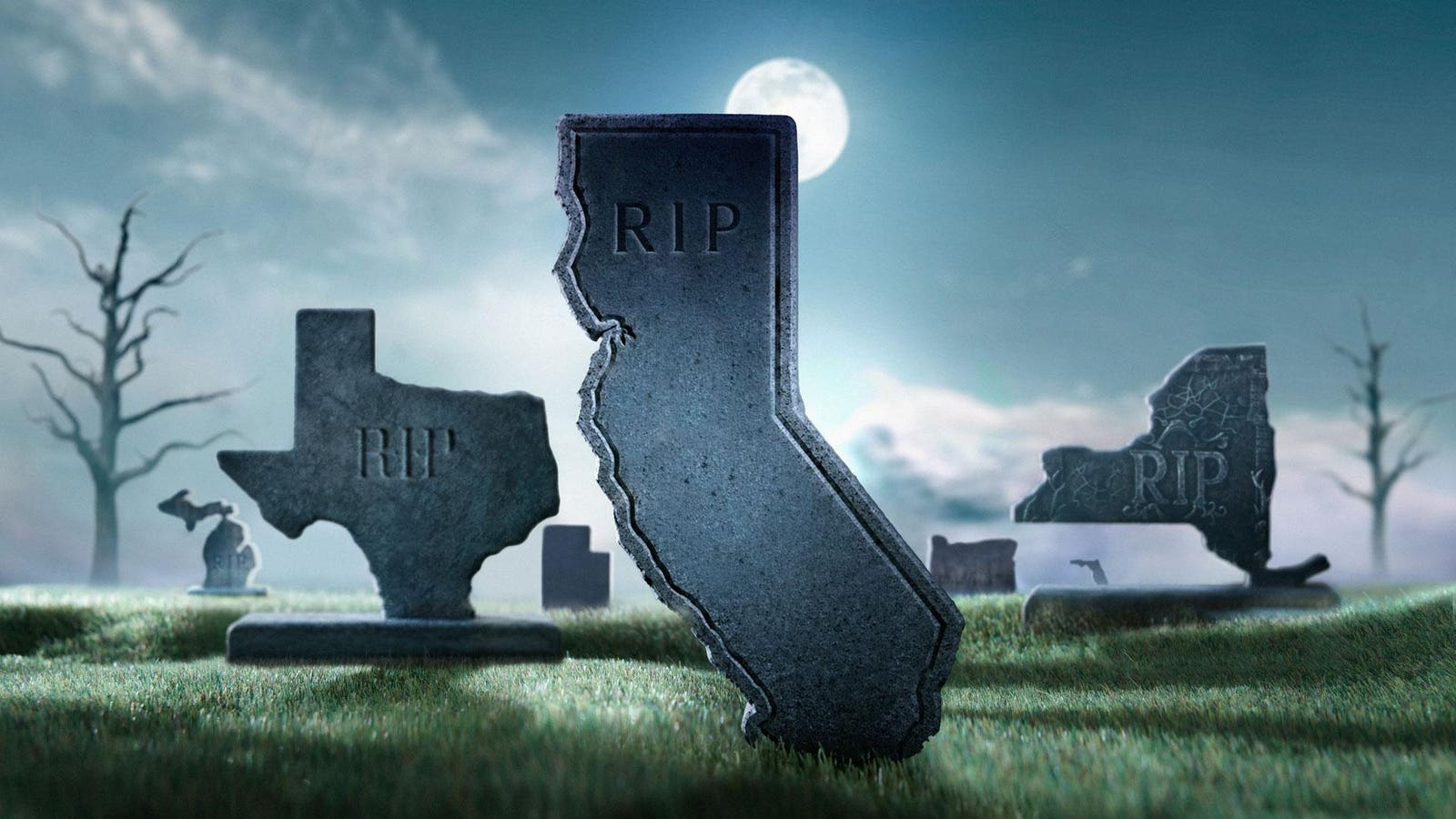
As the map shows, 15 states and Washington, D.C have either inheritance or estate taxes. Maryland has both. Meanwhile, another five states, including death-tax-free California and Florida, impose stiff fees to probate (that is, get court approval for) an estate and/or require a family to pay attorneys. Below the map, we explain what you need to know about how state death taxes work and how you can reduce them, including by making gifts well before your death.
Estate Tax vs. Inheritance Tax
State death taxes come in two varieties. An estate tax is imposed on the estate itself before assets are distributed. In other words, the state taxes the estate on everything left (above an exemption amount) to anyone other than a legal spouse or charity. The rate usually rises with the size of the estate.
An inheritance tax is technically imposed on the beneficiary (though a will might provide that it is to be paid by the estate), with the tax rate depending on who receives the money. As with the estate tax, what’s left to a spouse or charity usually isn’t taxed. But bequests to a child, sibling, cousin, friend, or unmarried partner can receive very different tax treatment, even if those parties inherit the same amount of money.
The Estate Tax 13
In 2026, the District of Columbia and 12 states–Connecticut, Hawaii, Illinois, Maine, Maryland, Massachusetts, Minnesota, New York, Oregon, Rhode Island, Vermont, and Washington–impose an estate tax. State exemptions from tax vary widely. Connecticut has tied its to the federal exemption and so it sits at a hefty $15 million per person for 2026. But all the others are far below the federal exemption. Oregon’s tax kicks in at $1 million and Massachusetts’ at $2 million. Washington state’s exemption sits at $3.076 million, but is being rolled back to $3 million effective July 1, 2026, with a new top marginal rate of 20%, down from 35%. Illinois’ exemption is $4 million, while Maryland’s and Vermont’s are $5 million.
New York has an exemption gotcha, often referred to as a “cliff.” Estates under the exemption ($7,350,000 for 2026) pay no tax. But if the estate’s value exceeds 105% of the exemption, the state taxes the entire estate from the first dollar. That means being just a little too wealthy can be very expensive in the Empire State.
Bottom line: A family might be nowhere near being subject to federal estate tax and still be subject to a state estate tax. Remember, the value of an estate for tax purposes includes all assets of the decedent, even those (such as a retirement account), that might pass outside the terms of a will.
The Inheritance Tax Five
Only five states currently impose inheritance taxes: Kentucky, Maryland, Nebraska, New Jersey, and Pennsylvania. Iowa long had an inheritance tax too, but eliminated it for deaths on or after January 1, 2025.
Pennsylvania is probably the most surprising to ordinary families. There is no broad dollar exemption for taxable beneficiaries. Spouses are exempt, as are minor children and the parents of a minor who dies. But adult children and other lineal heirs (meaning those in the direct family line, including grandchildren, parents and grandparents) pay 4.5%, siblings pay 12%, and other beneficiaries 15%.
New Jersey exempts spouses and lineal relatives (in this case that includes children, grandchildren, great-grandchildren, step-children, parents, and grandparents). But siblings, sons-in-law, and daughters-in-law only receive a $25,000 exemption and face rates of 11% to 16%. For nieces, nephews, cousins, friends, unmarried partners, and unrelated individuals, the exemption is only $500 before the tax kicks in.
In Kentucky, close relatives—spouse, parent, child, grandchild, siblings—are exempt. Other beneficiaries, including nieces, nephews, sons-in-law, and daughters-in-law, are taxed after a $1,000 exemption at rates of 4% to 16%, while more distant relatives and unrelated individuals face rates of up to 16% after only a $500 exemption.
Nebraska taxes by class: Close relatives pay 1% after a $100,000 exemption; aunts, uncles, nieces, and nephews pay 11% after a $40,000 exemption; and unrelated beneficiaries pay 15% after a $25,000 exemption. (Nebraska’s tax might be on the way out; backers of a voter referendum to repeal it are now gathering signatures to place it on the November 2026 ballot.)
The Death Tax Unicorn: Maryland
Maryland is the only state with both an estate tax and an inheritance tax, and the same dollars can effectively be exposed to both. If a Maryland resident dies with a taxable estate exceeding the $5 million exemption, the estate itself may owe Maryland estate tax. Then, after assets are distributed, certain beneficiaries may also owe Maryland inheritance tax at a rate of 10%. Spouses, children, grandchildren, parents, siblings, and sons- and daughters-in-law are exempt from the Maryland inheritance tax, but other relatives and unrelated heirs get hit.
The “double tax” problem usually arises when larger estates leave assets to nieces/nephews, cousins, friends, unmarried partners, or unrelated beneficiaries. For example, a $7 million estate left primarily to a longtime unmarried partner could face Maryland estate tax on the excess over $5 million, and then a 10% inheritance tax on what the unmarried partner receives. One small break: Maryland does allow inheritance tax owed to be deducted from the estate’s value before the estate tax is calculated. Clear, huh?
Mandated Fees: The Hidden Estate Levies
Even if there is no estate tax and no inheritance tax, the government can still make dying expensive.
When you pass away, how your assets are distributed is determined by your will or state law. The legal process of accounting for and distributing estate assets is referred to as probate. (Certain assets like retirement accounts pass outside of probate, if they have individual named beneficiaries.)
Most states make the probate process relatively manageable. Others, including death-tax free Florida and California, turn it into a fee-generating machine for the courts or local attorneys. Florida stands out not only because formal probate administration generally requires attorney involvement, but also because state law actually establishes “presumptively reasonable” probate attorney fees tied (much like a tax would be) to an estate’s value. So it turns out that “move to Florida” is not a complete estate plan, no matter what your uncle who has retired to The Villages (a booming senior citizen haven 50 miles northwest of Orlando and one of Forbes’ Best Places To Retire In 2026) says at Thanksgiving.
California, for its part, has a hefty statutory probate fee schedule based on the gross value of the probate estate: 4% of the first $100,000, 3% of the next $100,000, 2% of the next $800,000, 1% of the next $9 million, and 0.5% of the next $15 million. A $5 million estate would face a $63,000 probate fee. And that is before additional extraordinary fees. The worst part? The fee is based on gross value, not net equity. A heavily mortgaged house or debt-heavy business can still produce a large statutory fee.
While California does not technically require an attorney in every probate matter, as Florida generally does, usually a lawyer does need to get involved and California has written a hefty lawyer’s fee schedule directly into the probate code. (In fact, both the attorney and executor may each receive statutory compensation.)
Arkansas, Missouri, and Wyoming also have statutory probate compensation schedules or frameworks that can tie fees to estate value.
If they plan in advance, families in states like California are able to cut probate fees with various strategies, such as moving assets into revocable living trusts, which keeps them out of the probated part of the estate.
But outside the handful of unusually expensive or attorney-driven systems we’ve cited, probate can be routine and probate costs reasonable, especially with a valid will, cooperative heirs, and straightforward assets. So while planning is always wise, you don’t need to spend enormous amounts of time and money trying to avoid probate at all costs. Be wary of one-size-fits-all advice insisting everyone, in every state, must put everything into a revocable trust. Poorly coordinated retitling of assets can create administrative headaches, refinancing issues, and potential problems with homestead, property tax, or other state-specific benefits. A revocable trust can be useful, but whether it makes sense depends on the state, the assets, and the family’s goals.
The Moving and Gifting Solutions
One obvious way to avoid a state death tax is to move–that is, change your domicile. But the move has to be real. Aggressive states (for example, New York) may look at voting records, driver’s licenses, and how much time the person actually spent in each state, particularly if substantial dollars are at stake.
Don’t want to move? Then making gifts during your lifetime, if done correctly, is the easiest way to reduce your exposure to state estate and inheritance taxes.
First, a little background. The federal gift tax and federal estate tax are part of a single unified system. The idea is simple: Taxpayers are not supposed to avoid the estate tax merely by giving assets away right before death. As a result, taxable lifetime gifts and transfers at death are tied to the same $15 million exemption for 2026 (it will be adjusted for inflation).
But the federal system also allows an annual gift exclusion that doesn’t count against the $15 million: In 2016, you can give away $19,000 to as many people as you like. A couple can give $38,000 per person. If you go over the exclusion amount, you can avoid gift tax by chipping away at your lifetime exemption. So, if you used up $5 million of your lifetime exemption on taxable gifts, only $10 million of your exemption would remain. Realistically, this means that most people never actually pay federal gift tax.
Here’s the key: Most states, including those with their own estate and inheritance taxes, don’t have gift taxes. (Connecticut is the exception. It is the only state with a stand-alone gift tax, which is tied to the federal exclusion amount.)
While they don’t have gift taxes, per se, a few states do tax “deathbed gifts.” Pennsylvania, for example, generally pulls gifts made within one year of death back into the estate for inheritance tax purposes. And Minnesota, for the purposes of its estate tax, has a similar three-year clawback rule for certain taxable gifts. These rules are designed to prevent last-minute transfers from defeating state death taxes.
When you make a gift for tax purposes, it typically must be what’s considered a “completed gift,” where you have truly given the asset away. That means that you have given up control over the property and no longer have the power to take it back, change who benefits from it, or decide how it will be used. Transferring property to a properly structured irrevocable trust is a completed gift, but moving assets into a revocable trust isn’t a completed gift and doesn’t get them out of your taxable estate.
Some Words of Caution
Nobody likes paying taxes. But always consider the whole picture. Trying to minimize state estate or inheritance tax by, for example, artificially depressing asset values—like using the lower end of a real estate appraisal on an estate or inheritance tax return—can backfire when it comes to capital gains taxes. Inherited assets generally receive a step-up in basis to fair market value at death. Undervaluing appreciated assets to save a relatively modest inheritance tax can leave heirs with a much lower basis and a bigger capital gain tax bill when the asset is eventually sold.
The federal long-term capital gains rate currently reaches 20%, plus the 3.8% net investment income tax for higher-income taxpayers, before any state capital gains tax is added. In states like Pennsylvania, where transfers to a surviving spouse are exempt, and transfers to children are taxed at just 4.5%, paying a small inheritance tax upfront produces a far better long-term tax result,
Bottom line: The federal estate tax is not one most families need to be concerned about. In 2026, with a $15 million exemption and only a tiny fraction of estates paying, it remains mostly a very high-net-worth and ultra-high-net-worth problem. The state picture, however, can be more complicated and hit many more families.
Benjamin Franklin famously wrote that nothing is certain except death and taxes. In 2026, where you die may determine just how much those two certainties collide.
More from Forbes
Read the full article here


