







President Donald Trump is not making it easy for Republicans in Florida to keep their firewall.
The same forces undercutting the GOP in other states — including Trump’s war in Iran and ensuing high gas prices, Hispanic voters turned off by his immigration surges and stubborn concerns over affordability — are hitting Floridians.
Now, some polling has shown statewide races inside the margin of error, including for governor and U.S. Senate. Democratic congressional seats seen as flippable after mid-decade redistricting are a question mark while some Republicans have distanced themselves from an increasingly unpopular president.
Democratic wins in Florida would send tremors through the political ecosystem. It could not only help increase Democrats’ margins if they win back the House, but would also have a dramatic impact on the 2028 presidential race if Democrats win the governor’s race, given Florida has 30 electoral college votes up for grabs. Both Gov. Ron DeSantis and Trump won landslide victories in 2022 and 2024.
Few top Republicans are publicly panicking about losing statewide seats, especially since Democrats have much less money and a history of electoral missteps. But POLITICO heard emerging concerns in interviews with nearly two dozen GOP politicians, operatives and consultants — many of whom acknowledged Republicans shouldn’t take a win in the Sunshine State for granted.
“It’s definitely 2018 vibes out there,” said Carlos Curbelo, a former Florida GOP House member who lost his reelection during Democrats’ 2018 blue wave during Trump’s first presidency. “A lot of former colleagues are bracing for the worst.”
“I still bet on Republicans holding the governor’s mansion,” he continued, “but it’s going to be more competitive than people could have anticipated just a few months ago.”
Added GOP state Sen. Don Gaetz: “Anybody who is on the ballot ought to be concerned if they have a Democratic opponent.” Gaetz, father of former Rep. Matt Gaetz, hails from northwest Florida, which has been called “victory lane” for Republicans in the state.
The fundamentals in Florida unquestionably favor Republicans. The Republican candidate for governor, Rep. Byron Donalds, has raised nearly $121 million, which is more than 10 times the amount of his Democratic opponent, former Rep. David Jolly. Republicans have a 1.55 million voter registration advantage over Democrats. National groups aren’t rushing in to help.
Republicans also see themselves as having an ideological advantage since the Democratic Senate nominee, state Rep. Angie Nixon of Jacksonville, is an insurgent progressive candidate who joined the Democratic Socialists of America in June. They confidently predict her positions will repel influential voters in South Florida whose families fled left-wing dictatorships in Cuba, Venezuela and Nicaragua.
But there are shifts in Democrats’ favor. A New York Times analysis found Hispanic voters are moving to the left, an erosion of Trump’s winning 2024 coalition. A Fox News poll published findings this week that show several Florida House races moving from “Likely R” to “Lean R” or even “Lean R” to “Toss-up.” Decision Desk HQ, an independent elections forecasting organization, rates the governor’s race as a “toss up.”
“I don’t think we are dead yet,” said one GOP county chair in Florida, granted anonymity to speak candidly as the party both nationally and in state has dismissed any possible concerns about the state of play. “We are not on life support. But we are hemorrhaging. The question is: Do we stop the bleeding now, or wait until we reach critical conditions?”
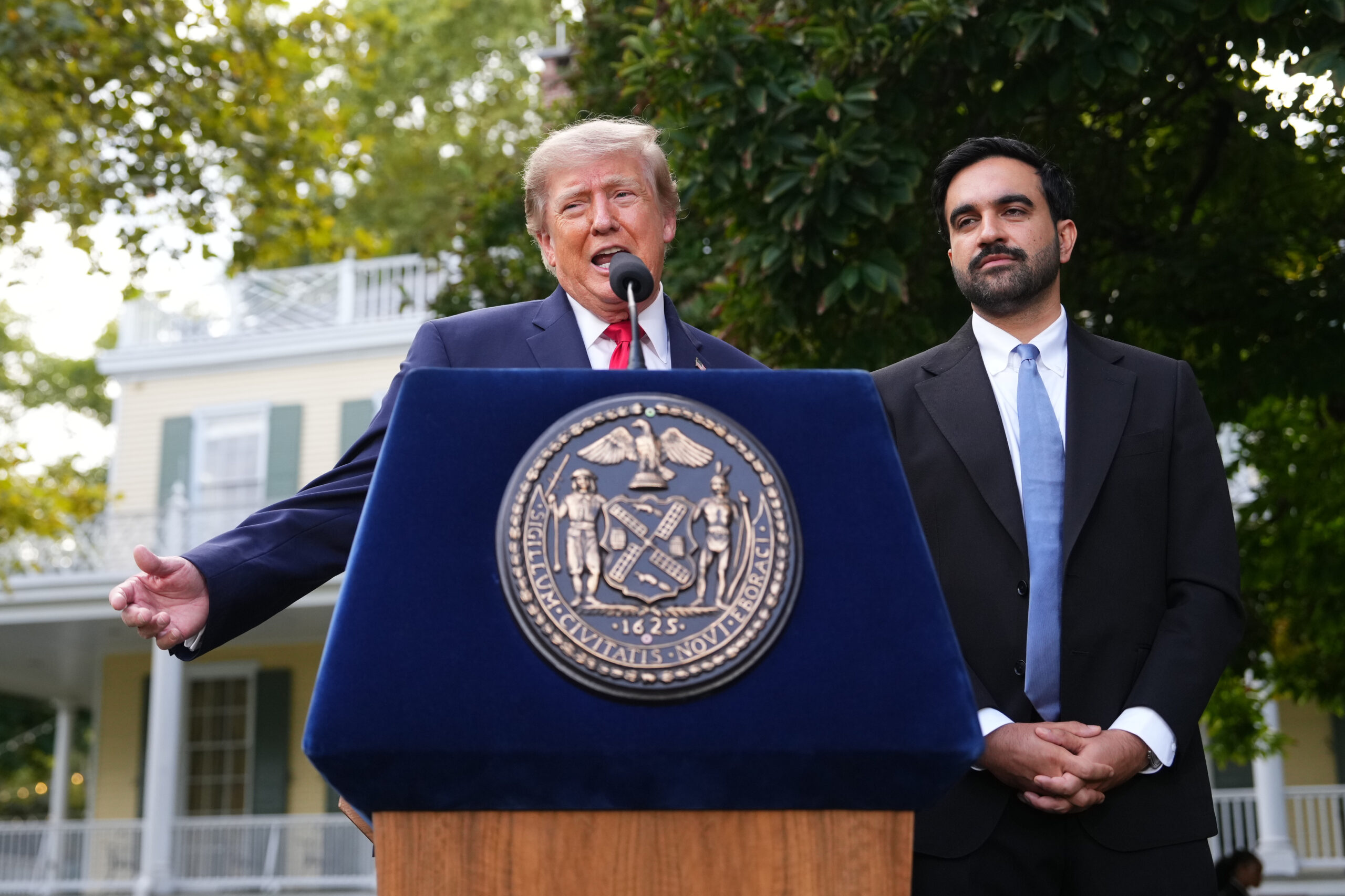
Several factors appear to be undercutting the GOP advantage, including the effects of Trump’s mass deportations. Rep. María Elvira Salazar, a Miami Republican and daughter of Cuban exiles in a competitive reelection contest, launched a TV ad last week complaining they’d “gone too far.” And as Cubans and Venezuelans await changes to their home countries’ regimes, Trump has been photographed this week smiling next to Democratic socialist New York Mayor Zohran Mamdani and meeting with interim Venezuelan leader Delcy Rodríguez.
Tony Figueroa, president of Miami Young Republicans, which operates separately from the Republican Party of Florida, said he didn’t think populous Miami-Dade County was guaranteed for Republicans, noting Democrats control the city and county mayors’ offices.
“We can never rest on our laurels just because of our gains with DeSantis and Trump,” he said. “They’re not on the ballot, and given everything that has gone on in the past two years — Trump was elected on affordability, and we are still talking about it two years later, it’s never a given.”
Davis Ingle, a White House spokesperson, cited Trump’s record on jobs, national security, energy, the cost of drugs and boosting the value of the investment accounts of Americans as a reason that Republicans would win in the midterms.
“President Trump is the unequivocal leader, best messenger and unmatched motivator for the Republican Party,” Ingle said. “The choice has never been clearer: doubling down on President Trump’s winning, commonsense agenda or the Democrats’ extreme liberal policies and obstruction.”
Yet the picture of the electorate in Florida specifically gets murkier when factoring in the partisan fault lines that have emerged over data centers, with Democrats at the top of the ticket firmly against their construction. And separately, a scandal has erupted over $10 million in “misappropriated” taxpayer money that has entangled GOP Sen. Ashley Moody and Florida Attorney General James Uthmeier, two DeSantis appointees who are up for election in November.
Also, the GOP voter registration advantage may not be as solid as it appears. An analysis of voter registration conducted by a GOP consultant shows that more than 70% of 5.6 million registered Republicans were enrolled with the party in 2022, the year that DeSantis won his reelection by almost 20 points. Nearly all the growth since then has come from people who switched from Democrat or were not signed up with any party.
Mason-Dixon Pollster Brad Coker of Jacksonville called those voters potentially “squishy.” He noted many of them moved from blue states to Florida during and after the throes of the Covid pandemic because they liked having few restrictions. But a good chunk may not necessarily be GOP devotees and could prove to be a “wildcard” during the coming election, perhaps affecting the governor’s race.
“I can’t sit here and say Jolly can’t win,” he continued. “That to me is definitely possible. But the odds are Donalds wins.”

The Senate contest has its own complications. Though Nixon’s progressive positions risk repelling certain segments of the electorate, she’s also a charismatic grassroots campaigner expected to appeal to Black voters, young people and progressives. If she’s able to pull in those groups — who weren’t energized in the last two cycles — other Democrats could benefit.
Moody, in contrast, has run a very cautious campaign, one whose posture has members of her own party grimly likening it to that of former President Joe Biden. Her campaign started airing TV ads against Nixon this week, though AdImpact shows they’re concentrated in the political battleground I-4 corridor that extends from Tampa in the west to Daytona Beach in the east rather than in Cuban and Venezuelan diaspora-heavy South Florida.
Brandon Ludwig, who chairs Florida Young Republicans and lives in northeast Florida, has been canvassing statewide in a bid to juice turnout among base voters. He told POLITICO those voters raise Nixon’s DSA associations and tend to want candidates who side closely with the president — underscoring Trump’s continued staying power with the base in his adopted home state.
“Florida is safe red,” Ludwig said, “but if you get complacent and don’t engage with those voters, then that advantage doesn’t bring them out. We are working on voters that may not vote.”
Political strategist Alex Patton said his research shows the electorate in Florida appears angrier than he has seen in a long time, which could increase the chances of “lighting in a bottle” for Democrats. Patton left the GOP a couple of years ago due to the Trump takeover of the party and is now an independent.
“The perfect storm exists for Democratic surprises,” he said, pointing to “an arrogant GOP that thinks they can’t lose” as well as “national trends tanking.”
But Donalds brushed off the polling shifts, attributing them to “the overall national environment.” He added, however, that in traveling the state he’d seen voters wanted Florida to stay the course.
“People love Florida,” Donalds said. “Our Democrats love Florida. Independents love Florida. Republicans — obviously. … People have chosen our state for a reason, and my belief is that they’re going to choose the same direction, the same kind of common sense this November.”
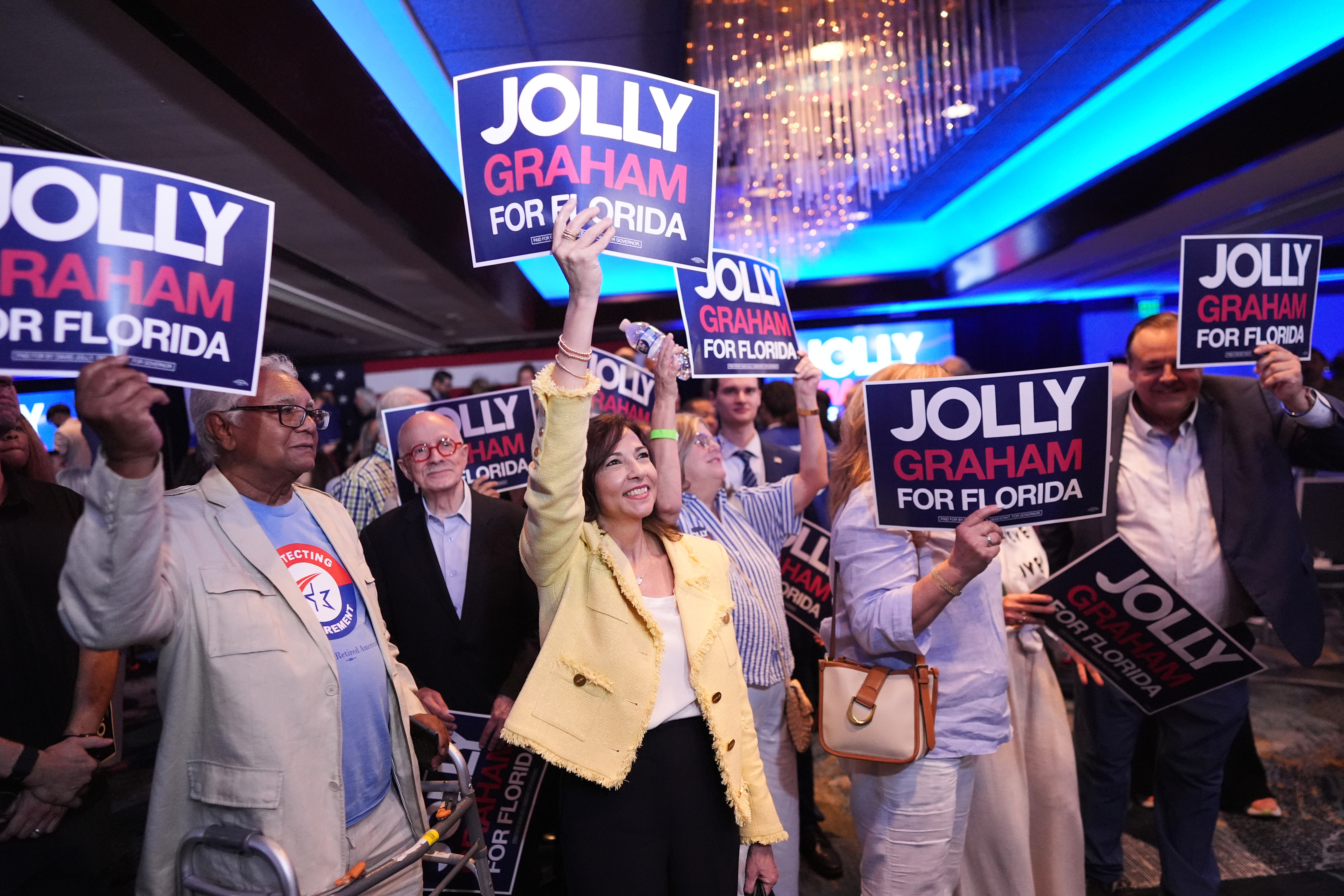
Donalds’ race appears to be tightening despite his political committee and the Republican Party spending nearly $80 million on ads, according to ad tracker AdImpact. As a candidate, Donalds has been flooding the zone with campaign events, which are broadcast through his social media. In contrast, Jolly has refused to debate. He became a Democrat just last year and his even-tempered demeanor clashes with a large segment of a base brimming with fury.
Yet five Republicans interviewed for this story said they’d be concerned about the race if Jolly were able to raise even $20 million. Many point to losses Donalds, who is Black, faced during his primary in 17 heavily white and rural counties.
“If [Democrats] had fielded a better candidate there would be more concern,” said one long-time Florida Republican consultant who was granted anonymity to discuss the climate candidly.
Another GOP operative, who was also granted anonymity to talk frankly about the upcoming election, said about the governor’s race that “the big fear is that a weird tech bro could get in, but the Democratic megadonors are more focused on the federal level.” That operative said “anything can happen but the math is the math.”
Many Republican officials are publicly dismissive that Democrats have a shot at Florida. Emma Hall, a spokesperson for the Republican National Committee, contended that Democrats are “doomed” and that Democrats are “living in a fever dream” if they think they can win.
While the National Republican Senatorial Committee appears to be pulling its focus back from Senate seats in North Carolina and Georgia, alarm bells about Florida are nowhere to be found. Nick Puglia, NRSC regional press secretary, argued Florida voters wouldn’t let Nixon “turn the Free State into another failed socialist experiment.” He predicted voters would back Moody given she supported the Trump tax cuts and because of her record on law enforcement as a former state attorney general. Moody’s allies in Florida also note that, as state attorney general, she won statewide twice by higher margins than other Republicans on the ticket, a trend they expect in her Senate race.
Evan Power, chair of the Republican Party of Florida, said that while the midterms are “challenging” he noted past predictions of a Democratic wave in the state never materialized.
“I take nothing for granted, but I’m not raising alarms,” Power said. “I think our voters are going to come home. We are going to turn out voters.”
Read the full article here


