
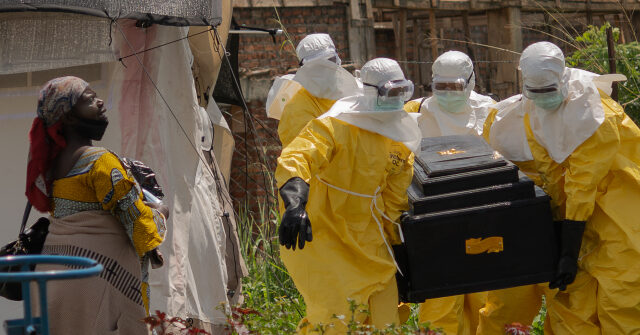
The World Health Organization (W.H.O.) said on Wednesday that the Ebola outbreak in the Democratic Republic of the Congo (DRC) began much earlier than previously suspected, and is spreading faster than anticipated, but the wider world still has no reason to fear the disease will spread beyond the DRC and neighboring Uganda.
“W.H.O. assesses the risk of the epidemic as high at the national and regional levels, and low at the global level,” said the organization’s director, Tedros Adhanom Ghebreyesus, at a press conference on Wednesday.
Tedros said there were several reasons for “serious concern about the potential for further spread and further deaths,” including the troubling length of time that Ebola spread in the eastern Congo before the outbreak was detected and containment procedures were implemented.
“First, beyond the confirmed Ebola cases, there are almost 600 suspected cases and 139 suspected deaths. We expect those numbers to keep increasing, given the amount of time the virus was circulating before the outbreak was detected,” he said.
Tedros noted there is “significant population movement in the area,” including both commerce and warfare.
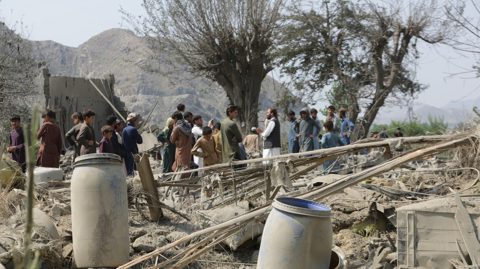
“The province of Ituri is highly insecure. Conflict has intensified since late 2025, and fighting has escalated significantly over the past two months, with over 100,000 people newly displaced,” he said.
“The area is also a mining zone, with high levels of population movement that increase the risk of further spread,” he added.
The outbreak began at least two months before it was officially declared on Friday, including what W.H.O. described as a “critical four-week detection gap” between the first recorded symptomatic Ebola infection and laboratory confirmation.
“Investigations are ongoing to ascertain when and where exactly this outbreak started. Given the scale, we are thinking that it started probably a couple of months ago,” said W.H.O. technical officer for viral threats Anais Legand.
The first known fatality from the outbreak occurred on April 24 at a medical center in Bunia, the capital of the Ituri province – but Congolese Health Minister Samuel Roger Kamba noted that the victim was a health care worker, which means they probably contracted Ebola from someone who was infected even earlier.
Kamba said the April 24 death was followed by a funeral at which mourners were “touching” the body, which probably became a super-spreader event driving the subsequent surge of cases. W.H.O. was notified of “an unknown illness with high mortality” spreading through the Ituri mining town of Mongbwalu, where the funeral was held, on May 5.
Kamba, who has been critical of the response by provincial and national health officials to the outbreak, also castigated area residents and community leaders for believing Ebola infections were “witchcraft” and seeking treatment from witch doctors and faith healers instead of hospitals.
The MRC Center for Global Infectious Disease Analysis issued a statement on Monday that said there has been “substantial” under-detection of Ebola infections, even after alarms were raised and W.H.O. declared a public health emergency, and the true number of infections could be over a thousand, rather than the 600 suspected cases Tedros mentioned.
One case has now been confirmed in Goma, the rebel-held city near the Ugandan border that has loomed large in the fears of epidemiologists because the insurgents may not be forthcoming with Congolese or global health officials. The Goma case is reportedly a woman who traveled to the city after her husband contracted Ebola and died in Bunia.
Almost every major media report on the Ebola outbreak makes some effort to connect it with cuts to foreign aid by the Trump administration, although Tedros said on Wednesday it was “too early to say” if funding cuts to either the DRC or W.H.O. played a role in the slow response.
On Tuesday, Secretary of State Marco Rubio said W.H.O. was “a little late to identify this thing, unfortunately.”
Rubio said the United States has already committed $13 million in assistance for the outbreak, and plans to open about fifty Ebola clinics in the DRC. He noted the effort would be difficult because the Ituri province is a “hard-to-get-to place in a war-torn country.”
Tedros responded on Wednesday that Rubio’s comments showed a “lack of understanding” of “the responsibilities of W.H.O. and other entities.”
W.H.O. also criticized the United States for imposing travel bans against the DRC, South Sudan, and Uganda, insisting that travel bans are “not supported” by W.H.O. protocols for outbreak response.
Read the full article here