








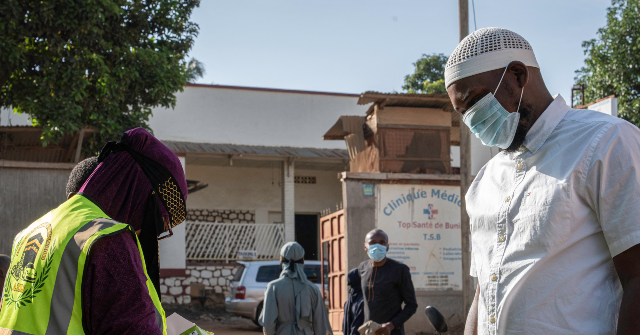
The director-general of the World Health Organization (W.H.O.), Tedros Adhanom Ghebreyesus, lamented in remarks on Wednesday that violent attacks on health workers in the Democratic Republic of Congo (DRC) have made contact tracing “nearly impossible,” significantly damaging attempts to contain the Ebola outbreak there.
“Stopping this Ebola transmission depends entirely on humanitarian access,” Tedros wrote in a message published on social media. “Yet ongoing clashes are driving mass displacement, pushing exposed contacts into overcrowded camps and severing critical containment corridors.”
“Frontline workers are risking everything, while attacks on health facilities make tracking cases and their contacts nearly impossible,” he added.

“We cannot build community trust or isolate the sick while bombs are falling,” Tedros added.
The W.H.O. chief is at press time en route to the DRC, where he is scheduled to meet with Ebola victims and families in person to address concerns and supervise containment efforts. Prior to arriving, he published an open letter to the people of the DRC explaining why he was visiting them and demanding a ceasefire from the various armed gangs that have ravaged the population for years.
“We cannot do this work if those who are trying to help are prevented from doing so or put in danger. We are working closely with all relevant partners to ensure that the response can reach every community that needs it, and that no one is left behind because of where they live or what is happening around them,” he explained.
“That is why today I am making a direct appeal to all warring parties in this region: please, declare a ceasefire. Even briefly. Even just enough to let health workers through,” Tedros pleaded. “People are dying from Ebola who do not have to die. Children are sick. Families are suffering. No cause, no conflict, no grievance is worth condemning innocent people to death from a preventable disease.”
The W.H.O. declared the Ebola outbreak centered in Ituri, DRC, a global health emergency on May 17 after conceding that its officials had been slow to identify the signs of a burgeoning outbreak in the region. Scientists have since identified the outbreak as being driven by the Bundibugyo variety of Ebola virus, for which no vaccine exists and treatment is limited. As of Thursday, authorities have confirmed 101 diagnosed infections of Ebola Bundibugyo in the outbreak area and 221 deaths. Nearly 1,000 other people have been identified as “suspected” Ebola cases.
The W.H.O. has faced some criticism for responding slowly to the outbreak, conceding this month that the virus was spreading much faster than anticipated. Three days after declaring a global health emergency, Tedros told reporters that the U.N. agency considered the risk of an epidemic “low at the global level” but “high” locally as Ituri is “highly insecure.”
The eastern region of DRC where health workers identified the outbreak is among the most volatile in the world, overrun with dozens of criminal gangs fighting each other to control critical mining territory. The violence, which has lasted for years, has resulted in multiple deaths of United Nations peacekeepers and attacks on humanitarian aid workers, as well as fueling a lucrative industry forcing people, including children, to engage in dangerous mining practices. During a previous Ebola outbreak in Ituri, in 2019, the W.H.O. documented a catastrophic increase in Ebola cases linked to the mass displacement of civilians by rival warlords fighting for land.
Also preventing optimal disease response protocol from being effective in DRC is widespread distrust of international health workers. Many in the region deny the existence of Ebola and fear it is an excuse for “population control” by foreigners to limit the number of Africans. Others object to being told that traditional burial practices, which often involve prolonged exposure to an infected body, could facilitate the spread of the disease. The W.H.O. has compounded local distrust as a result of a massive sexual abuse scandal in which its workers, positioned in the DRC from 2018 to 2019, reportedly coerced local women into sex and abandoned the girls and women after impregnating them.
During the current outbreak, health workers have documented numerous mob attacks in which locals who refused to believe Ebola was a real virus attempted to burn down improvised medical centers and physically attacked health workers. In the process, confirmed Ebola patients escaped the health facilities, exposing an unknown number of people to new infections.
Tedros also addressed this situation in his open letter, stating that “there is anger and mistrust in some communities, and I understand why.”
“Trust must be earned, it cannot be assumed. We have not always done things correctly,” he conceded, without mentioning the sex abuse scandal or the W.H.O.’s failure to identify the current outbreak in a timely way.
The W.H.O. chief concluded by emphasizing that his organization would allow “safe and dignified burials” and making a personal promise: “I will not be managing this from a comfortable office far away.”
Follow Frances Martel on Facebook and Twitter.
Read the full article here


