




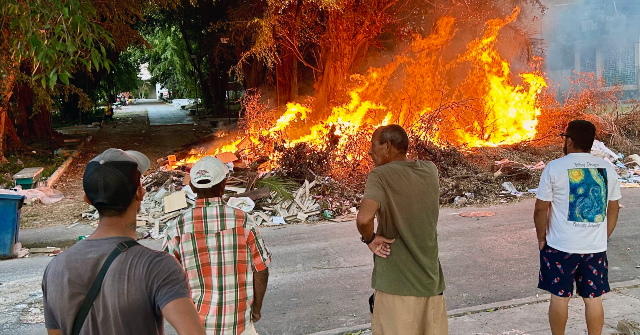
Social media users with access to electricity shared dramatic images throughout the weekend of protests across Cuba, many of them featuring large bonfires of garbage, banging of pots and bans, and the emergence the next day of anti-communist graffiti.
In Colón, Matanzas — about 120 miles east of Havana — locals recorded spray-painted messages reading “down with communism,” “down with the dictatorship,” and “Viva Trump,” a reference to the American president.

Cuba is currently experiencing an aggravated state of poverty and misery — even beyond its usual levels during the past 67 years of communist rule — following President Donald Trump’s decision to approve an operation to arrest deposed Venezuelan dictator Nicolás Maduro, wanted on various narco-terrorism charges. When Maduro ruled the oil-rich country, it supplied his masters in Havana with heavily discounted oil and other resource support. In exchange, the Castro regime provided Maduro with security and espionage expertise. For years, both parties denied the extensively reported presence of the Cuban security apparatus in Venezuela, but the Castro regime acknowledged that the operation to arrest Maduro killed 32 of its soldiers, apparently present in Caracas to protect the dictator.
With Venezuela no longer shipping oil to Cuba, and critical allies such as Russia, China, and Iran offering little more than words of encouragement, the Castro regime has effectively run out of fuel. Its airports announced last month that they have no jet fuel, devastating the regime’s vital tourism revenue. The routine power outages that have affected the country for years have become even more pervasive and long-lasting, sending people to the streets.
The independent Cuban outlet 14ymedio described the atmosphere in the island’s cities this weekend as “apocalyptic” as growing numbers of civilians left their homes and banged pots and pans to protest the lack of electricity, predictable access to basic foods and medicine, and human rights. Many burned the large piles of garbage that have accumulated for years in the cities as the communist regime fails to offer even the most minimal services at the municipal level.

“When the sunlight leaves and, with it, the fear of being recognized, the banging of pots and pans becomes sonorous in multiple neighborhoods,” 14ymedio narrated. “It does not matter anymore how centrally located they are, how prone to protests or touristy they are.”
Anti-communist graffiti, the outlet noted, has become a common occurrence, both in the capital and in cities throughout the country. Much of the paint is difficult for officials to fully remove, leaving signs reading “down with communism” or, more simply, “it’s over.” The report indicated that so many people are protesting, and waiting until their streets are dark during blackouts, that security officials are struggling to arrest, beat, and torture protesters as they normally would.
The emergence of graffiti and lack of ability to detain protesters is a meaningful change from the Castro regime’s usual repressive actions, as is the overwhelming number of people believed to be participating. A decade ago, when longtime mass murdering dictator Fidel Castro finally died, only one person in Havana took to the streets to participate — the dissident artist Danilo Maldonado Machado, known by the artistic name “El Sexto,” who streamed his celebration live on Facebook and urged other Cubans to join him.
“What we need is for people to recover their conscience and take to the streets to struggle for liberty, to earn their liberty because nobody is getting their liberty sitting at home,” he said in the video, stopping passersby and asking, “How long are you going to not want to speak out?”
Maldonado also spray-painted the words se fue (“he’s gone”) on a wall. Alone and openly identifying himself, he was arrested, imprisoned, drugged, and tortured for two months before he was released in January 2017.
Cubans documented some state security abuses this weekend, but the regime appears less able to competently beat and abduct the protesters. In Havana, dissident Marianela Peña Cobas was beaten during an anti-communist protest and temporarily detained.
“They freed her, not because they are good people, but because there is no prison space to jail all the Cubans who are demanding freedom and the fall of this regime in shouts,” Marianela’s sister Marisol Peña Cobas noted from the United States.
President Trump, whose efforts to bring an end to the Maduro regime in Venezuela precipitated the current situation in Cuba, has suggested that he is working to take down the regime.
“The Cuban government is talking with us, and they’re in a big deal of trouble, as you know,” he told reporters last week. “They have no money, they have no anything right now… and maybe we’ll have a friendly takeover of Cuba.”
This weekend, while hosting a group of Latin American leaders for a summit on combatting joint threats, Trump revealed that several heads of state asked him to “take care of Cuba.”
“I was surprised, but four of you said, actually, ‘Could you do us a favor?’ Take care of Cuba.’ I’ll take care of it, ok?” he promised.
Follow Frances Martel on Facebook and Twitter.
Read the full article here


