

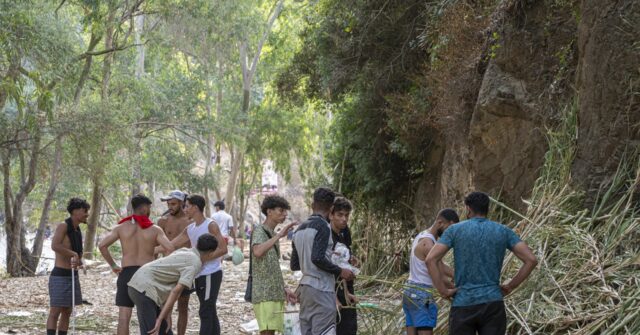
The right-leaning Spanish newspaper ABC highlighted a growing community of Moroccan men living in the woods on the outskirts of the city of Ceuta, Spain, which experienced an unprecedented mass migrant invasion last week that has rattled Europe to its core.
Tens of thousands of foreign men – estimated to have reached 60,000 in number at its peak – invaded Spain’s city of Ceuta, located on the African continent, beginning on Thursday, overwhelming border patrols and threatening to invade and loot residents’ homes. The impetus for the invasion was a Spanish Supreme Court decision that ruled that Spanish authorities could not rapidly deport a foreigner who enters the country by sea, rather than by land. That prompted the migrants to swim around the Moroccan coast into the shores of Ceuta, knowing they would receive some legal standing upon arrival.
The majority of them were reportedly Moroccan nationals seeking entry into the Schengen area, the free travel zone created by the European Union (EU) in which passport verification is not required to cross from one country to another. Some estimates suggest that as many as 49,000 men crossed into Ceuta in 24 hours; the city usually has an estimated population of about 80,000 Spaniards.
The government of radical leftist Prime Minister Pedro Sánchez, who remains in power after cutting an amnesty deal for terrorists in 2023, did little to deter the flood of foreign men into the region, outraging locals and other EU governments. Led by calls from Italy, several EU countries have demanded emergency negotiations and called for suspending Spain from the Schengen agreement, meaning all Spanish passport-holders would no longer benefit from the free travel rules. At home, the Spanish conservative party Vox called for the prosecution of Sánchez in relation to the Moroccan invasion, in addition to previous calls for his prosecution as a result of various corruption allegations.
A woman holds a placard reading “Sanchez, may Mohammed VI vote for you” during a protest outside the Embassy of Morocco in Madrid against illegal migration following the recent migration crisis in the Spanish enclaves of Ceuta and Melilla. (Marcos del Mazo/LightRocket via Getty)
The Spanish government insisted over the weekend that the vast majority of the invading men had returned home, in part as a result of locals shutting down all businesses and refusing to grant them access to their food or water. ABC noted on Monday, however, that many Moroccan men, and some boys as young as 14 years old, are still hiding in the woodlands and beach outside the city, with no place save for never returning to Morocco.
The report described the men in the woods as “Maghrebis,” as opposed to the thousands of sub-Saharan African people who the Spanish government has not attempted to expel from the local migrant reception headquarters. These individuals, according to ABC, were some of the “hundreds … fighting for a piece of bread” while trying to survive in Ceuta. About 20 of them have created a woodland community to sustain each other.
Out of the woods and nearby beach, ABC reported, the men have made an “improvised home until deciding what steps to take or until authorities find their hideout.” They occasionally venture out to the beach to clean their clothing or themselves and still, apparently, have access to mobile phone service, as they have continued to publish content on their Instagram accounts in which they boast of their success in entering Ceuta.
WATCH: Thousands of Migrants from Morocco Flood into Spanish Territory
“We are here hiding because people beat us and the police want to take us to the border,” one anonymous migrant told the newspaper in Arabic.
One migrant explained that they have survived, in part, with support from Moroccans legally in Ceuta.
“Sometimes we go down and there are Moroccan people who are from here and they give us water,” one migrant explained. “Sometimes we use Moroccan money to buy because some stores accept. We have some 20 or 30 euros, nothing more.”
One migrant complained that Spanish authorities were allowing migrants who appeared sub-Saharan to seek aid at the Immigrant Temporary Stay Center (CETI), but not visibly North African migrants: “they let the blacks stay there and not us, out of control.”
ABC also noted that some of the “men” in the woodland cohort are, in fact, children: teens of about 14 or 15 years of age. These, it related, have struggled significantly as other migrants have robbed them of their food or other meager belongings, so they have to eat in secret so the adult migrants do not know that they have food.
The president-mayor of Ceuta, Juan Jesús Vivas, said in an interview on Monday that his government believes as many as 5,000 migrants remain in Ceuta – far less than the 60,000 who entered last week, but still a formidable sum for a town of 80,000. He described the response from the Sánchez government as “tardy and insufficient.”
“The reaction by the state has been manifestly tardy and manifestly insufficient,” he complained to the broadcaster Telecinco, adding that it was “impossible for us to say that we have returned to normal” at the moment. Vivas exempted the police, Spanish Civil Guard, and soldiers from his criticism of the response, describing them as “exemplary,” but conceding they can only do as much as Sánchez’s government allows.
Other local leaders similarly objected on Monday to Madrid’s claims of a return to normal in Ceuta.
“I wish I could say the contrary, but the normality they wish to transmit does not exist,” Laura García, a spokesperson for the national police union, told the conservative outlet Libertad Digital. “There are still thousands of people there and, as the days pass, there is more and more tension.”
García described the CETI migrant welcome facility as “completely collapsed,” creating “security problems” for locals. “They have invaded the beaches, there have been store lootings … and there hasn’t been more thanks to the arrival of the partners in the military.”
As of Monday, authorities have documented 67 deaths in the chaos of the migrant invasion in Ceuta.
Follow Frances Martel on Facebook and Twitter.
Read the full article here
