






Acting President of Venezuela Delcy Rodríguez on Thursday announced that VenApp, a state-owned social media platform once used by Nicolás Maduro to hunt anti-socialist dissidents, is being used to report missing individuals in the aftermath of Wednesday’s deadly twin earthquakes.
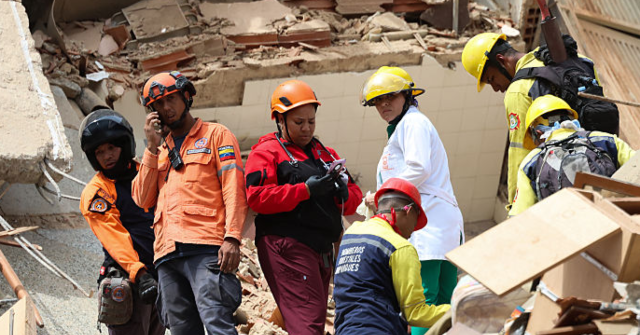
Venezuela suffered two back-to-back magnitude 7.2 and 7.5 earthquakes on Wednesday evening, causing widespread destruction and the collapse of numerous buildings, mostly in the capital city of Caracas and the neighboring state of La Guaira. Venezuela’s main airport, the Simón Bolívar International Airport in Maiquetía, La Guaira, was shut down after suffering damages to its infrastructure.
According to official information from the Venezuelan regime, the death toll climbed from 32 to 164 in the early morning hours of Thursday, with at least 970 reported injured at press time.
Rodríguez, speaking in an emergency early Thursday morning broadcast, announced that VenApp was immediately activated with functions to report missing persons after the earthquake and to report structural damage in Venezuelan households. VenApp is a multi-purpose social media platform launched by the Venezuelan socialist regime in 2022 during the rule of dictator Nicolás Maduro as part of a “transparency and accountability” initiative. The platform, and its corresponding smartphone applications, have been used by the regime in the past for nefarious purposes.
At the time of its initial release, Venezuelan authorities claimed that VenApp allowed users to file complaints and denounce malfunctions in Venezuela’s rundown public utilities in addition to other types of services. In the aftermath of the July 2024 sham presidential election, Maduro ordered VenApp to be retrofitted with new features to allow users to report dissidents of the socialist regime so that Venezuelan law enforcement could “go against them.” In late 2025, Maduro sought to use VenApp’s existing infrastructure for the development of a full-fledged “snitch” app. The plans, however, appear not to have materialized following Maduro’s arrest by U.S. forces on January 3.
Decades’ worth of a lack of investment by Venezuelan authorities appear to have left the nation ill-prepared to face natural disasters. For years, Venezuelan outlets denounced that the lack of proper maintenance left Venezuela’s Civil Protection and other disaster and emergency response units without proper resources, emergency equipment, and supplies to face natural catastrophes.
Footage published by Venezuelan journalists in the aftermath of Wednesday’s deadly tragedy show rescue workers carrying out search and rescue operations in the ruins of collapsed buildings without basic instruments — having to use phones as flashlights.

Acting President Rodríguez, in an unprecedented move for the nation’s socialist authorities, called for the nation’s private sector to allow the Venezuelan state to rent heavy machinery to be used in the ongoing search and rescue efforts. Per the Venezuelan state-owned news channel VTV, Rodríguez held a conversation with the head of Venezuelan Federation of Chambers of Commerce (Fedecamaras) to expedite efforts towards obtaining the heavy-lifting equipment.
President Donald Trump announced in a Truth Social post that the United States is ready to help Venezuela. Trump emphasized that the early reports “are not good.” Speaking to reporters on Thursday morning, Secretary of State Marco Rubio detailed that the United States is deploying search and rescue teams from Fairfax County, Virginia, and Los Angeles, California.
“That’s their most immediate need right now is search and rescue efforts. They have a bunch of collapsed buildings, and so they’ll need a lot of help in terms of digging through that. The airport there is badly damaged, so we’ll have to rely on the Department of War to deploy assets there,” Rubio said. “And then we’re also helping them with some overhead imagery, especially in coastal areas where they don’t have full visibility over what the damage has been and what the impact has been.”
“Those are the acute, like short-term needs over the next 48 to 72 hours because in search and rescue you’re trying to get to people while you can still save their lives. They’re buried under rubble,” he stressed.
Several other nations, including El Salvador, Mexico, Qatar, and India, have expressed their willingness to provide help and humanitarian assistance to Venezuela.
While the Venezuelan regime reported a death toll of at least 164 as of Thursday morning, a preliminary U.S. Geological Survey (USGS) disaster model estimates a high chance of significantly greater loss of life than the latest official reports — ranging anywhere between 10,000 to 100,000.
Christian K. Caruzo is a Venezuelan writer and documents life under socialism. You can follow him on Twitter here.
Read the full article here


