




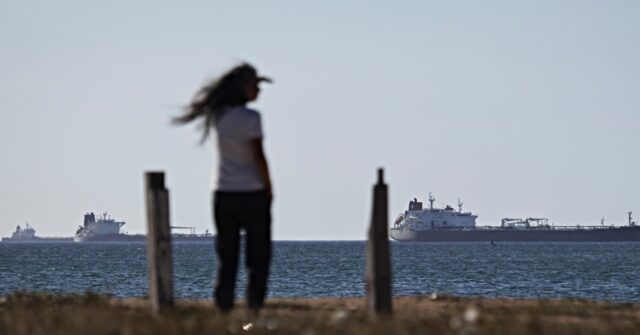
Venezuela experienced a sharp increase in its oil exports in February following the arrest of deposed socialist dictator Nicolás Maduro, Bloomberg News reported on Monday.
Bloomberg, citing shipping reports and statistical data from maritime intelligence firm Kpler Ltd. reported that oil Venezuela exported 788,000 barrels of oil in February — more than double the 383,000 barrels reportedly exported during January while also marking a five-month record high in oil exports.
The outlet pointed out that crude oil production in Venezuela is recovering after the United States carried out a law enforcement operation in Caracas on January 3 to arrest Maduro and his wife Cilia Flores, who both face multiple narco-terrorism charges at a New York court.
For years, the Venezuelan regime unsuccessfully attempted to restore Venezuela’s lost oil output after the Venezuelan socialists pushed the nation’s oil industry into a dire, near ruined-state through two decades of mismanagement and disastrous socialist policies. The situation dramatically worsened during Maduro’s rule, during which Venezuela’s oil output went from 3.2 million barrels per day in 2002 to less than 500,000 in 2020.
Maduro repeatedly promised to the Organization of Petroleum Exporting Countries (OPEC) that he would bring Venezuela’s output back to “2 million” barrels per day, but ultimately never did so. As part of the now-deposed dictator’s attempts to reverse the socialist near-destruction of Venezuela’s oil industry, his regime enlisted the aid of the Iran’s Islamic regime, who provided the Venezuelan socialists with assistance in repairing and operating the rundown refineries.
The Iranian efforts did not result in a significant boost to oil output and are instead reportedly attributed with causing disastrous oil spills across the Venezuelan coastline.
RELATED: Hero Helicopter Pilot Eric Slover Receives Medal of Honor for Actions in Maduro Raid

Much of that lost oil output, the Spanish newspaper El Pais recounted in January, was exported to the United States, which has access to refineries across the Gulf of America capable of processing Venezuela’s extra-heavy crude oil. The U.S. was historically the top buyer of Venezuelan oil until late dictator Hugo Chávez began intensified his plans to impose a socialist state in Venezuela, implementing a series of socialist policies form the mid-2000s onwards that included the forced expropriation and seizure of assets from U.S. companies in Venezuela that remain fully unresolved at press time.
Following Maduro’s arrest, the Venezuelan regime, now led by “acting President” Delcy Rodríguez, has begun collaborating with the administration of President Donald Trump after more than two decades of hostilities by Maduro and his predecessor Chávez, seeking U.S. help in restoring and repairing Venezuela’s rundown oil and energy sectors in return for Venezuela sharing its oil with the U.S.
Last week, Rodríguez described President Trump as a “friend” and “partner” shortly after Trump referred to Venezuela s as a “new friend” of America during his State of the Union address.
Bloomberg reported that, since then, U.S. refineries have received the majority of the Venezuelan oil exports, which the outlet described as “the biggest haul of oil in more than seven years.” The oil is reportedly received through California-based Chevron and commodity travers Vitol Group and Trafigura Group, who were tapped by the U.S. to sell as much as 50 million barrels of oil.
President Trump, however, revealed during his State of the Union address that the U.S. just received “80 million barrels of oil” from Venezuela, an amount much higher than the initial 50 million barrel estimates. According to Bloomberg, Trafigura and Vitil have so far shipped at least 35 million barrels of oil from Venezuela since early January, include crude, fuel oil, and asphalt. About half of the shipped oil has reportedly been put in storage tanks across the Caribbean.
“In Venezuela, crude output has risen after the country regained access to heavy naphtha, a diluent essential to reduce its oil’s viscosity for pipeline delivery and continued production. Venezuela received five cargoes of diluents last month, compared with two in January,” Bloomberg wrote.
Most notably, Bloomberg reported, China has not bought Venezuelan oil since Maduro’s arrest. Under Maduro’s rule, Venezuela exported much of its oil to China as part of its oil-for-cash debt program with the Chinese communist regime. China received the Venezuelan oil under a heavily discounted price as part of the debt payment while also assisting Maduro evade U.S. oil sanctions imposed on the state-owned oil company PDVSA in response to the Maduro regime’s numerous human rights abuses committed against its own people.
President Trump detailed in late January that his administration would allow China to purchase Venezuelan oil — but only if China paid regular international prices for it instead of the heavily discounted rates the Chinese regime was paying Venezuela under Maduro.
Reuters reported at the time that the Chinese state-owned oil company PetroChina instructed its partners not to purchase Venezuelan oil after the U.S. arrested Maduro and the start of the Venezuelan regime’s collaboration with the Trump administration.
Bloomberg noted on Monday that oil traders are assessing the Venezuelan oil export data against the backdrop of the ongoing developments in Iran after the United States launched “Operation Epic Fury” over the weekend. The military operation, which the U.S. launched against Iran’s Islamic regime in parallel with the Israel Defense Forces (IDF), has targeted Iranian missile assets and high-profile targets, leading to the death of numerous top regime officials — including “Supreme Leader” Ayatollah Ali Khamenei. Reports published this week indicated that Saudi Arabia shut down Ras Tanura, it’s largest oil refinery after Iranian drone strikes hit the facility.
“While vital Strait of Hormuz remains open, vessels are steering clear of the waterway, the conduit for about a fifth of the world’s seaborne oil and gas,” Bloomberg’s report read. “Though the tar-like heavy crude that Venezuela produces cannot directly replace many Middle Eastern barrels, it can be blended with lighter grades to create similar substitutes.”
Christian K. Caruzo is a Venezuelan writer and documents life under socialism. You can follow him on Twitter here.
Read the full article here


