




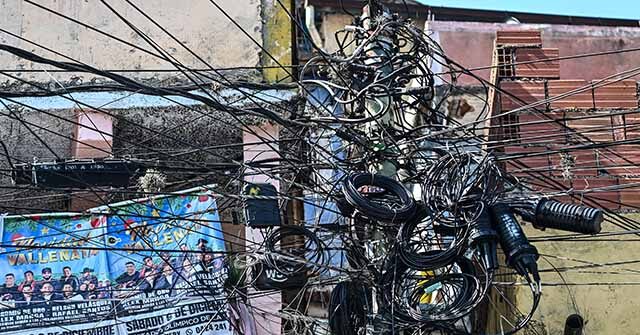
Venezuela’s state-owned energy company Corpoelec and General Electric (GE) Vernova on Monday signed a memorandum of understanding to cooperate on the recovery of Venezuela’s rundown power grid — which was left in a dire state after decades of socialist mismanagement.
The new agreement was signed at the Miraflores presidential palace in Caracas during an event led by “acting President” Delcy Rodríguez. According to the Venezuelan Communications Ministry, the agreement between Corpoelec and GE Vernova aims to “address the persistent daily power outages” that affect Venezuela. John Barrett, the chargé d’affaires of the U.S. embassy in Caracas, attended the signing ceremony.
“Acting President” Rodríguez reportedly stated that the agreement will enable progress toward the gradual restoration of the country’s electricity generation capacity, with short- and medium-term goals. She detailed that GE Vernova carried out a weeks-long technical diagnosis of the current state of Venezuela’s power grid prior to signing the deal on Monday.
Per the Venezuelan Communications Ministry, the agreement establishes a technical roadmap to restore 1,000 megawatts in the first 24 months of implementation, up to “more than 5,000 megawatts within four years.”
“[Power generation] essential to national life, both for every Venezuelan household and for our country’s industrial base, but above all for the life of the nation. I am grateful that this is good news for Venezuela,” Rodríguez said.
“We want to move quickly so that the system is functioning as well as possible within a few months, and I believe we can do it together. We’ve already reached an agreement on the technical aspects and how we can move forward quickly. Over the next 12 months and beyond, we’re going to strengthen the SEN [Venezuela’s National Electric System],” Roger Martella, GE Vernova’s Chief Corporate Officer said on Monday.
Much like the rest of Venezuela’s entire infrastructure, decades of sheer socialist mismanagement and corruption during the rule of late dictator Hugo Chávez and Nicolás Maduro left the nation’s power grid in a dysfunctional state, forcing its citizens to face constant, recurring blackouts. In some areas of Venezuela, such as the western state of Zulia, the recurring blackouts started as early as 2009 and worsened through time — leading to dangerous occurrences such as the explosion of transformers and other power equipment in Zulia that continue to occur in 2026.
By the mid 2010s, the Maduro regime had implemented nationwide power rationing measures that generally excluded the capital city of Caracas, the socialist regime’s seat of power. The already dire situation dramatically worsened in March 2019 after Venezuela’s entire power grid collapsed, leaving most of the country without electricity for days. Years later, in 2024, Venezuela suffered another nationwide power blackout that the socialist regime attributed to a purported “electrical sabotage.”
Last week, the Venezuelan newspaper El Nacional detailed that while Venezuela has an installed capacity of 36,732 megawatts, the country’s power grid is currently operating at only about 36 percent of said capacity, at an estimated 12,415 megawatts. The amount falls short from the 15,000 megawatts that, according to information from local non-government organization Monitor Ciudad cited by the newspaper, is the current estimated national demand. The energy shortfall has led to virtually daily power outages across much of the country throughout this year.
As of last week, the daily power outages in the states of Zulia, Táchira, Mérida, and Trujillo can reportedly last anywhere between 6 to 12 hours. In Carabobo, Lara, and Sucre, El Nacional pointed out, the blackouts are averaging anywhere between 3 to 8 hours per day. Caracas, usually shielded from the full effects of the malfunctioning national power grid in years past, is now left facing growing power fluctuations.
Following Nicolás Maduro’s arrest in a January 3 U.S. law enforcement operation in Caracas, “acting President” Rodríguez began collaborating with the administration of President Donald Trump, seeking U.S. investment in assistance towards restoring the nation’s rundown oil sector, power grid, mining, and other areas.
Rodríguez met with Energy Secretary Chris Wright in February, roughly a month after Maduro’s capture. At the time, Rodríguez told reporters that she and Sec. Wright conversed about establishing “long-term productive partnerships” on multiple energy-related fields, such as oil, electricity, gas, and mining.
Christian K. Caruzo is a Venezuelan writer and documents life under socialism. You can follow him on Twitter here.
Read the full article here


