




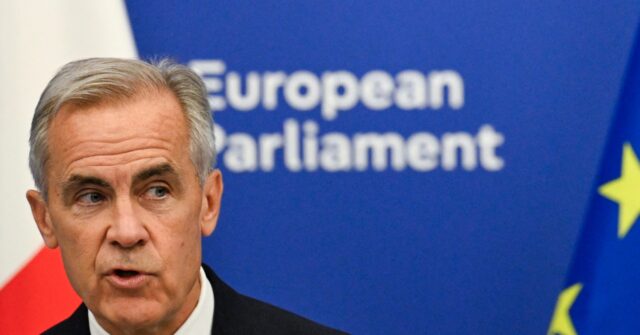
Far-left Canadian Prime Minister Mark Carney enthusiastically embraced an unconventional proposal for his country to become an “associate” member of the European Union while addressing the body’s parliament in France on Thursday, calling for Canada’s global ties to “take on a new dimension.”
Carney was visiting the European Parliament headquarters in Strasbourg, France, on Thursday, a day after EU President Ursula von der Leyen floated an unprecedented invite for Canada to become an “associate member” of the global institution. Prior to her remarks at the parliament, “associate membership” of the EU did not exist, and the EU has not clarified at press time what “associate” status would entail.”
Given the lack of clarity around the invite, Carney did not explicitly accept it, but rather offered a positive disposition towards the creation of a special position for Canada, a North American country, to join the European family.
“Mutual advantage is at the core of the case for a deeper partnership between Canada and Europe,” Carney told the EU parliament. “Canada and Europe should secure our strategic autonomy through deep cooperation in the full range of strategic capabilities, including critical minerals, defence industrial capacity, AI and compute, energy security, space, and payments.”

“Deepening and widening our relationship will strengthen our sovereignty, improve affordability, opportunity and security for Canadian and European citizens, while safeguarding our ability to live our lives as we choose,” he asserted.
Given the negative reaction to the EU invite on Wednesday from the White House, Carney added a caveat that any partnership between Ottawa and the EU capitals was not intended to create “a third bloc in order to become a great-power rival – only with better manners.”
“We do not seek power to dominate others. On the contrary, we are pursuing resilience so that no one can control our open markets, impair our sovereignty, threaten our territorial integrity, or undermine our freedoms, our democracies, our rule of law,” he claimed.
“An alliance strong enough so that no one can dictate our choices. Open enough that others can join. Principled enough that our strength reinforces international law rather than replaces it,” Carney stated.
Carney reportedly did not address the United States directly, but was interrupted by chants of “USA USA” from some lawmakers in the chamber, according to Canada’s Globe and Mail.

Carney’s address was a response to comments by von der Leyen on Wednesday at the same venue in which she welcomed Carney to the parliament and suggested that Canada could join the EU, despite its location outside of Europe.
“Europe and Canada believe in democracy, that power does not belong to the strongest, richest and loudest, but to all of us,” von der Leyen said. “I would like to work with you on opening the door for Canada to being the first associate member of the European Union.”
Observers noted that EU lawmakers gave the invite a standing ovation, though “associate member” status does not exist. It is not clear which of the benefits EU membership provides – adoption of the Euro currency, entry into the Schengen free travel zone, beneficiary trade policies – would apply or not apply to an EU “associate.”
In Washington, President Donald Trump called the idea of Canada joining the EU “laughable,” but also warned that the United States would interpret the move as a “hostile act.”
“If they do that, if I think it’s at all a hostile act, I will put very serious tariffs or stop trading with Europe on many things,” Trump warned.
Canada’s Prime Minister Mark Carney greets European Commission President Ursula von der Leyen after delivering a speech at the European Parliament in Strasbourg, eastern France, on September 17, 2026. (Jean-Christophe VERHAEGEN / AFP via Getty Images)
Carney, who had never held public office before being hand-picked to take over the prime ministership of Canada by predecessor Justin Trudeau, began his term by announcing that he would end the historic friendship between Canada and America, declaring, “there will be no turning back” and that Canada’s interests require it to “dramatically reduce our reliance on the United States.”
“Over the coming weeks, months, and years, we must fundamentally reimagine our economy,” Carney said in March 2025, while serving as prime minister but before he was elected to the role.
“We will need to ensure Canada can succeed in a drastically different world. The old relationship we had with the U.S. based on deepening integration of our economies and tight security and military co-operation is over.”
Carney has since made an aggressive pitch that Canada’s national identity is European, and not part of the Western Hemisphere. Part of this pivot has consisted in Canada joining the European Broadcasting Union (EBU) and announcing in July that it would compete in the 71-year-old Eurovision Song Contest, an entertainment event conceived as a way to unite Europe after World War II.
“We’re the third largest exporter of music in the world, Canada is, after the United States and UK,” Carney declared at the time. “The world wants Canada, wants Canadian culture, and this is another way to just spread the message, spread the love and a little bit of unity.”
The public Canadian Broadcasting Corporation (CBC) has refused requests to answer how much Canada’s Eurovision bid, expected to consist in a national competition to represent the country, would cost the Canadian taxpayer.
Follow Frances Martel on Facebook and Twitter.
Read the full article here


