






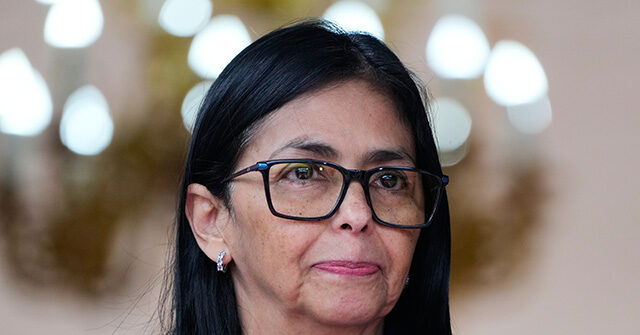
“Acting president” of Venezuela Delcy Rodríguez on Wednesday evening acknowledged that the Venezuelan socialist regime committed “errors in the past” that led to the nation’s unprecedented hyperinflation spiral and exodus of millions of Venezuelans.
Rodríguez addressed Venezuela in a roughly 30-minute broadcast during which she called for the mistakes of the past to be “corrected” and presented six proposals to “transform” and “modernize” the Venezuelan state. The Argentine outlet Infobae pointed out that her broadcast was interrupted by a power outage. According to Rodríguez, the policies seek to move toward a “sustained, prudent, and responsible” model that puts an end to inflation and “ensures the sustainability of public policies.”
“We acknowledge them [the errors], we correct them, and I ask that we not repeat them. And that is why, first and foremost, I want to direct this message toward the future — toward a Venezuela that must be definitively free of blockades and sanctions,” Rodríguez said.
Throughout the broadcast, the “acting president,” in a rare occurrence for the Venezuelan socialist regime, acknowledged the out-of-control inflation, “which exceeded 344,000 percent,” experienced in the country by 2019 alongside critical shortages of essential items, and acknowledged the mass migrant exodus of Venezuelans experienced over the past decade.
“We also experienced migration driven by economic circumstances. In its initial phase, this migration was selective, with professionals from various sectors of our country moving abroad in search of a better standard of living and a brighter future,” Rodríguez said.
“Doctors and engineers from our country’s essential industries left, and this was followed by a second phase of mass migration in which vulnerable segments of the population left our country,” she continued.

Throughout the past decade, the collapse of Venezuela’s “Bolivarian socialism” caused one of the worst migrant crises in the world, rivaling in magnitude that of war-torn Syria and Ukraine. The exact number of Venezuelans who fled socialism from the 2010s onwards remains uncertain at press time. While the United Nations estimated in January than nearly eight million Venezuelans — a quarter of the country’s entire population — fled their country, studies conducted by independent groups, such as the non-government organization Venezuelan Diaspora Observatory, estimated that, by May 2025, 9.1 million Venezuelans had fled Venezuela since 2013, spreading across 500 cities in 90 countries around the world.
Rodríguez, who previously served as Nicolás Maduro’s foreign minister before being concurrently appointed as his vice president and oil minister, is among the Venezuelan regime officials who repeatedly denied the existence of a Venezuelan mass migrant crisis at international venues.
The exact percentage of hyperinflation experienced in Venezuela over the past also remains not fully determined — particularly due to the Central Bank of Venezuela’s decision to stop publishing official monthly inflation rates from 2014 until 2019. By 2018, the International Monetary Fund had estimated that Venezuela was set to hit 1.4 million percent inflation at the end of that year. At press time, the Venezuelan Central Bank continues to sporadically publish inflation rates, with local outlets pointing out that the institution measured a 51.94-percent inflation rate over the first two months of 2026 after not having published any official data since November 2024.
Rodríguez, among the announcements issued on Wednesday, confirmed that the Venezuelan regime will increase the monthly minimum wage for the first time since 2022 on May 1, but did not disclose by what amount. Since 2022, the Venezuelan regime has set the monthly minimum wage in the country to 130 Venezuelan bolivars — an amount that, at the time, was equivalent to $30 but that is now only worth roughly $0.27 at official exchange rates.
The “acting president” said that the increase will be backed by revenue from windfall fuel sales, channeled through a sovereign wealth fund.
Following the arrest of dictator Nicolás Maduro in a U.S law enforcement operation in Caracas on January 3, Rodríguez has begun collaborating with the administration of President Donald Trump to sell Venezuelan oil to international markets under strict U.S. oversight. Proceeds from any oil sales remain under U.S. control through bank accounts administered by the Treasury Department and all commercial terms must follow American guidelines.
The Venezuelan regime “compliments” the virtually symbolic wage with “bonuses” handed through its Patria (“Fatherland”) Chinese social score-inspired platform. According to Rodríguez, said monthly bonuses were increased to the equivalent of $160-190 at local currency under official exchange rates.
Other new policies announced by Rodríguez on Sunday include the establishment of a “National Economy Council” to design a new tax model for the country; a new “Law on Streamlining and Optimizing Administrative Procedures” to tackle Venezuela’s notoriously excessive bureaucracy; and the creation of a joint commission to evaluate state-owned enterprises and determine their strategic importance, opening the door to private participation in certain sectors. She requested that the National Assembly — led by her brother Jorge Rodríguez — reform the nation’s housing market laws to incorporate some “500,000 properties that are currently vacant.”
Rodríguez also called on Venezuelan migrants to return to the country and join the “modernization” process, which will be accompanied by a national census that will include young people, professionals, and retirees.
Christian K. Caruzo is a Venezuelan writer and documents life under socialism. You can follow him on Twitter here.
Read the full article here


