








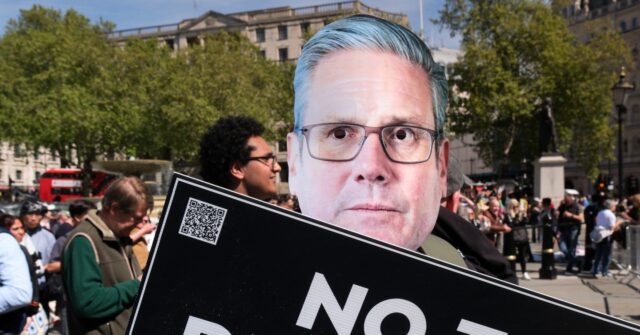
The British government has announced plans to mandate tech giants like Apple and Google to implement age verification measures to prevent children from accessing pornography and even from taking photographs of themselves. Critics warn that the demands will result in the imposition of effective digital IDs on law-abiding adults.
Prime Minister Sir Keir Starmer said on Monday that his government will introduce legislation that will force tech companies to introduce “device-level controls to prevent children from taking, sharing or viewing nude images” within three months or face major fines or even potential criminal charges.
According to the BBC, Starmer has told some major tech firms that they could activate systems that are already built into their platforms to verify the age of users and thus prevent children from accessing or sending explicit material.
“This is not an impossible challenge. These are some of the most innovative companies in the world, and I believe they can solve it,” the prime minister said at a London Tech Week event.
However, civil liberties proponents have warned that such measures would likely require the collection of biometric data from law-abiding citizens to verify their age, which some fear could lay the groundwork for a digital ID system.

Silkie Carlo of the Big Brother Watch campaign group said on Monday: “Protecting children online is vital, but these are outrageous plans that will fail to address the underlying causes of online harm. This will only result in population-wide ID checks for all of us to use our phones, tablets and laptops.
“Put simply, the Labour Government is threatening ID checks for the internet. No one in a democracy should need to show their passport just to get online,” she warned.
Carlo said that those who refused to submit to identity checks would face having their internet access restricted with essentially child-locked devices, while children could still skirt the restrictions by simply using adult-registered devices.
In addition to implementing effective ID checks through age verification systems, the government is also looking to force companies to implement programmes that scan private messages for child abuse material, which the controversial Online Safety Bill empowers the broadcaster regulator Ofcom to demand of tech companies.
Yet, some tech companies have warned that demands from the British government would force them to break their own encryption systems, with messaging platforms like Signal saying they would rather leave the UK market entirely than put their users’ privacy at risk.
“The history of digital technology is littered with the magical thinking of governments that have tried and failed to create backdoors that can only be accessed by ‘the good guys’ while remaining secure against threats from ‘everyone else’. These efforts have failed because what they’re attempting is impossible,” the company previously noted.
Big Brother Watch’s Silkie Carlo said: “The Government mandating that all phones in Britain require ID and surveillance software is a crossing of the Rubicon that would make the UK one of the most authoritarian internet regimes in the world. This extreme technological censorship requires rigorous public and parliamentary scrutiny that is currently totally missing.”
However, imposing new internet restrictions appears to be a key aim of the Labour Party while it remains in power. Indeed, former Safeguarding and Violence Against Women and Girls, Jess Phillips, cited failure on the front as a chief reason for her resignation last month, saying that because Labour governments “come around rarely”, the government should seize upon this “rare opportunity with the gusto” rather than “waiting around for a crisis to push for faster progress.”
Shortly after Phillips’ resignation, Prime Minister Starmer announced plans for his government to introduce national digital IDs, a longtime aim of previous Labour Prime Minister Sir Tony Blair, which was shelved following the 2010 general election amid national pushback against what was seen as an authoritarian and simply un-British idea.
It remains to be seen if Starmer will be able to cling onto power long enough to actually implement such a system, with the PM facing the prospect of a leadership challenge in the coming weeks. Regardless, Reform UK boss Nigel Farage has vowed to overturn any digital ID system if given power at the next general election.
However, the Labour Party seems to be rallying around the cause, with Home Secretary Shabana Mahmood issuing a forceful statement on Monday defending the government’s plans, saying: “I make no apologies for doing the right thing to protect children from paedophiles. This is about stopping the coercion and sextortion of children, not surveilling or policing people’s phones.
“This technology is already on devices. The tech firms just need to switch it on to block children from seeing nude imagery.”
Mahmood asserted that the scheme would use systems on devices locally, meaning that any message scanning would not be collected by the state. She also said that “all adults will be able to switch off the protections if they are over 18,” ignoring the complaint from critics that they have to prove their age with digital ID checks in the first place.
Even those on the left vying to replace the current government appear set to double down on censorship, with Lucy Powell, a top ally of Labour leadership hopeful Andy Burnham, reportedly saying over the weekend that the government should seek to regulate social media algorithms, which she said have fostered “echo chambers” and “rabbit holes” for young people and adults alike which presumably do not fit in line with the left-liberal narrative preferred by the London political establishement.
Follow Kurt Zindulka on X: Follow @KurtZindulka or e-mail to: kzindulka@breitbart.com
Read the full article here


