




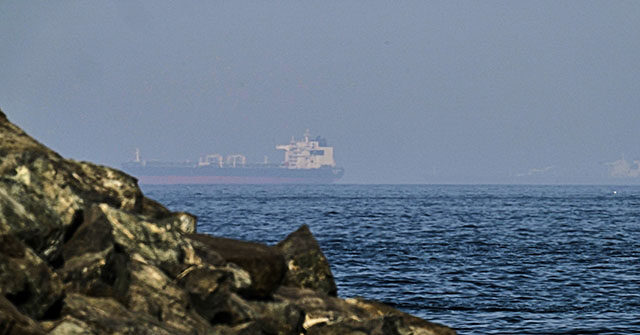
Reuters on Thursday reported that several tankers loaded with oil from the United Arab Emirates (UAE) have been able to pass safely through the Strait of Hormuz, evading detection by Iranian terrorists using the same techniques Iranian and Russian “shadow fleet” ships have employed to escape sanctions enforcement.
The UAE’s Abu Dhabi National Oil Company (ADNOC) reportedly used the classic shadow fleet tactics of disabling location trackers and performing ship-to-ship oil transfers at sea to get four tankers, carrying at least six million barrels of crude oil, through the Strait of Hormuz.
“The shipments were either unloaded by ship-to-ship (STS) transfer to a vessel that later carried the oil to a Southeast Asian refinery, unloaded into storage in Oman or sailed directly to South Korean refineries,” the report said.
WATCH — Trump: There Could Be Future Where U.S. Energy Companies Operate in Iran:

ADNOC was shipping 3.1 million barrels per day (bpd) before the Iran conflict began, so the stealthy – and risky – shipments represented only a fraction of the company’s normal output.
Bloomberg News reported on Thursday that ADNOC slipped two ships filled with liquefied natural gas (LNG) past Iran – and might have been able to move even more, because the UAE is apparently also using the shadow fleet tactic of “spoofing” or broadcasting false location data from its ships.
At least three empty ADNOC LNG carriers have disappeared from computer tracking systems by shutting off their transponders as they approached the Strait of Hormuz.
“Satellite imagery shows ships continuing to dock at the terminal, even as no tankers broadcast positions near the plant,” Bloomberg noted.
ADNOC did not respond to requests for comment on any of these reports.
On Tuesday, the UAE said Iran targeted an ADNOC crude oil tanker Barakah with two drones as it passed through the Strait of Hormuz. The Emiratis condemned the incident as a “terrorist attack.”
Shadow fleet or “dark fleet” tactics have been developed and refined ever since sanctions were imposed on seaborne oil and cargo. At the end of 2025, industry analysts estimated the shadow fleet included at least 978 oil tankers, which is over 18 percent of the entire global tanker fleet.
Oil tankers sit at anchor offshore in the Strait of Hormuz off Bandar Abbas, Iran, Saturday, May 2, 2026. (Amirhosein Khorgooi/ISNA via AP)
Since the ships are difficult to track and often employ fraudulent registration paperwork, some analysts think the true size of the shadow fleet could be closer to 1,600 tankers, plus countless smaller coastal ships that help the deep-sea vessels shuffle their cargo around.
Some of the practices employed by these ships are dangerous, including disabling their Automated Identification System (AIS) transponders or broadcasting false location data, which can make them invisible to legitimate ships relying on the sophisticated AIS system, creating navigational hazards.
Iran’s Ports and Maritime Organization (PMO) on Thursday began broadcasting bizarre messages to the hundreds of commercial vessels trapped at the entrance to the Strait of Hormuz, offering a “range of services including food supplies, fuel, medical and health assistance, and authorized repair items.”
WATCH — Trump to Hormuz Strait Dependent Nations: Buy U.S. Oil or Find Some Courage and Open It Yourselves:
The messages, broadcast three times per day, claimed Iran is devoted to “maritime safety” – even as the terrorist Islamic Revolutionary Guard Corps (IRGC) continues threatening to attack civilian ships that pass through the strait.
The more optimistic interpretations of the message suggest it was a reciprocal gesture for the United States suspending its “Project Freedom” effort to move ships through the strait under U.S. military protection, ostensibly to allow time for ceasefire negotiations to proceed. The more pessimistic interpretation is that Iran is laying the groundwork for its new system of ransoms and “tolls” for maritime traffic.
“Practically, what Iranians are saying is that this is not a temporary new maritime regime; they are talking about a permanent change in the status of the strait, and they say they are not going to give up on that,” said Al Jazeera News correspondent Resul Serdar Atas.
Read the full article here


