







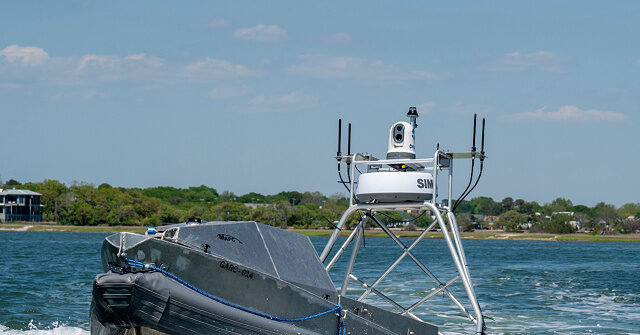
The United States has for the first time deployed autonomous, uncrewed drone speedboats in active combat operations against Iran, introducing a low-cost, asymmetric naval capability that officials say has already logged hundreds of hours patrolling key waterways under Operation Epic Fury.
Capt. Tim Hawkins, a spokesman for U.S. Central Command, confirmed to Reuters on Thursday that the vessels — known as Global Autonomous Reconnaissance Craft, or GARC — have been deployed for maritime patrols as part of the campaign.
“U.S. forces continue to employ unmanned systems in the Middle East region, including surface drone assets like the GARC,” Hawkins told the outlet, adding that the platform has “successfully logged over 450 underway hours and more than 2,200 nautical miles during maritime patrols in support of Operation Epic Fury.”
The deployment marks the first acknowledged use of uncrewed surface vessels by the United States in an active conflict, underscoring a broader shift toward autonomous systems designed to operate at a fraction of the cost of traditional naval platforms while expanding surveillance and strike capabilities.
The vessels, built by Maryland-based BlackSea Technologies, are designed for intelligence, surveillance, and reconnaissance missions, but can also support mine countermeasures, communications relay, anti-submarine warfare, and the deployment of aerial and underwater drones.

Each craft can reach speeds exceeding 40 knots and carry payloads of up to 1,000 pounds, according to manufacturer specifications, offering a flexible platform capable of supporting a wide range of maritime operations at an estimated cost of roughly $250,000 per vessel — a fraction of the roughly $2 billion price tag of a U.S. Navy destroyer.
Officials have not indicated that the drone boats have been used in offensive strike roles, though their design allows for adaptation into expendable, one-way attack systems increasingly seen in modern conflicts.
The Navy has maintained a growing unmanned presence in the region for years, including through its Bahrain-based Task Force 59 under the U.S. Fifth Fleet, which focuses on integrating autonomous platforms and artificial intelligence into maritime operations.

The use of such systems comes as the United States and its allies confront Iran’s escalating campaign against commercial shipping in and around the Strait of Hormuz, where Tehran has effectively choked off normal traffic through missile attacks, drone strikes, and explicit threats against ships tied to countries it considers aligned with the United States and Israel.
Iran’s Islamic Revolutionary Guard Corps said Friday that ships traveling “to and from” ports belonging to countries it described as supporters of the “Zionist-American enemies” would no longer be permitted to cross the strait, regardless of destination or shipping corridor used.
The deployment also reflects lessons drawn from recent conflicts, including Ukraine’s use of explosive-laden drone boats against Russia’s Black Sea Fleet, demonstrating how low-cost, hard-to-intercept systems can reshape naval warfare in contested waters.
The development comes as the United States weighs additional military options in the region, including the potential deployment of up to 10,000 additional ground troops, while continuing operations aimed at degrading Iran’s military capabilities and restoring freedom of navigation through the strait.
President Donald Trump has repeatedly rebuked European allies for declining to contribute military resources to efforts to reopen the waterway as the conflict expands and pressure mounts to break Iran’s grip on the chokepoint.
While U.S. naval forces have long operated unmanned systems in the region, the GARC deployment marks the first acknowledged use of this class of uncrewed surface vessel in an active conflict.
U.S. strikes have already destroyed 92 percent of Iran’s largest naval vessels, according to U.S. Central Command commander Adm. Brad Cooper, further shifting the maritime balance as autonomous systems take on a more prominent operational role.
Joshua Klein is a reporter for Breitbart News. Email him at jklein@breitbart.com. Follow him on Twitter @JoshuaKlein.
Read the full article here


