




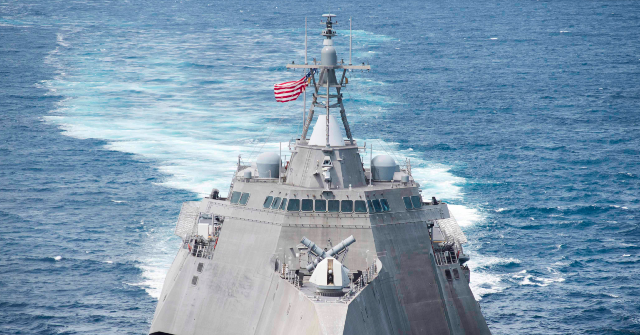
The U.N. Navy is aggressively enforcing the blockade against Iran, according to a U.S. official who said two oil tankers attempting to leave Iran were intercepted and turned back by an American destroyer on Tuesday.
The unnamed U.S. official told Reuters that two tankers departed from Iran’s port of Chabahar on the Gulf of Oman, only to be intercepted by a U.S. Navy destroyer that instructed them by radio to turn around. Both ships complied with the order.
Chabahar is a port city on the southeastern coast of Iran. It was originally constructed in 1983, to give Iran alternatives to shipping through the Persian Gulf during the long and bloody Iran-Iraq War.
In recent years, the Indian government made about $500 million in investments to expand the two major port complexes at Chabahar, giving them more deep-water berths for large cargo vessels.
These investments were made in concert with India’s development of a railroad through Afghanistan intended to link Chabahar with inland destinations that India cannot reach without going through Pakistan or the disputed Kashmir region — much as China is using the China-Pakistan Economic Corridor (CPEC) project under its Belt and Road Initiative (BRI) to move Chinese exports to the Gulf of Oman.
In the summer of 2025, India appeared to liquidate its interests in Chabahar, shortly before the United States imposed heavy sanctions on the port city. The U.S. granted India a six-month waiver from the sanctions on Chabahar — and that waiver is due to expire in less than two weeks.
Some analysts view the April 26 expiration date of the sanctions as a ticking clock on India’s hopes of preserving its huge investments in Chabahar by reaching a long-term sanctions waiver agreement with the United States, or possibly by hoping for the U.S. to lift sanctions on Iran as part of a peace deal.
Last week, after the U.S. temporarily waived sanctions on Iranian oil for ships already loaded with product, India granted special permission for four U.S.-sanctioned vessels to dock at Indian ports to sell their cargo. India’s usual requirements for seaworthiness were waived to allow for a hasty docking. Two of those ships appear to have originated from Chabahar.
It was not clear from the Reuters report if either of the ships intercepted by the U.S. Navy on Tuesday were connected to India. The Pentagon did not respond to a request for more details from Fox News on Wednesday.
U.S. Central Command (CENTCOM) confirmed on Tuesday that “U.S. Navy guided-missile destroyers are among the assets executing a blockade mission impacting Iranian ports.”
“The blockade is being enforced impartially against vessels of all nations entering or leaving coastal areas or ports in Iran,” CENTCOM said.
“A typical destroyer has a crew of more than 300 Sailors that are highly trained in conducting offensive and defensive maritime operations,” the statement added, possibly as fair warning to “shadow fleet” tankers thinking about slipping past the blockade with their usual tactics of false identity and positional broadcasts.
Ship tracking data from the first full day of the blockade on Tuesday suggested that a few shadow fleet ships might have thought about challenging the blockade, but turned back when they got close to those U.S. Navy destroyers.
Noam Raydan of the Washington Institute for Near East Policy told Reuters on Tuesday that it was too early to tell if any ships managed to slip past the blockade by “going dark.”
“We just don’t know yet how effective it is. We are still in day two,” Raydan said.
The Jerusalem Post on Wednesday suggested a complex geopolitical game is being played with the blockade, possibly including the U.S. Navy choosing to be a bit less vigilant against Chinese-linked ships to avoid the high political tensions that would result from boarding or attacking them.
For example, the Jerusalem Post’s analysts believe the China-linked tanker Rich Starry, which made a highly visible U-turn away from the U.S. Navy blockade line on Tuesday, tried again later on Tuesday night and was able to slip through — or was quietly allowed to pass.
“The shadow fleet that moves Iranian oil was built for exactly this game: false flags, spoofed transponders, and ship-to-ship transfers off the coast of Malaysia,” the report noted.
“China’s customs records show zero imports from Iran since 2022, yet its recorded ‘Malaysian’ crude imports in 2025 reached 1.3 million barrels per day, more than double Malaysia’s entire production. That evasion network has been running for years,” it observed.
The Jerusalem Post nevertheless concluded that China’s shipments of Iranian oil would be reduced to a trickle by the blockade, and Beijing does not seem intent on forcing a confrontation with the U.S. by openly challenging it, so China probably will not be coming to Iran’s rescue.
Read the full article here


