

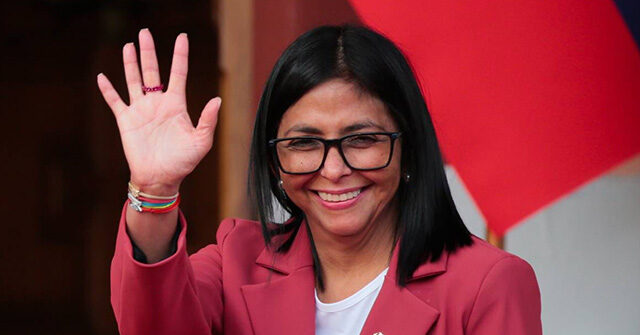
The U.S. Department of the Treasury’s Office of Foreign Assets Control (OFAC) on Wednesday announced that it lifted sanctions on Venezuela’s acting President Delcy Rodríguez.
Rodríguez, a staunch socialist, is one of the over 160 members of the Venezuelan socialist regime who have been subject to U.S. sanctions over the past decade for their role in the numerous instances of human rights violations and repression committed by the ruling socialists throughout the tenure of now-deposed dictator Nicolás Maduro.
She was originally sanctioned in September 2018 during President Donald Trump’s first term alongside her brother and current head of the National Assembly Jorge Rodríguez, Defense Minister Vladimir Padrino Lopez, and Maduro’s wife, Cilia Flores — who is presently detained at the Metropolitan Detention Center (MDC) in Brooklyn, facing drug trafficking charges alongside her husband in New York.
Rodríguez welcomed the decision through her social media accounts.
“President Trump’s decision is a significant step in the right direction to normalize and strengthen relations between our countries. We trust that this progress and determination will ultimately lead to the lifting of the additional active sanctions on our country,” Rodríguez wrote.
“This will allow for rapid economic development, investment, and an effective bilateral cooperation agenda for the benefit of our peoples. Let’s keep working toward a prosperous Venezuela for all,” she continued.
Rodríguez was sworn in as “acting president” and has been in charge of the Venezuelan regime after President Trump authorized a U.S. law enforcement operation to arrest Maduro and Flores on January 3. At the time of Maduro’s arrest, Rodríguez concurrently served as Maduro’s Vice President and Oil Minister, having served in other high-ranking positions under the Maduro regime over the past decade.
In the weeks following the dictator’s arrest, Delcy Rodríguez has collaborated with the Trump administration, seeking American help and investment to restore its rundown oil and energy sectors in return for sharing its oil.
As part of her collaboration, Rodríguez has met with several U.S. officials, including Energy Secretary Christ Wright, Secretary of the Interior Doug Burgum, and U.S. Southern Command (SOUTHCOM) commander Marine Gen. Francis L. Donovan. Rodríguez has held several phone conversations with President Trump over the past months, and in late February she described Trump as a “friend” and “partner.”
The lifting of Rodríguez’s U.S. sanctions comes nearly a month after the United States and Venezuela formally restored diplomatic ties, ending a seven year-long rupture between the two historically friendly nations after Maduro unilaterally had Venezuela cut ties with America in early 2019.
The U.S. embassy in Caracas, which remained closed since March 2019, formally reopened its doors this week, with Ambassador Laura Dogu at the head of the American diplomatic mission. The reopening of the embassy marked a new step in President Trump’s three-phase plan — stabilization, recovery, transition — toward restoring democracy in Venezuela following Maduro’s downfall.
“On Venezuela, you remember we had a three-pronged plan. The first one was stabilization. We didn’t want the country having a mass migration. We didn’t want civil war. We didn’t want upheaval in the streets. That’s largely been achieved — in fact we have not seen any of that,” U.S. Secretary of State Marco Rubio told Fox News this week.

Speaking to reporters on Wednesday, White House spokeswoman Anna Kelly said the move is a sign of progress between the United States and Venezuela.
“As President Trump has said, Delcy Rodriguez is doing a great job and is working with the United States very well,” Kelly said. “This decision reflects progress in the joint efforts between our two countries to promote stability, support economic recovery, and advance political reconciliation in Venezuela.”
“It’s only been three months. What’s been achieved in Venezuela in just three months is nothing short of extraordinary. Ultimately, there will have to be a transition phase. There will have to be free and fair elections in Venezuela, and that point has to come,” Rubio told Fox News.
“It’s not forever, but we have to be patient, but we also can’t be complacent. So I feel very good about the progress we’ve made in Venezuela in three months,” he continued.
Christian K. Caruzo is a Venezuelan writer and documents life under socialism. You can follow him on Twitter here.
Read the full article here