






The administration of President Donald Trump was among 14 countries publishing a joint statement on Sunday to mark the tenth anniversary of a ruling by the Permanent Court of Arbitration at The Hague that found China’s claims to nearly the entire South China Sea invalid.
In the statement, the countries reminded the Chinese Communist Party that the international tribunal ruling was “final, legally binding, and definitive” and that it found “there is no legal basis for China’s expansive maritime claims.” In addition to the United States, the Philippines, which was the plaintiff in the dispute at the Hague, signed the statement along with Japan, Australia, New Zealand, the United Kingdom, Latvia, Lithuania, Estonia, Canada, Germany, Italy, Slovenia, and Romania.
China claims almost the entirety of the South China Sea, imposing its positions through the publication of a map with a design known as the “nine-dash line.” The “nine-dash line” circles maritime territory belonging to Taiwan, the Philippines, Vietnam, Malaysia, and Brunei, as well as waters off the coast of Indonesia’s Natuna Island. Territories such as the Spratly and Paracel Islands, belonging to the Philippines and Vietnam, have become especially contested territories as China uses its naval might to scare away, and in some cases sink, domestic ships looking to fish or otherwise use their own waters.
In 2016, the Permanent Court of Arbitration ruled that China’s “nine-dash line” claims were invalid and that any attempt to enforce them would violate international maritime law.
“China’s claims to historic rights, or other sovereign rights or jurisdiction, with respect to the maritime areas of the South China Sea encompassed by the relevant part of the ‘nine-dash line’ are contrary to the Convention,” the ruling read, referring to the United Nations Convention on the Law of the Sea (UNCLOS), the international standard for maritime law. It went on to declare that those claims were “without lawful effect to the extent that they exceed the geographic and substantive limits of China’s maritime entitlements under the Convention,” the judgment reads.
“The Tribunal concluded that there was no legal basis for China to claim historic rights to resources within the sea areas falling within the nine-dash line,” it asserted.
The 14-country statement published on Sunday emphasized the validity of this ruling, which China has largely ignored.
“We reaffirm that the Award rendered ten years ago by the Arbitral Tribunal is a significant milestone and is final, legally binding, and definitive between China and the Philippines with respect to the maritime entitlements and claims addressed by the Arbitral Tribunal,” the countries declared.
“We reaffirm the Arbitral Tribunal’s decision that there is no legal basis for China’s expansive maritime claims in the South China Sea, including those based on ‘historic rights,’” the statement continued. “We reiterate our strong opposition to any destabilizing or unilateral actions including by force or coercion that threaten peace and stability in the region.”
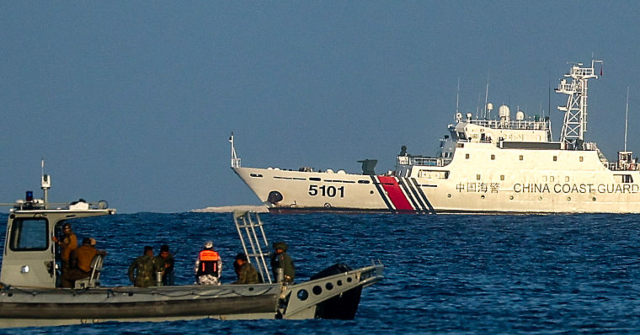
The countries especially condemned China for using its coast guard and military “to harass, obstruct, or intimidate lawful operations by other States at sea or in the air, and in so doing endanger the safety of personnel and fishermen and seriously degrade regional peace and security.”
The Chinese Communist Party regularly uses its coast guard, navy, and other assets to harass and attack Vietnamese, Filipino, and other fishing boats attempting to use domestic waters. China has also destroyed several ecosystems in the South China Sea, marine biologists have lamented, by building artificial islands off of reefs, creating military bases that essentially work as stationary aircraft carriers. John McManus, a professor of marine biology at the University of Miami in Florida, told Radio Free Asia in 2020 that some coral reefs in the area were “gone forever” as China had “infamously dredged up Fiery Cross Reef, Subi Reef, Mischief Reef, Woody Island, and some other islets between 2014 and 2017, to make way for artificial islands that now host its military.” Some of those sites have been equipped with a variety of high-tech military equipment, including fighter jets.
In 2016, the Chinese Communist Party responded to the Hague ruling by declaring it invalid, denying the authenticity of international law.
“The award is null and void and has no binding force,” the Chinese Foreign Ministry plainly responded at the time. Genocidal dictator Xi Jinping issued his own statements declaring that the territory of other countries in the South China Sea “have been China’s territory since ancient times” and confirming Beijing would ignore the ruling.
The state-run Global Times Chinese newspaper responded with similar dismissiveness and vitriol to the statement by the 14 countries on Monday, calling it “a piece of waste paper” and equating the statements to colonialism.
“We hereby reiterate that the so-called “award” is nothing more than an illegal, null and void piece of paper with no binding force,” the state newspaper stated. “China neither accepts nor recognizes the so-called “award” and opposes and rejects any claims or actions based on it.”
The article went on to call the original ruling a “political farce” and the countries signing the statement “absurd.”
“Apart from the Philippines, none of the 14 countries is a claimant state in the South China Sea. What qualifications do they have to make irresponsible remarks about China’s territorial sovereignty and maritime rights and interests in the South China Sea?” the newspaper asked. “We advise these countries to abandon their outdated colonial mindset; the South China Sea is not their backyard, and China is certainly not a target they can intimidate at will.”
Follow Frances Martel on Facebook and Twitter.
Read the full article here


