







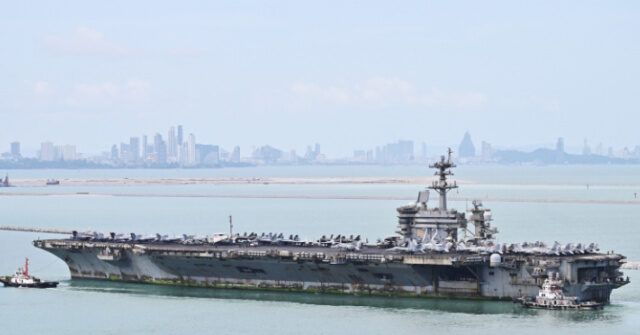
U.S. forces destroyed five IRGC-linked oil tankers Tuesday after Iran twice targeted an American warship with ballistic missiles, carrying out Washington’s warning that continued attacks on the U.S. Navy would exact an increasingly steep price on Tehran’s oil fleet.
U.S. Central Command (CENTCOM) said the American warship evaded both attacks over the past two days and continued patrolling regional waters, with no U.S. personnel harmed.
American forces responded by destroying four IRGC crude carriers — the M/T Kaviz, M/T Charminar, M/T Horizon 1, and M/T Riesco — in the Gulf of Oman and a fifth, the M/T Derya, near Kharg Island, Iran’s principal oil-export hub. The crews were ordered to abandon the vessels before they were struck and rendered inoperable.
CENTCOM said the tankers formed part of a multibillion-dollar shadow network used to finance the IRGC and its regional proxies, striking another source of revenue for Tehran as Washington intensifies its campaign to economically isolate the regime.

“Iran has no means by which to defend these vessels,” the command said.
Secretary of State Marco Rubio made the retaliatory policy explicit Tuesday, saying Tehran should expect to lose oil tankers each time it attempts to attack American naval forces.
“The back and forth is pretty straightforward, and that is that Iran continues to try to hit U.S. naval ships, and for every time they do that or try to do that, they’re going to lose tankers,” Rubio told reporters.
“I think you’ll see that again today,” he added.
Tuesday’s operation came just days after Washington demonstrated that President Donald Trump’s “tanker-for-tanker” policy would not necessarily remain a one-for-one exchange.
After the IRGC fired ballistic missiles toward a U.S. aircraft carrier and guided-missile destroyer Saturday, American forces destroyed three Iranian crude carriers. Neither American warship was hit.
CENTCOM Commander Adm. Brad Cooper warned afterward that further attacks would bring an even greater economic penalty.
“If you shoot at two of our ships, we will impose an even higher economic cost — taking out three of yours,” Cooper said.
He followed with a broader warning that took on new significance Tuesday: “We will not hesitate to defend American forces, and if necessary, destroy Iran’s limited and exposed oil fleet.”
Iran nevertheless targeted another U.S. Navy warship twice over the next two days, according to CENTCOM. This time, American forces destroyed five more tankers, bringing to eight the number of IRGC crude carriers destroyed or disabled since Saturday.
The escalating retaliation is unfolding alongside a broader Trump administration campaign aimed at choking off the oil revenues and financial networks sustaining the Iranian regime.
Treasury Secretary Scott Bessent said over the weekend that Operation Economic Outcast represents “the greatest economic isolation operation in the history of the world,” declaring that Washington intends to “asphyxiate this regime.”
Bessent described the combination of the U.S. naval blockade and sweeping sanctions as “one of the most powerful one-two punches in the history of economic isolation,” with American forces preventing Iranian crude from reaching foreign buyers while sanctions increasingly cut Tehran off from the financial networks needed to move the proceeds.
Energy Secretary Chris Wright made the administration’s objective similarly explicit Sunday, saying one of the military’s principal missions in the region is now preventing Iranian crude and related energy products from leaving the country.
“We are strangling their economy to try to bring either a change in policy from the existing regime or a new regime,” Wright said.
“Their current strategy is slowly failing for them.”
Kharg Island sits at the center of that pressure. The island has long served as Iran’s principal oil-export hub, handling roughly 90 percent of the country’s crude exports before the war and providing storage for tens of millions of barrels.
Trump repeatedly drew attention to the island over the weekend, sharing imagery depicting an attack on Kharg before punctuating one post with a three-word warning: “Bye bye, Kharg.”
Iran responded to Tuesday’s strikes by threatening to carry the confrontation into neighboring Gulf states.
The IRGC Navy ordered tanker crews in Kuwaiti and Bahraini ports and anchorages to immediately abandon their vessels, accusing the two countries, which host American forces, of complicity in the U.S. attacks.
The warning applied to tankers both anchored offshore and docked in port, according to the statement carried by Iranian state media.
“They will be targeted,” the IRGC warned.
Iran’s Khatam al-Anbiya Central Headquarters separately threatened strikes against American bases and interests throughout the Middle East if attacks on Iranian vessels continued.
IRGC Aerospace Force Commander Maj. Gen. Seyed Majid Mousavi went further, warning that an attack on Iranian tankers would begin “a domino chain of consequences” that he claimed only Tehran could stop.
Within hours, Iran launched a major missile barrage toward Jordan, where thousands of American troops are stationed and U.S. forces operate from several military installations.
Jordanian air defenses intercepted at least eight Iranian missiles over Amman and other parts of the kingdom, while Iranian state and semi-official media said the attack targeted the Muwaffaq Salti and Prince Hassan military bases.
Footage showed repeated interceptions in Jordanian skies as missiles crossed toward the kingdom, with additional projectiles reported near the Syrian border. There were no immediate reports of casualties.
The missile barrage came only hours after Tehran threatened American bases and interests across the region in retaliation for the U.S. strikes, widening an exchange that had begun with Iran’s attempted attacks on an American warship.
Tuesday’s five-tanker operation followed Saturday’s destruction of three Iranian crude carriers after the IRGC targeted two U.S. Navy warships, bringing to eight the number of IRGC-linked tankers American forces have destroyed or disabled in four days.
Rubio reiterated Tuesday that Washington intends to continue imposing the same response each time Iran attempts to strike American naval forces.
“For every time they do that or try to do that,” he said, “they’re going to lose tankers.”
Joshua Klein is a reporter for Breitbart News. Email him at jklein@breitbart.com. Follow him on Twitter @JoshuaKlein.
Read the full article here


