




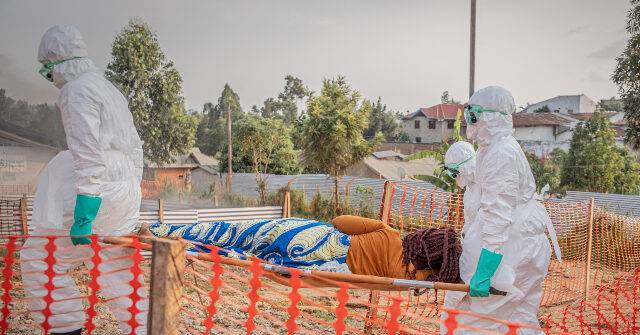
The White House said Monday that American citizens will not be allowed to return to the United States aboard commercial aircraft from the Democratic Republic of the Congo (DRC) due to the growing threat of Ebola.
The U.S. embassy in Kinshasa issued a health alert on Saturday, warning Americans not to “travel for any reason to the DRC” due to Ebola.
“If you travel and are exposed to Ebola, your life may be at serious risk. You may have to quarantine outside the United States at your own expense for up to 21 days and costs may be very significant. Your insurance may not cover these costs,” the embassy warned, presaging the travel ban that was to come.
Also on Friday, the U.S. Centers for Disease Control and Prevention (CDC) announced that a second American citizen who was performing humanitarian work in the Congo had tested positive for Ebola. The first was a missionary doctor who contracted the disease in May.
The new American patient arrived in Frankfurt, Germany, on Monday night and was taken to the Frankfurt University Hospital, where he is reportedly in stable condition. He has been identified as a male in his 60s, a full-time employee of the Samaritan’s Purse humanitarian organization.
The previous American Ebola patient was also treated in Germany, which has experience treating Ebola and relatively convenient air access to the DRC. The first patient made a full recovery and has since returned to the United States.
The White House said on Monday it had issued an order placing U.S. citizens in the DRC on a “do-not-board” list, which would prevent them from taking commercial flights back to the United States until they spent at least 21 days in a third country. This interval is considered long enough for persons infected with the Bundibugyo strain of Ebola to manifest visible symptoms of the disease.
A White House official told Reuters that roughly two dozen Americans had been planning to fly home from the DRC before the order was issued. The official said the State Department would provide support for everyone affected by the order.
The travel ban was issued under Title 49 in the U.S. Code of Federal Regulations, which allows the government to restrict travel when it presents a risk to public health and safety. The order for the travel ban reportedly came from Secretary of Health and Human Services Robert F. Kennedy Jr.
Non-U.S. citizens who visit the Ebola outbreak region, including Uganda and South Sudan in addition to the DRC, have been prohibited from traveling directly to the United States since May. Several other countries, including Canada and Mexico, have similar restrictions.
The Ebola Bundibugyo outbreak is still spreading with disturbing speed. On Tuesday, the World Health Organization (W.H.O.) expressed concern that many of the new cases are “outside our contact lists, and so are coming to us from unknown chains of transmission.”
The total number of officially documented cases in the outbreak stood at 1,926 as of Monday, with 702 fatalities. Health officials fear the true number of infections could be “at least two to four times” higher, because so many infections have not been treated.
“We’ve seen the fastest growth in a single month since the outbreak started, and of all the Ebola outbreaks that we have managed. Over the last few days, we’ve seen some of the highest numbers of new infections in a single day,” W.H.O. emergency program director Dr. Chikwe Ihekweazu said on Tuesday after returning from a trip to the DRC.
“You have to imagine that this is a fire. There’s something driving the fire in its heart, and it’s also expanding at the same time,” he said.
Read the full article here


