






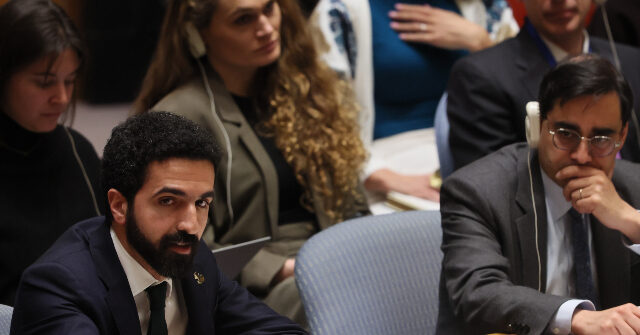
The government-run Syrian Arab News Agency (SANA) confirmed on Thursday that Syria had been elected as vice-chair of a committee to prepare the drafting of a United Nations convention on crimes against humanity.
SANA celebrated the election as a sign that the United Nations was aiding in the normalization of Syria’s current regime: an Islamist government run by the leader of the al-Qaeda offshoot Hayat Tahrir al-Sham (HTS) who came to power by toppling longtime dictator Bashar Assad. “Interim” President Ahmed al-Sharaa has repeatedly praised the alleged benefits of an Islamist government and implemented an Islamist constitution on the country in the first months following his seizure of power, despite the presence of a variety of religious minorities in the country.
Ibrahim Olabi, Syria’s representative at the U.N., told SANA that the election, which makes Syria the second most-powerful member state on that committee after the chair, Ireland, was a vote of confidence for the HTS government.
“This outcome highlights the confidence of member states in Syria’s contributions to global forums,” he said. SANA added that Olabi cited Syria’s recent history of over a decade of war and related atrocities as relevant in the drafting of any international legal documents to address crimes against humanity. The Syrian government agency was clear to blame the Assad regime for these crimes, although human rights organizations have documented a wide array of atrocities committed by both Assad and Syrian “rebel” groups, including HTS.
“The Syrian representative described the election as part of the country’s strategy to pursue active diplomacy and play a constructive role on international issues, leveraging its experience and expertise,” SANA added.
The formal name of the title Syria was elected to hold in the forum is “Vice Chair of the Bureau of the First Preparatory Committee of the United Nations Conference of Plenipotentiaries on Prevention and Punishment of Crimes against Humanity.” The “U.N. Conference of Plenipotentiaries on Prevention and Punishment of Crimes against Humanity” is its own body, one that will draft an international legal instrument formally defining what “crimes against humanity” are. The U.N. General Assembly passed a resolution in November 2024 – a month before the fall of Assad in Syria – agreeing to establish such a committee, expected to meet in 2027 and 2028. Before that, however, it also established a “preparatory committee” to prepare for the main committee; this is where Syria will hold its vice chairmanship.
The committee to prepare for the committee is meeting this year and was scheduled to conclude its first round of talks on Friday. The General Assembly tasked it with establishing “rules of procedure” and organization for the main committee. The Assembly also decreed that other “working groups” in anticipation of the main committee would meet.
There is currently no single, binding definition of crimes against humanity in international law, though some legal scholars consider them part of peremptory norms, non-negotiable international legal principles whose violation is prosecutable in any court. Today, the only court equipped to address crimes against humanity on a global level is the International Criminal Court (ICC). The ICC prosecutes individuals, not states, and has jurisdiction over crimes against humanity, genocide, and war crimes.
ICC documents currently list a series of crimes that fall under the definition of “crimes against humanity,” including murder, rape, enslavement, apartheid, and a catch-all category of “other inhumane acts” when such acts are “committed as part of a large-scale attack against any civilian population.”
The United Nations has not directly addressed at a leadership level the authority vested in Syria. Secretary-General Antonio Guterres did address the situation in Syria during a press conference on Thursday, responding to a reporter asking about the current conflict between the Syrian government and U.S.-aligned Syrian Kurds, who operate one of the most effective forces against jihadists in the region, the Syrian Democratic Forces (SDF).
“There is an history of persecution to Syrian Kurds that is real and that I recognize,” Guterres asserted. “Now, at the present moment, I think we need to, first of all, recognize that this problem was solved. The Government has now issued a decree that confers nationality to all Syrian Kurds. This is solved.”
The Syrian government signed an agreement this month, as Guterres noted, to grant citizenship to all Syrian Kurds, but in exchange the SDF will effectively have to dismantle and accept the authority of Damascus, as well as give up control of all Kurdish territory in Syria to Damascus. Syrian Kurdish organizations have denounced the regime and its affiliated jihadist fighters for committing various atrocities against Kurds after the agreement was announced, including beheadings and mass killings. Social media footage of a jihadist celebrating while holding a braid of hair he claimed was cut off the head of a dead Kurdish female soldier added to the widespread outrage among Kurds. Guterres did not directly address this situation in his remarks, calling the matter “solved.”
The United Nations has a longstanding record of empowering authoritarian regimes. The Human Rights Council in particular has been the subject of much controversy for giving seats to some of the world’s most repressive human rights violators. Currently among the members of the Council are China, Ethiopia, and South Africa – governments accused of genocidal acts – and several other authoritarian states such as Cuba, Qatar, and Pakistan.
Follow Frances Martel on Facebook and Twitter.
Read the full article here


