


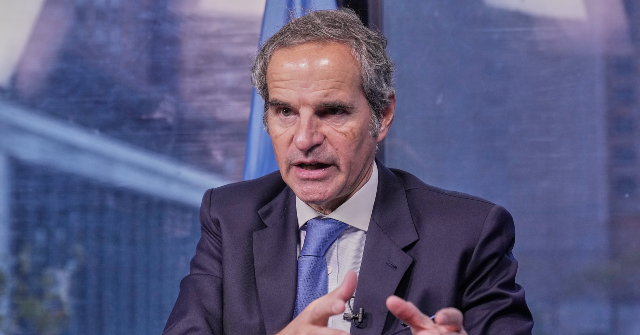
The Director General of the International Atomic Energy Agency (IAEA), Rafael Grossi, warned over the weekend that the world is at risk of a new nuclear arms race.
Grossi is the current head of the United Nations’ nuclear watchdog and one of the five candidates vying to become the next U.N. Secretary General once António Guterres finishes his term at the end of 2026. Grossi spoke with The Telegraph on Sunday on the current state of nuclear weapons around the world, particularly those of Russia and the United States, as well as the interest in obtaining nuclear weapons expressed by other countries in recent times.
The IAEA chief told The Telegraph a nuclear arms race was his “worst fear,” and warned, “At some point, we are going to see a crack in the system. And then we’ll have a domino [effect]. It is a very, very fragile position.”
Grossi affirmed that rising conflict and instability in the world could lead to such nuclear proliferation — a growing concern of the IAEA and among top-level diplomats.
“It’s not the case right now. But I think it’s fair enough that we highlight the need to reinforce and recommit to non-proliferation beacons if you want stability in a world that I think is in need of those,” Grossi said.
Grossi detailed that there have been talks among countries in Europe, Asia Minor, and the Far East towards the possibility of breaching the Non-Proliferation Treaty (NPT) and adopting what said countries are allegedly describing as “friendly proliferation.” The NPT is an agreement signed in 1970 by 191 countries that promised to to obtain nuclear weapons while recognizing that there are five nuclear-weapon states: the United States, the United Kingdom, France, Russia, and China.
“There are all these things which fill me with concern because I believe that a world with 20 nuclear weapon states or more would be extremely dangerous,” Grossi said.
The IAEA chief explained that countries such as Poland, South Korea, Sweden, and Japan have engaged in renewed debates about whether or not acquire nuclear weapons. Similarly, others, such as Poland, Turkey, and Saudi Arabia have expressed interest in pursing nuclear weapons.
The Telegraph, citing statistics from the International Campaign to Abolish Nuclear Weapons, detailed that the U.S. and Russia hold 90 percent of the world’s nuclear warheads.
Referring to Article 6 of the NPT, which requests that nuclear-armed states enter in talks towards nuclear disarmament, Grossi said, “At this point in history, it is not something that we are going to be seeing.”
“Of course it’s an aspiration, it is there, we all want to move in that direction, but I am a realist,” he continued.
Asked of the IAEA has the full picture when it comes to China’s expanding nuclear weapons program, Grossi answered, “Yes and no,” and explained that although he has had “good collaboration” from China, their behavior is different from other nuclear-armed countries.
“We are seeing something different. What we are seeing is a very steady growth in nuclear arsenal,” Grossi said. “So do I see this with concern in a certain sense? Yes, because I think a world with less nuclear weapons is better than a world with more.”
On the subject of Iran’s nuclear program, the threat of Iran obtaining a nuclear weapon, and the ongoing war in the Middle East, Grossi argued that any prospective deal between Iran and the United States would be “worthless” without the U.N. nuclear agency’s involvement and emphasized that, without verification, “any agreement is no agreement.” Last week, Grossi told reporters that any deal to limit Iran’s nuclear development would require the country to agree to international oversight.
“It’s an illusion of an agreement, or it’s a promise, which you don’t know whether it will be complied with or not,” he said, adding that the IAEA would be able to “confirm and certify” any agreement.
“We know Iran very, very well, all the facilities. We are the only ones who could guarantee absolute impartiality in the work,” Grossi stressed. “Then if the parties agree to do something else, well, it’s in their freedom to do that. But I doubt it very much.”
On the possibility of the United States seizing Iran’s nuclear material by force should Iran not relinquish it, Grossi told The Telegraph that there are “inherent challenges” to such, and said that although he has no doubt that the U.S. military is capable of such a fear, said materials are a “delicate thing to handle, to manipulate, to move around.”
“There is also an issue of access, which is possible, of course, but like in any other facility that has been bombarded, attacked, there are issues of the structural stability of the building and things like that,” he said.
Christian K. Caruzo is a Venezuelan writer and documents life under socialism. You can follow him on Twitter here.
Read the full article here