





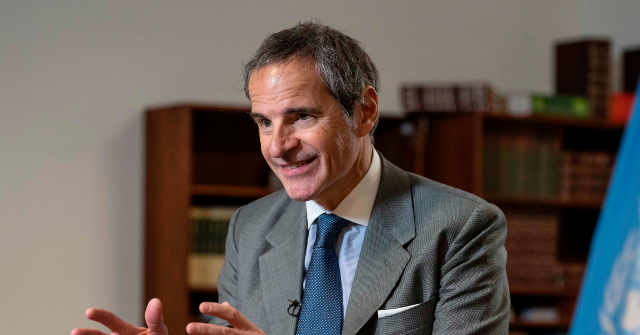
The head of the International Atomic Energy Agency (IAEA), Rafael Grossi, cheered the signing of a memorandum of understanding between America and Iran that allows for the end of active hostilities, especially appreciating that it carved out an oversight role for his agency.
President Donald Trump announced this weekend that, after months of negotiations, the Iranian terror regime had agreed to a temporary deal to extend a ceasefire that had paused “Operation Epic Fury” in April. Prior to the pause, the U.S. military had engaged in widespread bombing of Iranian military targets and, alongside the Israel Defense Forces (IDF), eliminated dozens of senior Iranian officials, among them dictator Ali Khamenei. Among several reasons for the American attack, which began in February, was Iran’s insistence on engaging in illicit nuclear development, particularly the enrichment of uranium at rates that are not compatible with any known civilian use. President Trump has repeatedly stated that he would not allow Iran to possess a nuclear weapon given the regime’s regular threats to destroy the nation of Israel and Iran’s heavy and consistent investment in a network of terror organizations including Hamas, Hezbollah, Palestinian Islamic Jihad, the Houthis of Yemeni, and a host of Iraqi Shiite paramilitaries.
The IAEA has for years expressed frustration with the Iranian regime, as it is a signatory to the nuclear Non-Proliferation Treaty (NPT) and has international legal obligations to allow the agency to inspect its nuclear sites. Tehran has all but banned IAEA inspectors from the country, however, save for some minor operations and meetings with officials that did not allow them to have appropriate access to the information they need to enforce international law. In his comments on Thursday, Grossi emphasized the importance of having that access.
“The fact that the indispensable role of the IAEA is recognized is a sound point of departure, and now it’s for us to sit down with our American colleagues, our Iranian colleagues, and start formulating the concrete steps that will have to be taken,” he told reporters. “So I think it’s good that the memorandum is there. Now the technical work starts.”

Grossi insisted that he was proceeding in his work assuming “good faith” from both America and Iran.
“I think if they have signed it, if they have taken the step of signing this memorandum, this important document, it’s because everybody wants this to be a success,” he stated, adding in French, “We cannot allow ourselves to be frustrated by past failures. What has happened has happened. Now we have a chance and we need to seize it, and that is what we will try to do with all our force and conviction.”
The text of the memorandum of understanding between Iran and America, as verified by Breitbart News on Wednesday, requires the participation of the IAEA in two separate sections of its 14 points. In point 7, Washington agrees to help lift all sanctions on Iran if the Iranian government holds to the terms of the memorandum and of the “final deal” expected to specify terms around the Iranian nuclear program after 60 days of negotiations. IAEA sanctions are specifically identified on the list of those to be lifted.
As part of Iran’s commitment that it will never build nuclear weapons, the agreement states the country has “agreed to resolve the disposition of stockpiled enriched material pursuant to a mechanism that will be mutually agreed upon, in accordance with the schedule mentioned in paragraph 7, with the minimum methodology to be down blending on-site, under the supervision of the IAEA.”
President Trump reportedly signed a copy of the memorandum of understanding at the Palace of Versailles in France on Wednesday. Iranian state media confirmed that President Masoud Pezeshkian, who is subordinate to missing “supreme leader” Mojtaba Khamenei, also signed the agreement on Wednesday, and that Pakistani Prime Minister Shahbaz Shariz has also agreed to be a signatory; Pakistan assumed the role of lead mediator in the negotiations that resulted in the memorandum.
As head of the IAEA, Grossi has repeatedly called for Iran to abide by international law and allow IAEA inspections. He has also criticized the prior nuclear agreement between Iran and the United States, the “Joint Comprehensive Plan of Action” (JCPOA) brokered by former President Barack Obama in 2015.
“Nobody applies it, nobody follows it. There have been attempts to revive it here in Vienna. But unfortunately, although they were relatively close to success, they failed for reasons unknown to me, because I was not involved in the process,” Grossi complained about the JCPOA in 2024.
As negotiations continued for a new agreement in April, Grossi insisted that a new agreement must have more robust protections than the JCPOA.
“Iran has a very ambitious, wide nuclear program, so all of that will require the presence of IAEA inspectors,” he said at the time. “Otherwise, you will not have an agreement. You will have an illusion of an agreement.”
According to reports this month, Grossi’s update to the IAEA Board of Inspectors in early June included an admission that, due to Iranian obstruction, the agency did not have information about the status or amount of enriched uranium the country possesses. In June 2025, President Trump approved airstrikes on Iran’s three largest enrichment sites in Fordow, Natanz, and Isfahan. According to Grossi, what happened to the enriched uranium there after the bombings remained a mystery as of early June.
“It is now almost one year that the Agency has had no access to any of the declared nuclear facilities affected by the military attacks of June 2025, therefore the Agency has lost continuity of knowledge of the previously declared nuclear material at those facilities,” Grossi reportedly explained. “This gives rise to a proliferation concern as this nuclear material includes 440 kg of highly enriched uranium, which the Agency has not been able to verify since June 2025.”
Follow Frances Martel on Facebook and Twitter.
Read the full article here


