







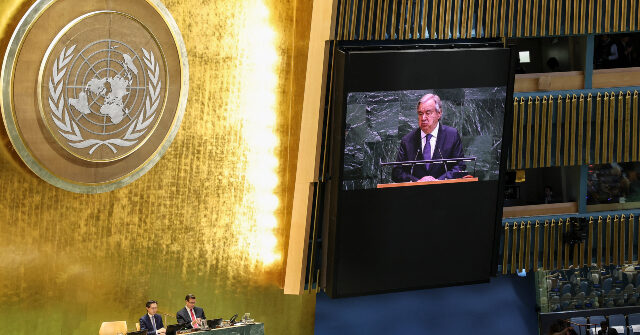
The United States strenuously objected on Monday when the United Nations gave Iran a vice-presidential role in a month-long conference to review the Nuclear Non-Proliferation Treaty (NPT).
Assistant U.S. Secretary for the Bureau of Arms Control and Nonproliferation Christopher Yeaw denounced the seating of Iran as a farce and an “affront” to the NPT, given that Iran has indisputably “demonstrated its contempt for non-proliferation commitments.”
“Rather than choosing to use this review conference to defend the integrity of the NPT and call Iran to account, we instead elect Iran a vice president. It is beyond shameful, and an embarrassment to the credibility of this conference,” Yeaw said.
The U.S. was joined in its objections by the United Arab Emirates (UAE), Australia, the United Kingdom, France, and Germany.
Iran’s ambassador to the International Atomic Energy Agency (IAEA), Reza Najafi, dismissed Yeaw’s statement as “baseless and politically motivated.”
Najafi said it was “indefensible” for the United States, as “the only state ever to have used nuclear weapons, and the one that continues to expand and modernize its nuclear arsenal,” to “position itself as an arbitrator of compliance.”
Iran was chosen for a vice-presidency by the “group of non-aligned and other states” during nominations on April 8.
The NPT conference met for the first time on Monday at U.N. headquarters in New York City, and is scheduled to last until May 22. The conference has 191 treaty members, the largest number of signatories to any arms control agreement in the world, and 34 vice-presidencies. It is scheduled to meet every five years to review the status of the NPT, which came into effect in 1970.
U.N. Watch Executive Director Hillel Neuer told Fox News Digital on Tuesday that Iran’s vice-presidency at the NPT conference was “part of a disturbing trend,” which also included Iran’s absurd nomination on April 13 to a U.N. body concerned with human rights, women’s rights, and counterterrorism.
“Iran has been accumulating senior roles across the U.N. system, from human rights bodies to key committees. Each appointment chips away at the credibility of international institutions, reinforcing the perception that political deal-making outweighs basic standards of conduct,” Neuer warned.
The IAEA formally declared Iran to be in non-compliance with its nuclear non-proliferation obligations in June 2025, after which Israel and the United States launched airstrikes against Iran’s uranium enrichment facilities. Tehran’s continued determination to acquire nuclear weapons prompted the U.S. and Israel to launch a wider series of strikes in March, a campaign named Operation Epic Fury by the United States.
Read the full article here


