
Close Menu
The Politic ReviewThe Politic Review
  • News
  • U.S.
  • World
  • Politics
  • Congress
  • Business
  • Economy
  • Money
  • Tech
  • More Articles
Trending

Breitbart Business Digest: The AI Inflation Shock Hidden Inside the PPI Report

May 13, 2026

Bodies of Three Women Pulled From Sea Off England’s South Coast

May 13, 2026

Watch Live: Kash Patel Testifies Before Senate

May 13, 2026
Facebook X (Twitter) Instagram
  • Donald Trump
  • Kamala Harris
  • Elections 2024
  • Elon Musk
  • Israel War
  • Ukraine War
  • Policy
  • Immigration
Facebook X (Twitter) Instagram
The Politic ReviewThe Politic Review
Newsletter
Wednesday, May 13
  • News
  • U.S.
  • World
  • Politics
  • Congress
  • Business
  • Economy
  • Money
  • Tech
  • More Articles
The Politic ReviewThe Politic Review
  • United States
  • World
  • Politics
  • Elections
  • Congress
  • Business
  • Economy
  • Money
  • Tech
Home»World»Trump’s China strategy is closer to Kissinger than Biden
World

Trump’s China strategy is closer to Kissinger than Biden

Press RoomBy Press RoomMay 13, 2026No Comments7 Mins Read
Share Facebook Twitter Pinterest Copy Link LinkedIn Tumblr Email VKontakte Telegram

An interview with Xiang Lanxin explores why Trump may seek a broader bargain with China and what it could mean for Taiwan, Russia and the EU

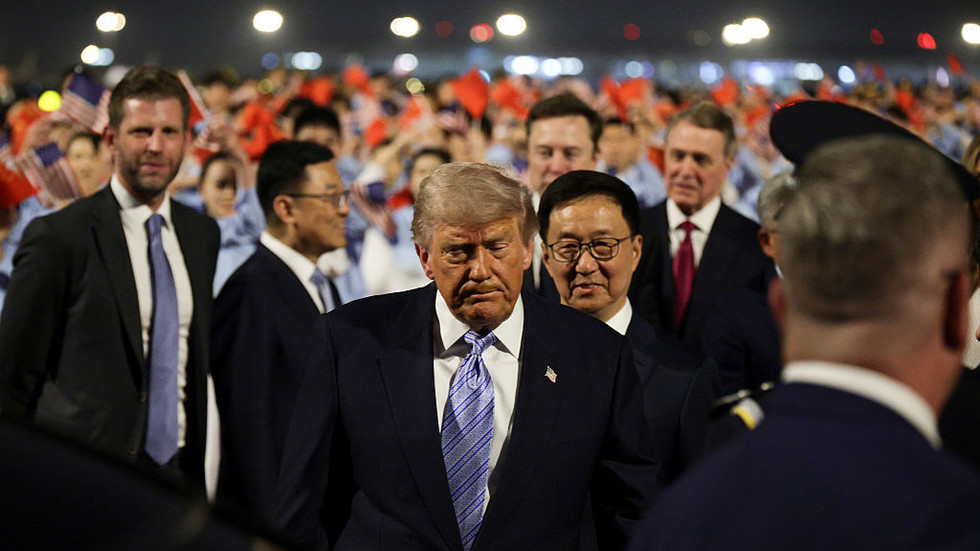
US President Donald Trump’s arrival in China this week is being treated as far more than another diplomatic photo opportunity. Relations between Washington and Beijing remain tense, competition between the two powers stretches across almost every domain, and yet both sides appear increasingly aware that uncontrolled confrontation would carry enormous costs. Against that backdrop, the prospect of a broader geopolitical bargain is once again entering the discussion.

According to Xiang Lanxin, visiting professor at East China Normal University and research fellow at the Stimson Center in Washington, Trump isn’t approaching China in the same ideological spirit that defined the Biden administration. The atmosphere in Washington, he argues, has shifted noticeably.

He spoke to Fyodor Lukyanov, the editor-in-chief of Russia in Global Affairs and research director of the Valdai International Discussion Club.  


Fyodor Lukyanov: What are the economic objectives of China and the US?

Xiang Lanxin: The economy is undoubtedly a bargaining chip. China wants fewer restrictions, greater market access, and perhaps a reduction in barriers in the high-tech sector, that is a key priority. The mood is competitive, but judging by the mood in Washington, the Trump team is much more conciliatory than the Biden administration, even in the high-tech sector. The ‘small backyard, high fence’ approach isn’t one the current White House is keen on. They realize it won’t work, as the administration is heavily influenced by the tech industry, particularly in the fields of semiconductors and cutting-edge technologies.

There are many such people on Vice President J.D. Vance’s team. History shows that it is impossible to stop technology from spreading across borders. Otherwise, the UK would still be dominating industry today. That’s simply not possible. People in the high-tech sector understand this very well. In that sense, I believe there are some positive signs.

Fyodor Lukyanov: But in the case of the United States, are there no illusions regarding relations with China, or are some changes still possible?

Xiang Lanxin: Of course, they are possible. We might even be talking about a ‘big deal’, which is exactly what Trump wants. Of course, there is no guarantee that they will actually be able to reach one. By a ‘big deal’, the Trump administration means an agreement that goes beyond the economy and touches on geopolitics, that is, the politics of the great powers. There are two key issues Trump would like to discuss with China. The first is how to stabilize the situation in the Taiwan Strait. Stabilize, precisely, because under the Biden administration the balance was seriously disrupted. Let me remind you that Biden made four statements deviating from the principle of strategic ambiguity regarding Taiwan (formal recognition of the PRC’s territorial integrity while maintaining separate relations with Taipei. – Ed.). That’s why Trump is proceeding cautiously. He wants to conclude a genuine agreement. I do not know whether this will take the form of a joint statement or some other format, but it is clear that he intends to take action. For China, even limited progress on the Taiwan issue would be a significant achievement. It would mean that the US would adopt a tougher stance against Taiwanese independence. 


When titans talk: What’s at stake for Trump’s China visit?

Previously, the phrasing ‘we do not support’ was used, and it left room for maneuver. In other words, roughly speaking: we, the Americans, don’t support it, but if the Taiwanese themselves want it, that is their business. If, however, the United States were to adopt the stance of ‘us against them’, that would be an entirely different approach. It implies a willingness, under certain circumstances, to take action, to work with China to prevent Taiwanese independence. This issue is currently on the negotiating table. Whether they will reach an agreement is another matter; it’s by no means certain. There’s serious opposition in the US Congress. But for China, the issue is of the utmost importance. The second point is Trump’s favorite idea of the ‘grand triangle’: Moscow – Beijing – Washington. And it seems to me that he takes this seriously.

The only foreign policy expert Trump really listened to was Henry Kissinger. He held him in very high regard. Kissinger advised him as far back as his first term in office: if this triangle is stable from a strategic point of view, everything else is secondary, including the European Union. Kissinger didn’t attach much importance to the EU at all. Remember his famous quote, which Trump likes: ‘Which partner is the most difficult? Not a rival, but an ally.’ I think Trump will raise the subject of this triangle at some point in his dialogue with China.

Fyodor Lukyanov: China is unlikely to stand in the way of such a triangle forming.

Xiang Lanxin: Yes, this isn’t about China, but about the European Union. Its existence precludes such a scenario. Will Trump push the EU to rethink what it has done? I would say the EU has made huge miscalculations, at least since the Biden administration, in its assessments of Russia, China, as well as the international economic system and the world order.


BRICS ministers to meet in India as Middle East tensions rise

As for China, the Europeans believed they could capitalize on Biden’s ideological orientation, as he sought to revive a Cold War-style framework in a new phase, to preserve their standing and influence in the world. But they didn’t expect Trump to return. They thought he was a one-off anomaly. And now the situation looks rather awkward for them, they have found themselves caught between two stools. During this period, they have distanced themselves from China – recall the EU’s tough statements on Taiwan. At the same time, they have severely damaged relations with Russia because of the war. As a result, the EU will be forced to seriously reconsider its position. They will have to rethink their relations with Russia. They have already begun to adjust their stance towards China. This is noticeable, although no concrete steps have been taken yet. As for Russia, however, nothing is happening yet. But a policy review is unavoidable there too. I think this will be a very significant change for them.

Fyodor Lukyanov: You once mentioned ‘military Keynesianism’ as a trend that, in essence, everyone is currently embracing. The term is more of a journalistic one, but the concept is clear, stimulating economic growth through government military spending. But what might that mean today? We’re not in the 1930s…

Xiang Lanxin: No, of course not the 1930s. And that situation is unlikely to be repeated unless the three major powers enter into direct military confrontation, which, in my view, will not happen under Trump. Incidentally, he is generally right when he says that under his leadership, the war in Ukraine might not have started at all. Local conflicts are not the main issue. Rather, the point is that military spending is being used as a tool to stimulate the economy and technological development.

Many European countries, as well as Japan, are already taking advantage of this opportunity. The war in Ukraine serves as a convenient pretext, particularly for Germany, for restructuring the economy, and the military sector is provided with a perfect justification. This is likely to be what happens. But this will not necessarily lead to an arms race and military conflict, unless Moscow, Beijing and Washington, for whatever reason, lose patience and enter into direct confrontation. But then that would truly be the end of the world.

This interview was produced specifically for the program International Review (Rossiya 24), and was translated and edited by RT team

Read the full article here

Share. Facebook Twitter Pinterest LinkedIn Tumblr Email Telegram Copy Link

Related Articles

World

Bodies of Three Women Pulled From Sea Off England’s South Coast

May 13, 2026
World

Trump Arrives in Beijing for Historic State Visit

May 13, 2026
World

Hundreds Flee Haiti’s Capital, Hospitals Shuttered amid Surge of Gang Violence

May 13, 2026
World

White House counterterror chief links Tucker Carlson to extremism

May 13, 2026
World

Trump Says He Will Secure Release of All Political Prisoners in Venezuela

May 13, 2026
World

Thousands march in EU capital against austerity measures (VIDEO)

May 13, 2026
Add A Comment
Leave A Reply Cancel Reply

Editors Picks

Bodies of Three Women Pulled From Sea Off England’s South Coast

May 13, 2026

Watch Live: Kash Patel Testifies Before Senate

May 13, 2026

Rep. Mike Lawler 'accosted' by Sen. Rand Paul's son

May 13, 2026

Trump’s China strategy is closer to Kissinger than Biden

May 13, 2026
Latest News

Trump Arrives in Beijing for Historic State Visit

May 13, 2026

Washington Manufacturer Fleeing Democrat State over Crime, Taxes, Political Climate

May 13, 2026

Georgia Senate Committee Subpoenas Stacey Abrams in Campaign Finance Violations Probe

May 13, 2026

Subscribe to News

Get the latest politics news and updates directly to your inbox.

The Politic Review is your one-stop website for the latest politics news and updates, follow us now to get the news that matters to you.

Facebook X (Twitter) Instagram Pinterest YouTube
Latest Articles

Breitbart Business Digest: The AI Inflation Shock Hidden Inside the PPI Report

May 13, 2026

Bodies of Three Women Pulled From Sea Off England’s South Coast

May 13, 2026

Watch Live: Kash Patel Testifies Before Senate

May 13, 2026

Subscribe to Updates

Get the latest politics news and updates directly to your inbox.

© 2026 Prices.com LLC. All Rights Reserved.
  • Privacy Policy
  • Terms of use
  • For Advertisers
  • Contact

Type above and press Enter to search. Press Esc to cancel.